


The Alzheimer's Association external quality control program for cerebrospinal fluid biomarkers
- PMID: 21784349
- PMCID: PMC3710290
- DOI: 10.1016/j.jalz.2011.05.2243
The Alzheimer's Association external quality control program for cerebrospinal fluid biomarkers
Erratum in
- Alzheimers Dement. 2011 Sep;7(5):556
Abstract
Background: The cerebrospinal fluid (CSF) biomarkers amyloid β (Aβ)-42, total-tau (T-tau), and phosphorylated-tau (P-tau) demonstrate good diagnostic accuracy for Alzheimer's disease (AD). However, there are large variations in biomarker measurements between studies, and between and within laboratories. The Alzheimer's Association has initiated a global quality control program to estimate and monitor variability of measurements, quantify batch-to-batch assay variations, and identify sources of variability. In this article, we present the results from the first two rounds of the program.
Methods: The program is open for laboratories using commercially available kits for Aβ, T-tau, or P-tau. CSF samples (aliquots of pooled CSF) are sent for analysis several times a year from the Clinical Neurochemistry Laboratory at the Mölndal campus of the University of Gothenburg, Sweden. Each round consists of three quality control samples.
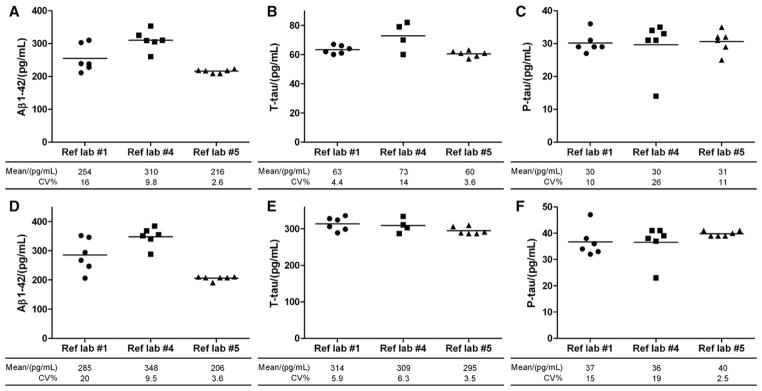
Results: Forty laboratories participated. Twenty-six used INNOTEST enzyme-linked immunosorbent assay kits, 14 used Luminex xMAP with the INNO-BIA AlzBio3 kit (both measure Aβ-(1-42), P-tau(181P), and T-tau), and 5 used Meso Scale Discovery with the Aβ triplex (AβN-42, AβN-40, and AβN-38) or T-tau kits. The total coefficients of variation between the laboratories were 13% to 36%. Five laboratories analyzed the samples six times on different occasions. Within-laboratory precisions differed considerably between biomarkers within individual laboratories.
Conclusions: Measurements of CSF AD biomarkers show large between-laboratory variability, likely caused by factors related to analytical procedures and the analytical kits. Standardization of laboratory procedures and efforts by kit vendors to increase kit performance might lower variability, and will likely increase the usefulness of CSF AD biomarkers.
Copyright © 2011 The Alzheimer's Association. Published by Elsevier Inc. All rights reserved.
Figures


References
-
- Strozyk D, Blennow K, White LR, Launer LJ. CSFAbeta 42 levels correlate with amyloid-neuropathology in a population-based autopsy study. Neurology. 2003;60:652–6. - PubMed
-
- Tapiola T, Alafuzoff I, Herukka SK, Parkkinen L, Hartikainen P, Soininen H, et al. Cerebrospinal fluid {beta}-amyloid 42 and tau proteins as biomarkers of Alzheimer-type pathologic changes in the brain. Arch Neurol. 2009;66:382–9. - PubMed
-
- Fagan AM, Mintun MA, Mach RH, Lee SY, Dence CS, Shah AR, et al. Inverse relation between in vivo amyloid imaging load and cerebrospinal fluid Abeta42 in humans. Ann Neurol. 2006;59:512–9. - PubMed
-
- Forsberg A, Engler H, Almkvist O, Blomquist G, Hagman G, Wall A, et al. PET imaging of amyloid deposition in patients with mild cognitive impairment. Neurobiol Aging. 2008;29:1456–65. - PubMed
-
- Blennow K, Hampel H, Weiner M, Zetterberg H. Cerebrospinal fluid and plasma biomarkers in Alzheimer disease. Nat Rev Neurol. 2010;6:131–44. - PubMed
Publication types
MeSH terms
Substances
Grants and funding
LinkOut - more resources
Full Text Sources
Other Literature Sources
Medical
