Review
. 2011 Oct;50(4):323-31.
doi: 10.1016/j.ceca.2011.06.001. Epub 2011 Jul 23.

S100A1 and calmodulin regulation of ryanodine receptor in striated muscle

Affiliations
Review

S100A1 and calmodulin regulation of ryanodine receptor in striated muscle

Benjamin L Prosser et al. Cell Calcium. 2011 Oct.

Abstract

The release of Ca2+ ions from the sarcoplasmic reticulum through ryanodine receptor calcium release channels represents the critical step linking electrical excitation to muscular contraction in the heart and skeletal muscle (excitation-contraction coupling). Two small Ca2+ binding proteins, S100A1 and calmodulin, have been demonstrated to bind and regulate ryanodine receptor in vitro. This review focuses on recent work that has revealed new information about the endogenous roles of S100A1 and calmodulin in regulating skeletal muscle excitation-contraction coupling. S100A1 and calmodulin bind to an overlapping domain on the ryanodine receptor type 1 to tune the Ca2+ release process, and thereby regulate skeletal muscle function. We also discuss past, current and future work surrounding the regulation of ryanodine receptors by calmodulin and S100A1 in both cardiac and skeletal muscle, and the implications for excitation-contraction coupling.


Figures

Fig. 1
Fig. 1. S100A1 and calmodulin compete for binding to an overlapping region of RyR1
The S100 consensus binding sequence is identified in RyR1 residues 3617–3625. This sequence lies in the N-terminus of the previously characterized calmodulin binding domain (CaM BD) of RyR1 (3615–3644). A 12 amino acid peptide containing this sequence (residues within the asterisks) is perfectly conserved between RyR1 and RyR2 and has a similar affinity for S100A1 and Ca-CaM [46]. Mutation of L3625D (red) abrogates both CaM and S100A1 binding to RyR1. This mutation impairs S100A1 activation of SR Ca2+ release and Ca-CaM inactivation of SR Ca2+ release [53]. We therefore refer to this region as the CaM/S100A1 binding domain. The CaM BD is highly conserved between RyR1 and RyR2 (red shading marks differing residues). Mutations of W3586A/L3590D/F3602A (green) abrogate CaM from binding and inactivating RyR2 in heart cells [73]. It is currently unknown whether S100A1 regulates Ca2+ release in the heart through interaction with this domain. The residue numbers used here correspond to mouse RyR1 and RyR2. Note that for the rabbit, residue numbers are shifted one residue lower for RyR1 and one residue higher for RyR2 compared to the mouse sequence.
Fig. 2
Fig. 2. S100A1 modulation of skeletal muscle EC coupling
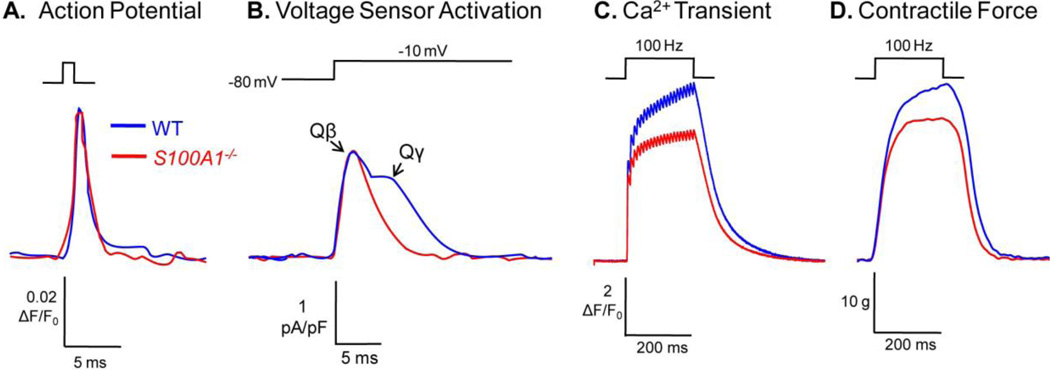
A) Di-8 ANEPPS recordings of action potentials elicited by field stimulation of WT (blue) and S100A1−/− (red) fibers. Genetic ablation of S100A1 has no effect on the propagated AP in the t-system of skeletal muscle fibers [55]. B) DHPR intramembrane charge movement currents elicited by a voltage clamp depolarization to −10 mV of WT and S100A1−/− fibers. Ablation of S100A1 has no effect on the RyR1-activating component of DHPR charge movement (Qβ), but does blunt a secondary component of DHPR charge movement (Qγ) that is a consequence of optimal SR Ca2+ release [57]. C) Fluo-4 recordings of Ca2+ transients elicited by 100 Hz field stimulation of WT and S100A1−/− fibers. The Ca2+ transient is depressed in S100A1−/− fibers, and demonstrates less summation during the train of stimuli [46, 55]. D) Tetanic force generated by the tibialis anterior of anesthetized WT and S100A1−/− animals in response to 100 Hz stimulation. Maximal force is suppressed in S100A1−/− muscle [55].
Fig. 3
Fig. 3. S100A1 and CaM differentially regulate RyR1 Ca2+ release
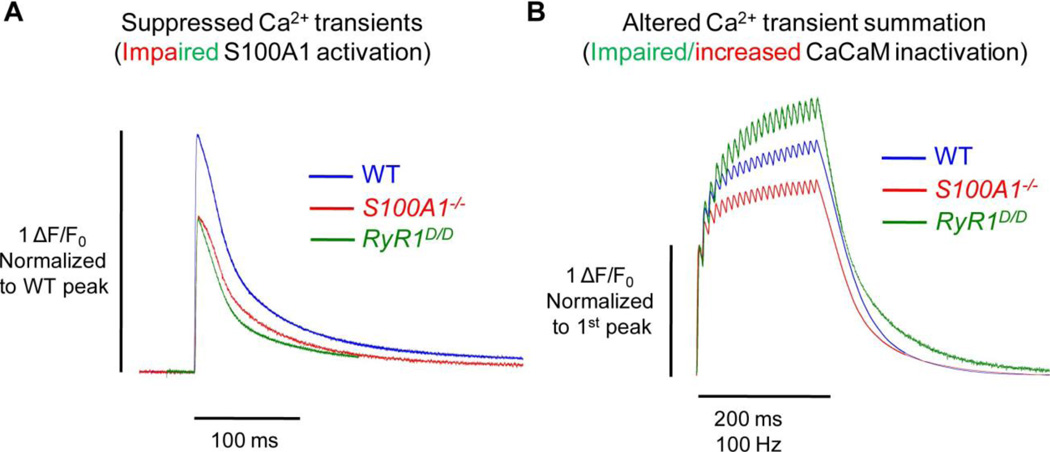
A) In response to a single action potential, the peak amplitude of the Ca2+ transient is similarly suppressed in the absence of S100A1 (S100A1−/−, red) and in fibers with a mutated CaM/S100A1 binding domain of RyR1 (RyR1D/D, green). This suggests that under resting conditions, S100A1 may predominantly occupy the CaM/S100A1 BD and potentiate Ca2+ release upon muscle activation. B) Fibers with a mutated CaM/S100A1 BD demonstrate greater relative summation of Ca2+ transients during repetitive activation. Conversely, fibers lacking S100A1 show less summation. This suggests that upon a rise in [Ca2+]i during prolonged muscle activation, Ca-CaM may predominantly occupy the CaM/S100A1 BD and inactivate some portion of Ca2+ release. This inactivation is impaired in RyR1D/D fibers, and enhanced in S100A1−/− fibers, as they lack CaM’s endogenous competitor. All data traces represent average data from [46, 53, 55].
Fig.4
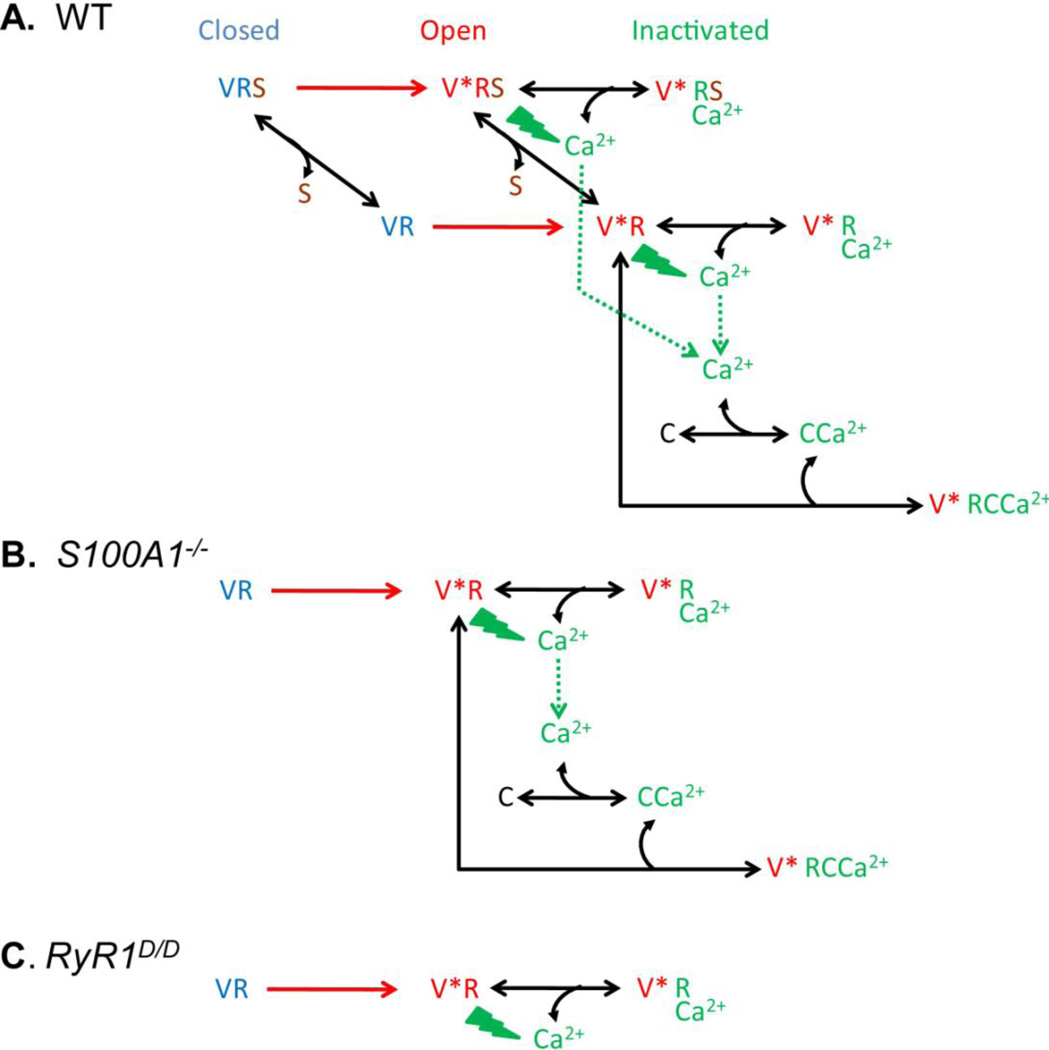
Fig.4. Reaction schemes for activation and inactivation of RyR1 Ca2+ release channels in skeletal muscle fibers from wild type (A), S100A1−/− (B) and RyR1D/D (C) mice
V, R, S and C represent the TT voltage sensor, the SR ryanodine receptor/Ca2+ release channel, S100A1 and calmodulin, with V* representing the voltage activated state of V. Channels move sequentially left to right from the resting (blue) to the activated (red) to the inactivated state (green) due to voltage activation of V (red) to Ca2+-dependent inactivated states (green). In A, S100A1 occupied states are depicted in the background, and S100A1 free states are in the foreground. See text (3.3, 3.4) for further details.

References

    1. Schneider MF, Chandler WK. Voltage-dependent charge movement in skeletal muscle: a possible step in excitation-contraction coupling. Nature. 1973;242:244–247. - PubMed
    1. Horowicz P, Schneider MF. Membrane charge moved at contraction theresholds in skeletal muscle fibres. Journal of Physiology. 1981;314:595–633. - PMC - PubMed
    1. Rios E, Brum G. Involvement of dihydropyridine receptors in excitation-contraction coupling in skeletal muscle. Nature. 1987;325:717–720. - PubMed
    1. Block BA, Imagawa T, Campbell KP, Franzini-Armstrong C. Structural evidence for direct interaction between the molecular components of the transverse tubule/sarcoplasmic reticulum junction in skeletal muscle. J Cell Biol. 1988;107:2587–2600. - PMC - PubMed
    1. Fahrenbach WH. Sarcoplasmic Reticulum: Ultrastructure of the Triadic Junction. Science. 1965;147:1308–1309. - PubMed

Publication types

MeSH terms