Chronic kidney disease awareness among individuals with clinical markers of kidney dysfunction
- PMID: 21784832
- PMCID: PMC3156423
- DOI: 10.2215/CJN.00730111
Chronic kidney disease awareness among individuals with clinical markers of kidney dysfunction
Abstract
Background and objectives: Awareness of chronic kidney disease (CKD) among providers and patients is low. Whether clinical cues prompt recognition of CKD is unknown. We examined whether markers of kidney disease that should trigger CKD recognition among providers are associated with higher individual CKD awareness.
Design, setting, participants, & measurements: CKD awareness was assessed in 1852 adults with an estimated GFR <60 ml/min per 1.73 m(2) using 1999 to 2008 National Health and Nutrition Examination Survey data. CKD awareness was a "yes" answer to "Have you ever been told you have weak or failing kidneys?" Participants were grouped by distribution of the following abnormal markers of CKD: hyperkalemia, acidosis, hyperphosphatemia, elevated blood urea nitrogen, anemia, albuminuria, and uncontrolled hypertension. Odds of CKD awareness associated with each abnormal marker and groupings of markers were estimated by multivariable logistic regression.
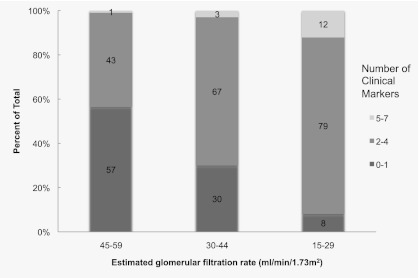
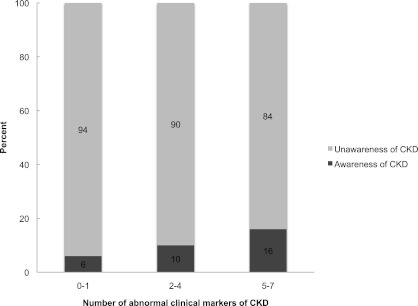
Results: Among individuals with kidney disease, only those with albuminuria had greater odds of CKD awareness (adjusted odds ratio, 4.0, P < 0.01) than those without. Odds of CKD awareness increased with each additional manifested clinical marker of CKD (adjusted odds ratio, 1.3, P = 0.05). Nonetheless, 90% of individuals with two to four markers of CKD and 84% of individuals with ≥5 markers of CKD were unaware of their disease.
Conclusions: Although individuals who manifest many markers of kidney dysfunction are more likely to be aware of their CKD, their CKD awareness remains low. A better understanding of mechanisms of awareness is required to facilitate earlier detection of CKD and implement therapy to minimize associated complications.
Figures

References
-
- Sarnak MJ, Levey AS, Schoolwerth AC, Coresh J, Culleton B, Hamm LL, McCullough PA, Kasiske BL, Kelepouris E, Klag MJ, Parfrey P, Pfeffer M, Raij L, Spinosa DJ, Wilson PW: Kidney disease as a risk factor for development of cardiovascular disease: A statement from the American Heart Association Councils on Kidney in Cardiovascular Disease, High Blood Pressure Research, Clinical Cardiology, and Epidemiology and Prevention. Hypertension 42: 1050–1065, 2003 - PubMed
-
- Hostetter TH, Lising M: National kidney disease education program. J Am Soc Nephrol 14: S114–S116, 2003 - PubMed
-
- Waterman AD, Browne T, Waterman BM, Gladstone EH, Hostetter T: Attitudes and behaviors of African Americans regarding early detection of kidney disease. Am J Kidney Dis 51: 554–562, 2008 - PubMed
Publication types
MeSH terms
Substances
Grants and funding
LinkOut - more resources
Full Text Sources
Medical