Localization of the Clostridium difficile cysteine protease Cwp84 and insights into its maturation process
- PMID: 21784932
- PMCID: PMC3187449
- DOI: 10.1128/JB.00326-11
Localization of the Clostridium difficile cysteine protease Cwp84 and insights into its maturation process
Abstract
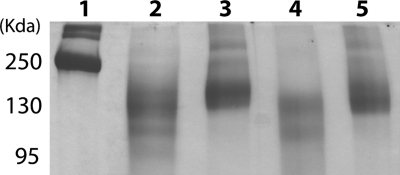
Clostridium difficile is a nosocomial pathogen involved in antibiotic-associated diarrhea. C. difficile expresses a cysteine protease, Cwp84, which has been shown to degrade some proteins of the extracellular matrix and play a role in the maturation of the precursor of the S-layer proteins. We sought to analyze the localization and the maturation process of this protease. Two identifiable forms of the protease were found to be associated in the bacteria: a form of ∼80 kDa and a cleaved one of 47 kDa, identified as the mature protease. They were found mainly in the bacterial cell surface fractions and weakly in the extracellular fraction. The 80-kDa protein was noncovalently associated with the S-layer proteins, while the 47-kDa form was found to be tightly associated with the underlying cell wall. Our data supported that the anchoring of the Cwp84 47-kDa form is presumably due to a reassociation of the secreted protein. Moreover, we showed that the complete maturation of the recombinant protein Cwp84(30-803) is a sequential process beginning at the C-terminal end, followed by one or more cleavages at the N-terminal end. The processing sites of recombinant Cwp84 are likely to be residues Ser-92 and Lys-518. No proteolytic activity was detected with the mature recombinant protease Cwp84(92-518) (47 kDa). In contrast, a fragment including the propeptide (Cwp84(30-518)) displayed proteolytic activity on azocasein and fibronectin. These results showed that Cwp84 is processed essentially at the bacterial cell surface and that its different forms may display different proteolytic activities.
Figures
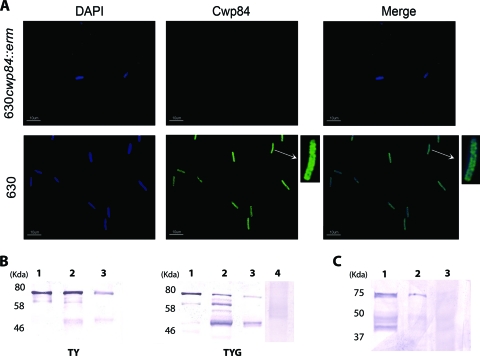
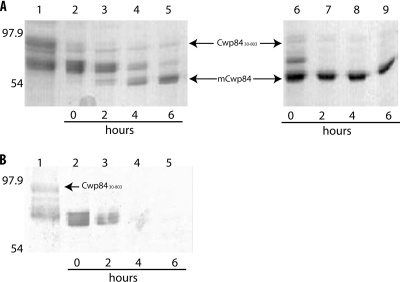

 ), the catalytic domain (□), and the domain corresponding to the anchoring domain (
 ) are indicated. The scheme shows the three Pfam 04122 motifs and the catalytic triad (Cys-116, His-262, and Asn-287). The amino acids involved in the proteolytic cleavage are indicated.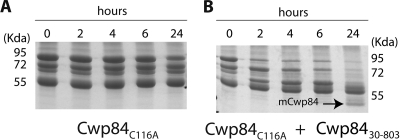
References
-
- Ausiello C. M., et al. 2006. Surface layer proteins from Clostridium difficile induce inflammatory and regulatory cytokines in human monocytes and dendritic cells. Microbes Infect. 8:2640–2646 - PubMed
-
- Bergmann S., Rohde M., Chhatwal G. S., Hammerschmidt S. 2001. α-Enolase of Streptococcus pneumoniae is a plasmin(ogen)-binding protein displayed on the bacterial cell surface. Mol. Microbiol. 40:1273–1287 - PubMed
-
- Bromme D., Nallaseth F. S., Turk B. 2004. Production and activation of recombinant papain-like cysteine proteases. Methods 32:199–206 - PubMed
-
- Buist G., Steen A., Kok J., Kuipers O. P. 2008. LysM, a widely distributed protein motif for binding to (peptido)glycans. Mol. Microbiol. 68:838–847 - PubMed
Publication types
MeSH terms
Substances
LinkOut - more resources
Full Text Sources
Other Literature Sources
Molecular Biology Databases