


S-nitrosoglutathione supplementation to ovalbumin-sensitized and -challenged mice ameliorates methacholine-induced bronchoconstriction
- PMID: 21784966
- PMCID: PMC3213990
- DOI: 10.1152/ajplung.00134.2011
S-nitrosoglutathione supplementation to ovalbumin-sensitized and -challenged mice ameliorates methacholine-induced bronchoconstriction
Retraction in
-
Retraction. S-nitrosoglutathione supplementation to ovalbumin-sensitized and -challenged mice ameliorates methacholine-induced bronchoconstriction.Am J Physiol Lung Cell Mol Physiol. 2015 May 1;308(9):L981. doi: 10.1152/ajplung.zh5-6751-retr.2015. Am J Physiol Lung Cell Mol Physiol. 2015. PMID: 25934761 Free PMC article. No abstract available.
Abstract
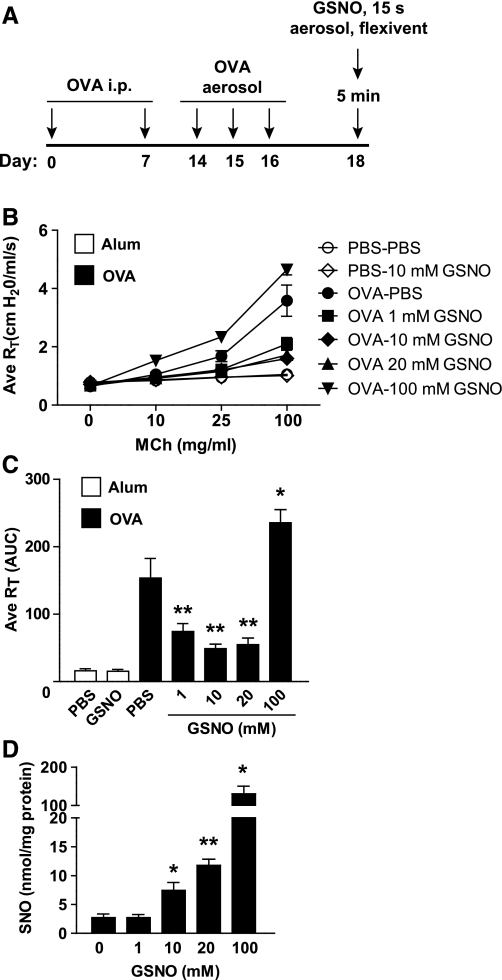
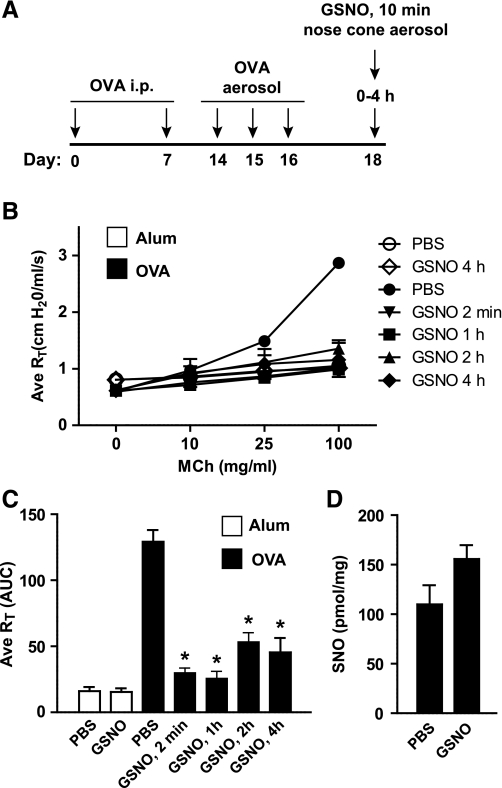
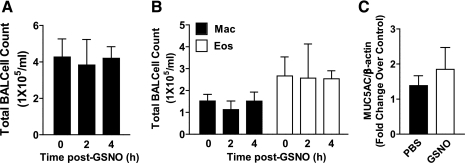
S-nitrosoglutathione (GSNO) is an endogenous bronchodilator present in micromolar concentrations in airway lining fluid. Airway GSNO levels decrease in severe respiratory failure and asthma, which is attributable to increased metabolism by GSNO reductase (GSNOR). Indeed, we have found that GSNOR expression and activity correlate inversely with lung S-nitrosothiol (SNO) content and airway hyperresponsiveness (AHR) to methacholine (MCh) challenge in humans with asthmatic phenotypes (Que LG, Yang Z, Stamler JS, Lugogo NL, Kraft M. Am J Respir Crit Care Med 180: 226-231, 2009). Accordingly, we hypothesized that local aerosol delivery of GSNO could ameliorate AHR and inflammation in the ovalbumin-sensitized and -challenged (OVA) mouse model of allergic asthma. Anesthetized, paralyzed, and tracheotomized 6-wk-old male control and OVA C57BL/6 mice were administered a single 15-s treatment of 0-100 mM GSNO. Five minutes later, airway resistance to MCh was measured and SNOs were quantified in bronchoalveolar lavage (BAL). Duration of protection was evaluated following nose-only exposure to 10 mM GSNO for 10 min followed by measurements of airway resistance, inflammatory cells, and cytokines and chemokines at up to 4 h later. Acute delivery of GSNO aerosol protected OVA mice from MCh-induced AHR, with no benefit seen above 20 mM GSNO. The antibronchoconstrictive effects of GSNO aerosol delivered via nose cone were sustained for at least 4 h. However, administration of GSNO did not alter total BAL cell counts or cell differentials and had modest effects on cytokine and chemokine levels. In conclusion, in the OVA mouse model of allergic asthma, aerosolized GSNO has rapid and sustained antibronchoconstrictive effects but does not substantially alter airway inflammation.
Figures

Comment in
-
Findings of Research Misconduct.Fed Regist. 2019 Nov 7;84(216):60097-60098. Fed Regist. 2019. PMID: 37547121 Free PMC article. No abstract available.
References
-
- Abderrahmane A, Salvail D, Dumoulin M, Garon J, Cadieux A, Rousseau E. Direct activation of K(Ca) channel in airway smooth muscle by nitric oxide: involvement of a nitrothiosylation mechanism? Am J Respir Cell Mol Biol 19: 485–497, 1998 - PubMed
-
- Akinbami LJ, Moorman JE, Liu X. Asthma prevalence, health care use, and mortality: United States, 2005–2009. Natl Health Stat Report 32: 1–14, 2011 - PubMed
-
- Bannenberg G, Xue J, Engman L, Cotgreave I, Moldeus P, Ryrfeldt A. Characterization of bronchodilator effects and fate of S-nitrosothiols in the isolated perfused and ventilated guinea pig lung. J Pharmacol Exp Ther 272: 1238–1245, 1995 - PubMed
-
- Barnes PJ. Nitric oxide and airway disease. Ann Med 27: 389–393, 1995 - PubMed
Publication types
MeSH terms
Substances
Grants and funding
LinkOut - more resources
Full Text Sources
