. 2011 Sep 1;187(5):2484-91.
doi: 10.4049/jimmunol.1100468. Epub 2011 Jul 22.

Long-distance regulation of fetal V(δ) gene segment TRDV4 by the Tcrd enhancer

Affiliations

Long-distance regulation of fetal V(δ) gene segment TRDV4 by the Tcrd enhancer

Bingtao Hao et al. J Immunol. .

Abstract

Murine Tcra and Tcrd gene segments are organized into a single genetic locus (Tcra/Tcrd locus) that undergoes V(D)J recombination in CD4(-)CD8(-) double-negative (DN) thymocytes to assemble Tcrd genes and in CD4(+)CD8(+) double-positive thymocytes to assemble Tcra genes. Recombination events are regulated by two developmental stage-specific enhancers, E(δ) and E(α). Effects of E(α) on Trca/Tcrd locus chromatin have been well documented, but effects of E(δ) have not. In this regard, E(α) acts over long distances to activate many V(α) and J(α) segments for recombination in double-positive thymocytes. However, in DN thymocytes, it is unclear whether E(δ) functions over long distances to regulate V(δ) gene segments or functions only locally to regulate D(δ) and J(δ) gene segments. In this study, we analyzed germline transcription, histone modifications, and recombination on wild-type and E(δ)-deficient alleles in adult and fetal thymocytes. We found that E(δ) functions as a local enhancer whose influence is limited to no more than ∼10 kb in either direction (including D(δ), J(δ), and TRDV5 gene segments) in adult DN thymocytes. However, we identified a unique long-distance role for E(δ) promoting accessibility and recombination of fetal V(δ) gene segment TRDV4, over a distance of 55 kb, in fetal thymocytes. TRDV4 recombination is specifically repressed in adult thymocytes. We found that this repression is enforced by a developmentally regulated loss of histone acetylation. Constitutively high levels of a suppressive modification, histone H3 lysine 9 dimethylation, may contribute to repression as well.


Figures
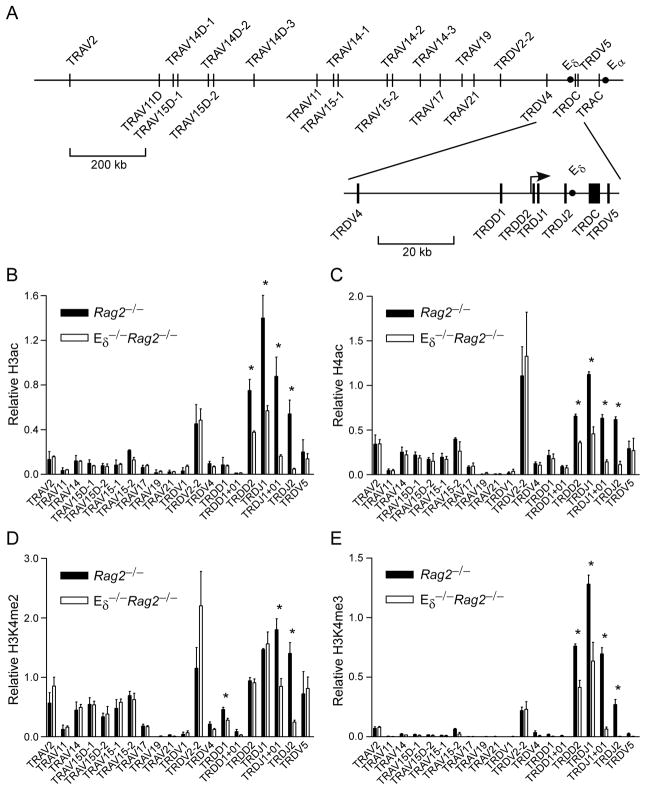
Figure 1
Figure 1
Influence of Eδ on Tcra/Tcrd locus histone modifications in adult DN thymocytes. A. Map of the Tcra/Tcrd locus depicting the relative positioning of gene segments analyzed in this study. Enhancers Eδ and Eα (circles), and the D2 promoter (bent arrow) are also depicted. Not all Tcra/Tcrd gene segments are shown. H3ac (B), H4ac (C), H3K4me2 (D) and H3K4me3 (E) were measured by ChIP using chromatin prepared from Rag2−/− and Eδ−/−Rag2−/− thymocytes. TRDD1+01 and TRDJ1+01 are sites situated 1kb downstream of D1 and J1, respectively. The data represent the mean ± SEM of three independent chromatin preparations for each genotype. Values of bound/input were expressed relative to those for B2m (normalized to one) in each sample. Note that PCR for TRAV11 detects both TRAV11 and TRAV11D; PCR for TRAV14 detects six members of the TRAV14 family (TRAV14D-1, D-2, D-3,-1,-2,-3). The significance of differences between Eδ−/− and wild-type were evaluated by two-tailed Student’s t-test: *, P<.01.
Figure 2
Figure 2
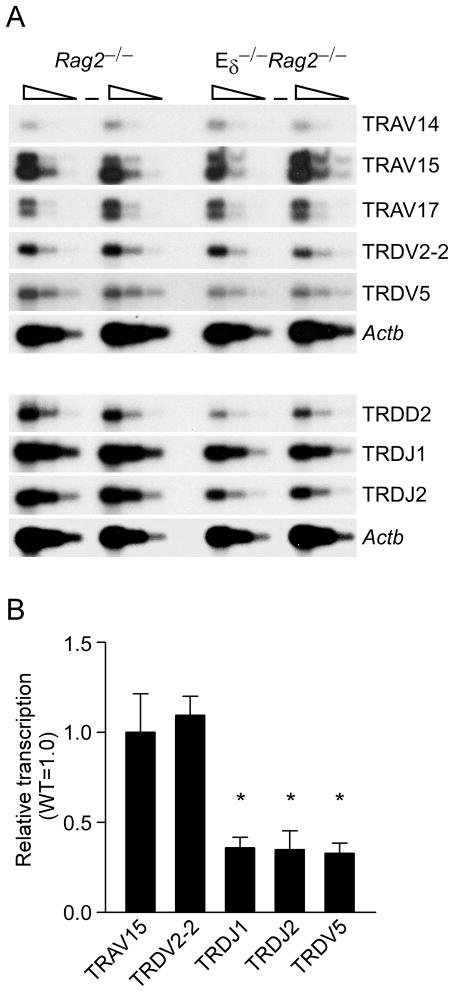
Influence of Eδ on Tcra/Tcrd locus germline transcription in adult DN thymocytes. A. Germline transcription was measured by RT-PCR using serial three-fold dilutions of cDNA (wedges) prepared from four independent cDNA preparations from Rag2−/− and Eδ−/−Rag2−/− thymocytes. Two preparations for each genotype are analyzed in the top set of panels; two different preparations for each genotype are analyzed in the bottom set of panels. (−) no reverse transcriptase. The TRAV14 and TRAV15 primers detect all members of the TRAV14 and TRAV15 families. B. Real-time PCR of germline transcription using cDNA preparations from Rag2−/− and Eδ−/−Rag2−/− thymocytes. The data represent the mean ± SEM of five independent cDNA preparations for each genotype, all normalized to values for β-actin (Actb). The values for Eδ−/−Rag2−/− for each site were then expressed relative to those for Rag2−/−, which were normalized to one. The significance of differences between Eδ−/− and wild-type were evaluated by two-tailed Student’s t-test: *, P<.05.
Figure 3
Figure 3
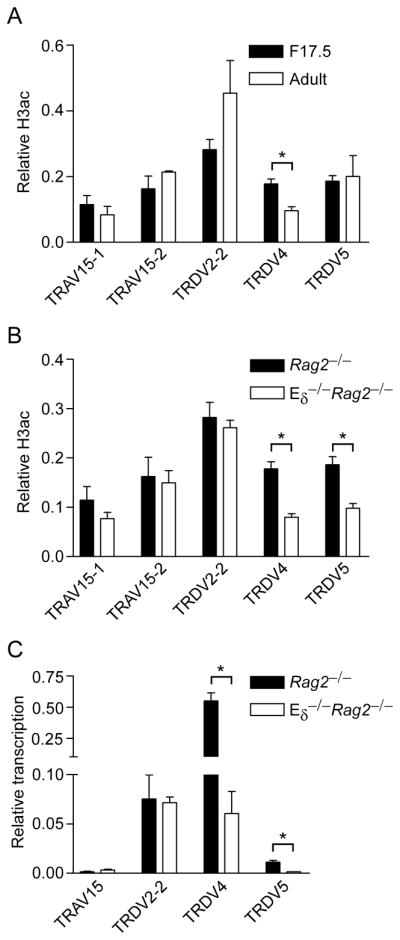
Influence of Eδ on Tcra/Tcrd locus histone acetylation and germline transcription in fetal thymocytes. H3ac was measured by ChIP using chromatin prepared from (A) F17.5 and adult Rag2−/− DN thymocytes and (B) F17.5 Rag2−/− and Eδ−/−Rag2−/− thymocytes. The data represent the mean ± SEM of three to five independent chromatin preparations for each genotype and developmental stage. Values of bound/input were expressed relative to B2m (normalized to one) in each sample. C. Germline transcription was measured by quantitative real-time PCR using cDNA prepared from F17.5 Rag2−/− and Eδ−/−Rag2−/− thymocytes. The data represent the mean ± SEM of two independent cDNA preparations for each genotype, all normalized to values for Actb. *, P<.05 by two-tailed Student’s t-test.
Figure 4
Figure 4
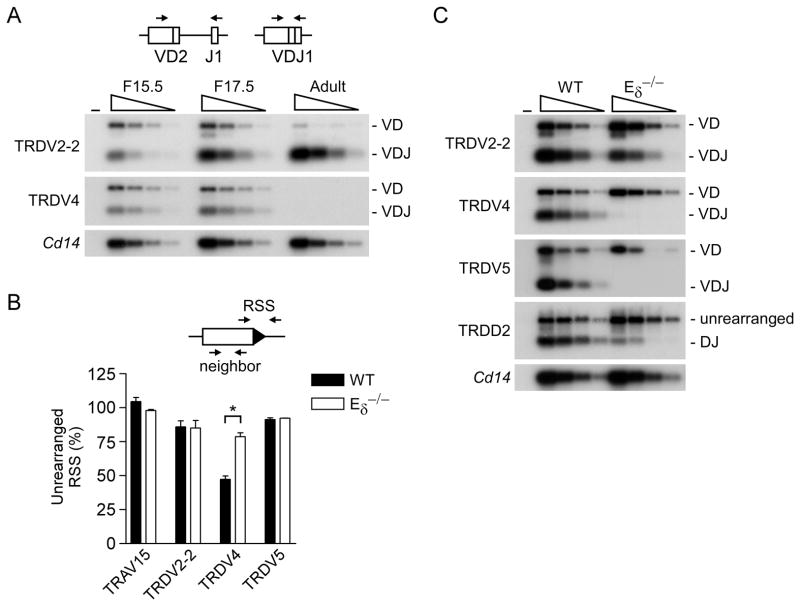
Influence of Eδ on Tcrd gene rearrangement in fetal thymocytes. A. J1 rearrangement in 129 mice. Three-fold serial dilutions (wedges) of genomic DNA from thymocytes of F15.5, F17.5 and adult 129 mice were analyzed by PCR followed by Southern blot. PCR was performed using TRDV2-2 or TRDV4 primers in combination with a J1 primer; a 32P-labeled internal J1 oligonucleotide was used as a probe. Cd14 PCR insured use of similar amounts of DNA. (−), no DNA. The data are representative of three independent experiments. B. RSS cleavage in genomic DNA of wild-type (WT) 129 and Eδ−/− fetal thymocytes. Real-time PCR was used to quantify percent unrearranged RSS relative to a neighboring amplicon. TRAV15 primers detect all members of the TRAV15 family. The data represent the mean ± SEM of four and two independent genomic DNA preparations, respectively, from WT and Eδ−/− F17.5 thymocytes. *, P<.05 by two-tailed Student’s t-test. C. Tcrd rearrangement in fetal thymocytes of wild-type (WT) 129 and Eδ−/− mice. Genomic DNA samples from F17.5 thymocytes were analyzed by PCR using the indicated primers in conjunction with a J1 primer, followed by Southern blot using a 32P-labeled internal J1 oligonucleotide probe. The data are representative of two to three independent experiments.
Figure 5
Figure 5
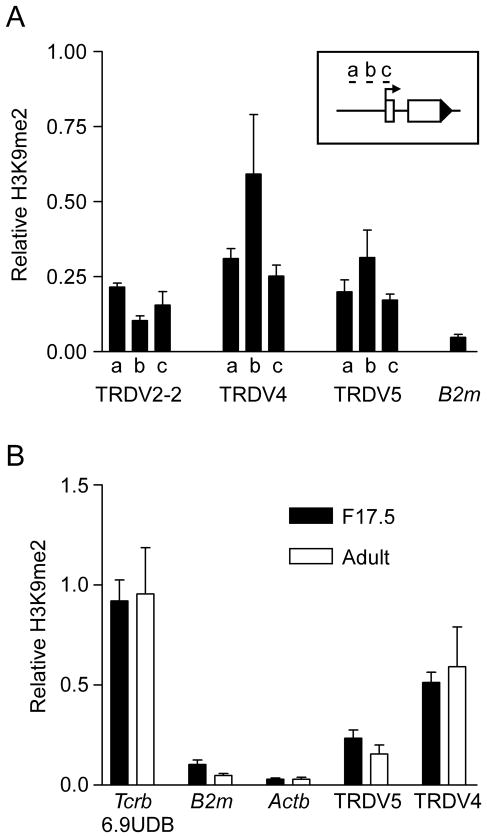
H3K9 dimethylation of Vδ gene segments in adult and fetal thymocytes. A. H3K9me2 of TRDV2-2, TRDV4 and TRDV5 was measured by ChIP using chromatin prepared from adult Rag2−/− thymocytes. Each V gene segment was analyzed at three sites (a, b, c, as diagrammed. Values of bound/input were expressed relative to MageA2 (normalized to one). The data represent the mean ± SEM of three independent chromatin preparations. B. H3K9me2 was compared in chromatin prepared from F17.5 and adult Rag2−/− thymocytes. The data represent the mean ± SEM of three to four independent chromatin preparations. TRDV4 and TRDV5 were analyzed at sites “b”. 6.9UDB is a positive control site within the Tcrb locus (39); B2m and Actb served as negative control sites.
Figure 6
Figure 6
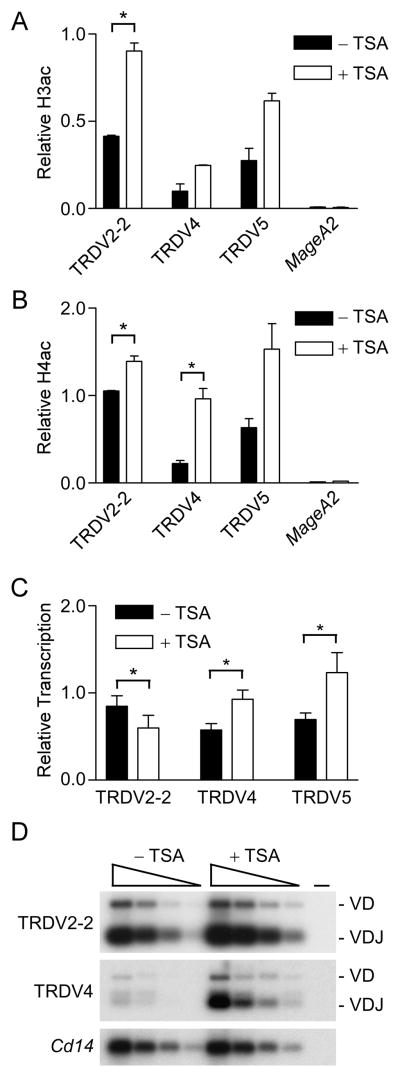
Activation of Vδ gene segment chromatin and rearrangement using a HDAC inhibitor. H3ac (A) and H4ac (B) were measured by ChIP using chromatin prepared from adult Rag2−/− thymocytes that were cultured for 8 hrs with or without 3 ng/ml TSA. Values of bound/input were expressed relative to B2m (normalized to one) in each sample. The data represent the mean ± SEM of two to three independent chromatin preparations for each treatment. *, P<.05 by two-tailed Student’s t-test. C. Germline transcription was measured by quantitative real-time PCR using cDNA prepared from adult Rag2−/− thymocytes that were cultured for 8 hrs with or without 3 ng/ml TSA. The data represent the mean ± SEM of four independent cDNA preparations for each genotype, all normalized to values for Actb. *, P<.05 by two-tailed paired Student’s t-test. D. Adult 129 DN1 thymocytes were placed in culture for 14 days with or without 3 ng/ml TSA on OP9-DL1 stromal cells; DN3 thymocytes were sorted from cultured cells for preparation of genomic DNA. Three-fold serial dilutions (wedges) of genomic DNA were analyzed by PCR followed by Southern blot. PCR was performed using TRDV2-2 or TRDV4 primers in combination with a J1 primer; a 32P-labeled internal J1 oligonucleotide was used as a probe. Cd14 PCR insured use of similar amounts of DNA. (−), no DNA. The data is representative of three independent experiments.

References

    1. Krangel MS. Mechanics of T cell receptor gene rearrangement. Curr Opin Immunol. 2009;21:133–139. - PMC - PubMed
    1. Krangel MS, Carabana J, Abbarategui I, Schlimgen R, Hawwari A. Enforcing order within a complex locus: current perspectives on the control of V(D)J recombination at the murine T-cell receptor α/δ locus. Immunol Rev. 2004;200:224–232. - PubMed
    1. Shih HY, Hao B, Krangel MS. Orchestrating T-cell receptor α gene assembly through changes in chromatin structure and organization. Immunol Res 2010 - PMC - PubMed
    1. Lauzurica P, Krangel MS. Temporal and lineage-specific control of T cell receptor α/δ gene rearrangement by T cell receptor α and δ enhancers. J Exp Med. 1994;179:1913–1921. - PMC - PubMed
    1. Sleckman BP, Bardon CG, Ferrini R, Davidson L, Alt FW. Function of the TCR α enhancer in αβ and γδ T cells. Immunity. 1997;7:505–515. - PubMed

Publication types

MeSH terms