Review
. 2011 Aug;197(2):318-24.
doi: 10.2214/AJR.11.6797.

Molecular theranostics: a primer for the imaging professional

Affiliations
Review

Molecular theranostics: a primer for the imaging professional

Daniel Y Lee et al. AJR Am J Roentgenol. 2011 Aug.

Abstract

Objective: A theranostic system integrates some form of diagnostic testing to determine the presence of a molecular target for which a specific drug is intended. Molecular imaging serves this diagnostic function and provides powerful means for noninvasively detecting disease. We briefly review the paradigms rooted in nuclear medicine and highlight recent advances in this field. We also explore how nanometer-sized complexes, called nanomedicines, present an excellent theranostic platform applicable to both drug discovery and clinical use.

Conclusion: For imagers, molecular theranostics represents a powerful emerging platform that intimately couples targeted therapeatic entities with noninvasive imaging that yields information on the presence of defined molecular targets before, during, and after cognate therapy.


Figures
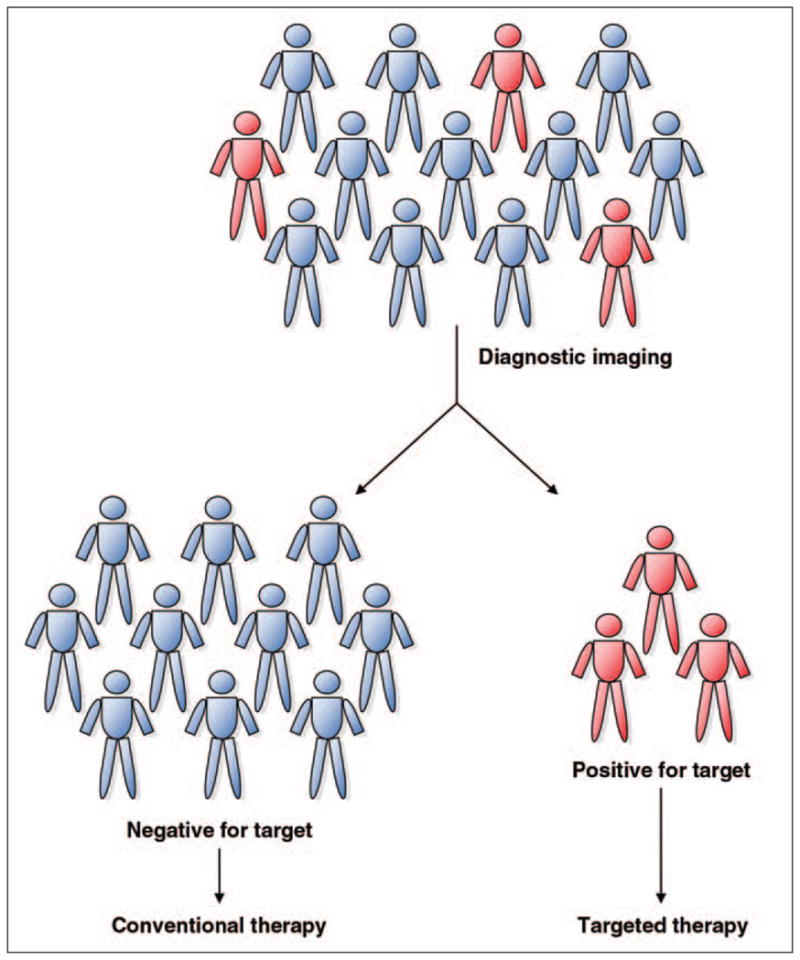
Fig. 1
Fig. 1
Diagram shows how theranostic systems combine diagnostic tests, in this case, imaging, to detect presence of molecular target in each patient. Patients who are found to be positive for molecular target are selected for therapeutic intervention.
Fig. 2
Fig. 2
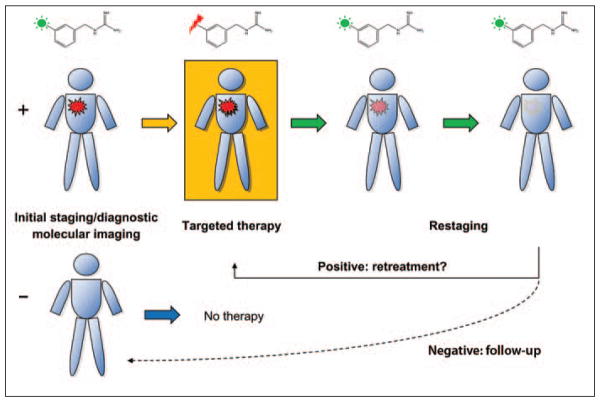
Diagram shows example of single-entity theranostic system that combines initial staging with imaging version of specific probe (green sunburst as active moiety) followed by therapy with therapeutic version of imaging probe (red lightning bolt). Restaging examinations at follow-up are performed with imaging probe. Patients with positive imaging results (red lesion) can be treated with therapeutic agent. Patients with negative results will not be treated with targeted agent. Organic molecule structure used in this example is that of metaiodobenzylguanidine with 123I for imaging and 131I for therapy-imaging.
Fig. 3
Fig. 3
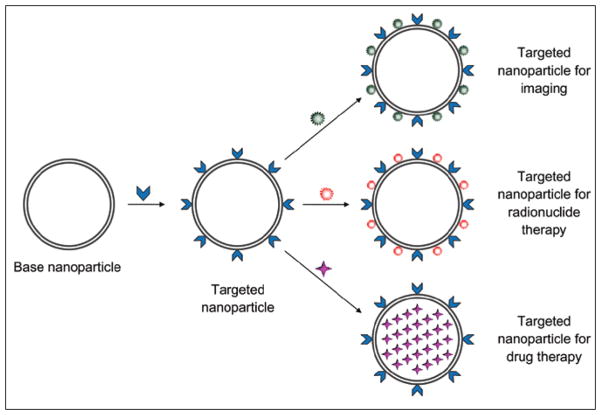
Diagram shows hypothetical nanomedicine theranostic platform. Biocompatible base nanoparticle may be synthesized from variety of compositions and production methods. To confer targeting for specific cellular receptor or other molecular feature of diseased tissue, ligands are conjugated to nanoparticle, typically in multivalent manner. Ligands (blue arrowheads) can be small organic molecules, monoclonal antibodies, aptamers, peptides, proteins, or other compatible materials. Diagnostic molecular imaging capabilities can be conferred simply by conjugation of certain agents (green starburst) suitable for detection, such as radionuclides or paramagnetic-superparamagnetic metals. In some configurations, cytotoxic radionuclide (red starburst) may be substituted for imaging radiometal. Alternatively drugs of wide variety of compositions (purple 4-point star) may be encapsulated within nanoparticle structure.
Fig. 4
Fig. 4
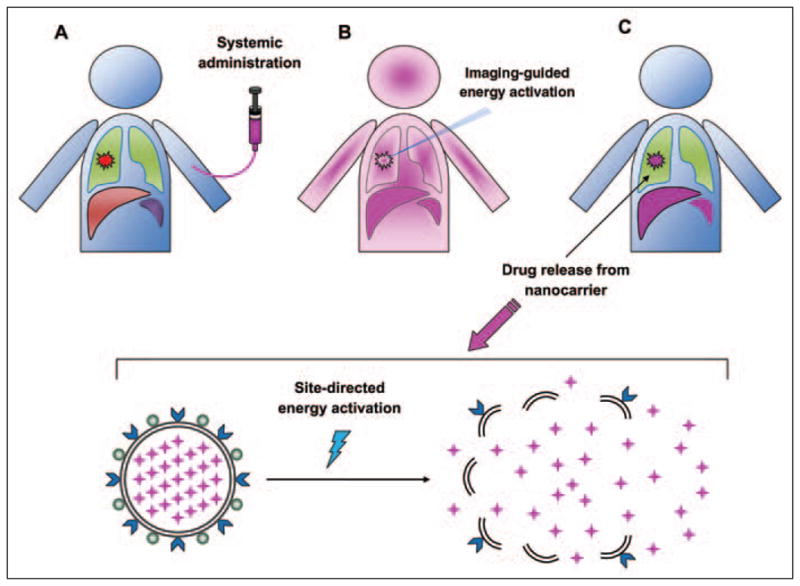
Remotely activated drug release from targeted nanoparticles (although active targeting is optional in this approach). A, Diagram shows nanomedicine (purple ) intravenously administered to patient with lung tumor (red lesion). B, After a period of time to maximize tumor accumulation (determined by diagnostic molecular imaging), activation energy (blue rays) is applied to site of disease by imaging-guidance. C, Activation energy causes release of drugs encapsulated in the nanocarrier elaborated in lower panel. Notice that after systemic administration, pharmacokinetics and biodistribution will be determined by physical properties of nanoparticles, including size and surface charge largely due to interaction with mononuclear phagocyte system (represented by liver and spleen in diagram). Activation step to release drugs at desired sites circumvents some of biodistribution issues of nanomedicines.

References

    1. Hertz S, Roberts A. Radioactive iodine in the study of thyroid physiology; the use of radioactive iodine therapy in hyperthyroidism. J Am Med Assoc. 1946;131:81–86. - PubMed
    1. Chapman EM, Evans RD. The treatment of hyperthyroidism with radioactive iodine. J Am Med Assoc. 1946;131:86–91. - PubMed
    1. Sisson JC, Shapiro B, Beierwaltes WH, Copp JE. Locating pheochromocytomas by scintigraphy using 131I-metaiodobenzylguanidine. CA Cancer J Clin. 1984;34:86–92. - PubMed
    1. Sisson JC, Shapiro B, Beierwaltes WH, et al. Radiopharmaceutical treatment of malignant pheochromocytoma. J Nucl Med. 1984;25:197–206. - PubMed
    1. Postema EJ, McEwan AJ. Radioiodinated metaiodobenzylguanidine treatment of neuroendocrine tumors in adults. Cancer Biother Radiopharm. 2009;24:519–525. - PubMed

LinkOut - more resources