


To share or not to share: a randomized trial of consent for data sharing in genome research
- PMID: 21785360
- PMCID: PMC3203320
- DOI: 10.1097/GIM.0b013e3182227589
To share or not to share: a randomized trial of consent for data sharing in genome research
Abstract
Purpose: Despite growing concerns toward maintaining participants' privacy, individual investigators collecting tissue and other biological specimens for genomic analysis are encouraged to obtain informed consent for broad data sharing. Our purpose was to assess the effect on research enrollment and data sharing decisions of three different consent types (traditional, binary, or tiered) with varying levels of control and choices regarding data sharing.
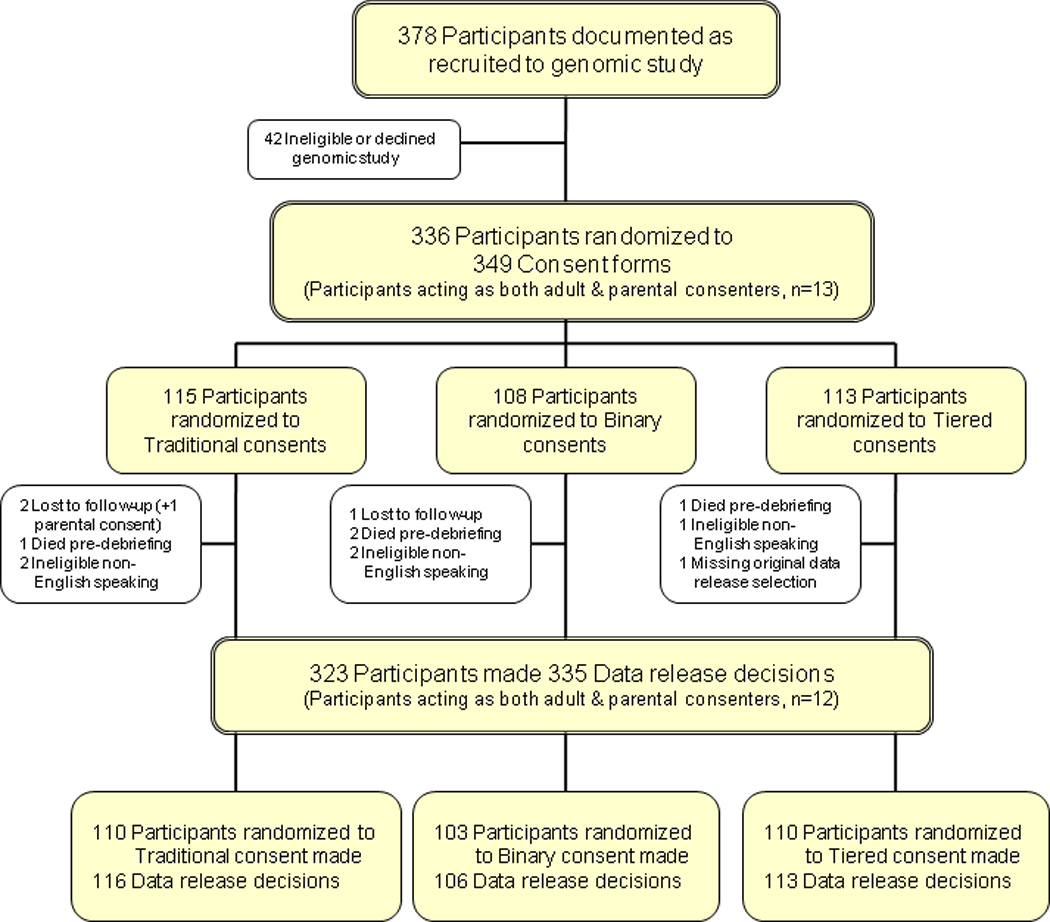
Methods: A single-blinded, randomized controlled trial was conducted with 323 eligible adult participants being recruited into one of six genome studies at Baylor College of Medicine in Houston, Texas, between January 2008 and August 2009. Participants were randomly assigned to one of three experimental consent documents (traditional, n = 110; binary, n = 103; and tiered, n = 110). Debriefing in follow-up visits provided participants a detailed review of all consent types and the chance to change data sharing choices or decline genome study participation.
Results: Before debriefing, 83.9% of participants chose public data release. After debriefing, 53.1% chose public data release, 33.1% chose restricted (controlled access database) release, and 13.7% opted out of data sharing. Only one participant declined genome study participation due to data sharing concerns.
Conclusion: Our findings indicate that most participants are willing to publicly release their genomic data; however, a significant portion prefers restricted release. These results suggest discordance between existing data sharing policies and participants' judgments and desires.
References
-
- The Wellcome Trust (Bermuda, February 25, 1996) Summary of Principles Agreed at the International Strategy Meeting on Human Genome Sequencing, 1996. [Accessed February 3, 2011]; Available at: http://www.wellcome.ac.uk/About-us/Policy/Policy-and-position-statements....
-
- The Wellcome Trust (Fort Lauderdale, January 14 – 15, 2003) Sharing Data from Large-Scale Biological Research Projects: A System of Tripartite Responsibility, 2003. [Accessed February 3, 2011]; Available at: http://www.genome.gov/Pages/Research/WellcomeReport0303.pdf.
-
- National Human Genome Research Institute Reaffirmation and Extension of NHGRI Rapid Release Policies: Large Scale Sequencing and Other Community Resource Projects, February 2003. [Accessed February 3, 2011]; Available at: http://www.genome.gov/10506537.
-
- Lin Z, Owen AB, Altman RB. Genomic research and human subject privacy. Science. 2004;205:183. - PubMed
Publication types
MeSH terms
Grants and funding
LinkOut - more resources
Full Text Sources
Medical
