


doi: 10.1038/nm.2407.
Variants at 6q21 implicate PRDM1 in the etiology of therapy-induced second malignancies after Hodgkin's lymphoma
Affiliations
- PMID: 21785431
- PMCID: PMC3229923
- DOI: 10.1038/nm.2407
Item in Clipboard
Variants at 6q21 implicate PRDM1 in the etiology of therapy-induced second malignancies after Hodgkin's lymphoma
Nat Med.
.
Abstract
Survivors of pediatric Hodgkin's lymphoma are at risk for radiation therapy-induced second malignant neoplasms (SMNs). We identified two variants at chromosome 6q21 associated with SMNs in survivors of Hodgkin's lymphoma treated with radiation therapy as children but not as adults. The variants comprise a risk locus associated with decreased basal expression of PRDM1 (encoding PR domain containing 1, with ZNF domain) and impaired induction of the PRDM1 protein after radiation exposure. These data suggest a new gene-exposure interaction that may implicate PRDM1 in the etiology of radiation therapy-induced SMNs.
Figures
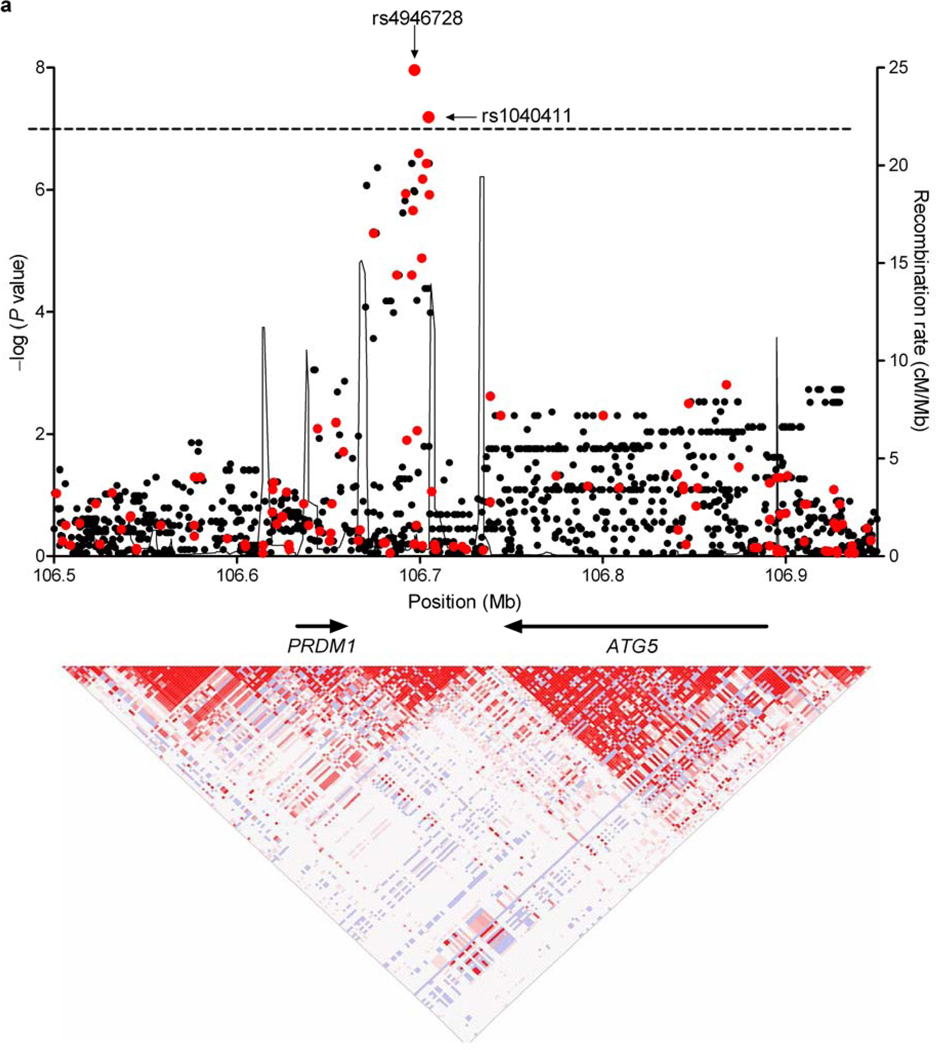
(a) Shown is the regional association plot of the 6q21 locus. The −log (P value) for SNPs in this region are shown with respect to genomic position. Genotyped SNPs are in red; imputed SNPs are in black. The line at −log (P) = 7 denotes the threshold for genome-wide significance. Recombination rates (taken from HapMap) and genes within this region are also shown (top panel). LD structure based on D’ values for the GWAS data are shown (bottom panel). NCBI build 36 was used for all map locations. (b) Shown is the western blot analysis over time for PRDM1 in eight lymphoblastoid cell lines, four homozygous for the chromosome 6q21 protective haplotype and four homozygous for the risk haplotype, treated with 10 Gy gamma irradiation. The protective haplotype was associated with both higher baseline PRDM1 protein levels than the risk haplotype and a marked induction of PRDM1 following irradiation. In contrast, PRDM1 was not induced by irradiation in cells homozygous for the risk haplotype.
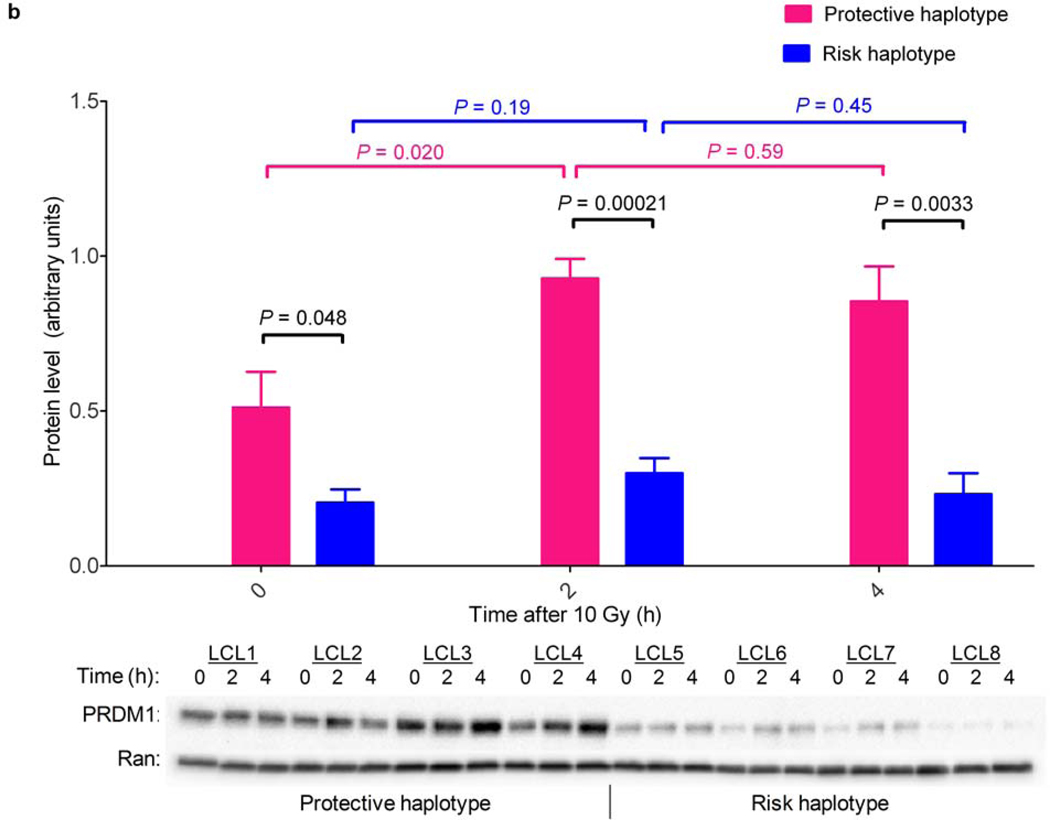
(a) Shown is the regional association plot of the 6q21 locus. The −log (P value) for SNPs in this region are shown with respect to genomic position. Genotyped SNPs are in red; imputed SNPs are in black. The line at −log (P) = 7 denotes the threshold for genome-wide significance. Recombination rates (taken from HapMap) and genes within this region are also shown (top panel). LD structure based on D’ values for the GWAS data are shown (bottom panel). NCBI build 36 was used for all map locations. (b) Shown is the western blot analysis over time for PRDM1 in eight lymphoblastoid cell lines, four homozygous for the chromosome 6q21 protective haplotype and four homozygous for the risk haplotype, treated with 10 Gy gamma irradiation. The protective haplotype was associated with both higher baseline PRDM1 protein levels than the risk haplotype and a marked induction of PRDM1 following irradiation. In contrast, PRDM1 was not induced by irradiation in cells homozygous for the risk haplotype.
Comment in
-
A step toward slaying the hydra of second cancers.Nat Med. 2011 Aug 4;17(8):924-5. doi: 10.1038/nm.2428. Nat Med. 2011. PMID: 21818085 No abstract available.
References
-
- Travis LB, et al. Breast cancer following radiotherapy and chemotherapy among young women with Hodgkin disease. Jama. 2003;290:465–475. - PubMed
-
- Neglia JP, et al. Second malignant neoplasms in five-year survivors of childhood cancer: childhood cancer survivor study. J Natl Cancer Inst. 2001;93:618–629. - PubMed
Publication types
MeSH terms
Substances
Grants and funding
- CA40046/CA/NCI NIH HHS/United States
- U01 GM061393/GM/NIGMS NIH HHS/United States
- R21 CA129045/CA/NCI NIH HHS/United States
- K08 GM089941/GM/NIGMS NIH HHS/United States
- N01 PC035139/CA/NCI NIH HHS/United States
- GM089941/GM/NIGMS NIH HHS/United States
- R21 CA139278/CA/NCI NIH HHS/United States
- CA110836/CA/NCI NIH HHS/United States
- CA55727/CA/NCI NIH HHS/United States
- CA129045/CA/NCI NIH HHS/United States
- CA58839/CA/NCI NIH HHS/United States
- U24 CA055727/CA/NCI NIH HHS/United States
- P01 CA040046/CA/NCI NIH HHS/United States
- N01-PC-35139/PC/NCI NIH HHS/United States
- P30 CA14599/CA/NCI NIH HHS/United States
- P30 CA014599/CA/NCI NIH HHS/United States
- U01GM61393/GM/NIGMS NIH HHS/United States
- HD0433871/HD/NICHD NIH HHS/United States
- CA139278/CA/NCI NIH HHS/United States
- R03 CA110836/CA/NCI NIH HHS/United States
LinkOut - more resources
Full Text Sources
Medical
Research Materials
