


doi: 10.1038/nn.2880.
Selective optical drive of thalamic reticular nucleus generates thalamic bursts and cortical spindles
Affiliations
- PMID: 21785436
- PMCID: PMC4169194
- DOI: 10.1038/nn.2880
Item in Clipboard
Selective optical drive of thalamic reticular nucleus generates thalamic bursts and cortical spindles
Nat Neurosci.
.
Abstract
The thalamic reticular nucleus (TRN) is hypothesized to regulate neocortical rhythms and behavioral states. Using optogenetics and multi-electrode recording in behaving mice, we found that brief selective drive of TRN switched the thalamocortical firing mode from tonic to bursting and generated state-dependent neocortical spindles. These findings provide causal support for the involvement of the TRN in state regulation in vivo and introduce a new model for addressing the role of this structure in behavior.
Figures
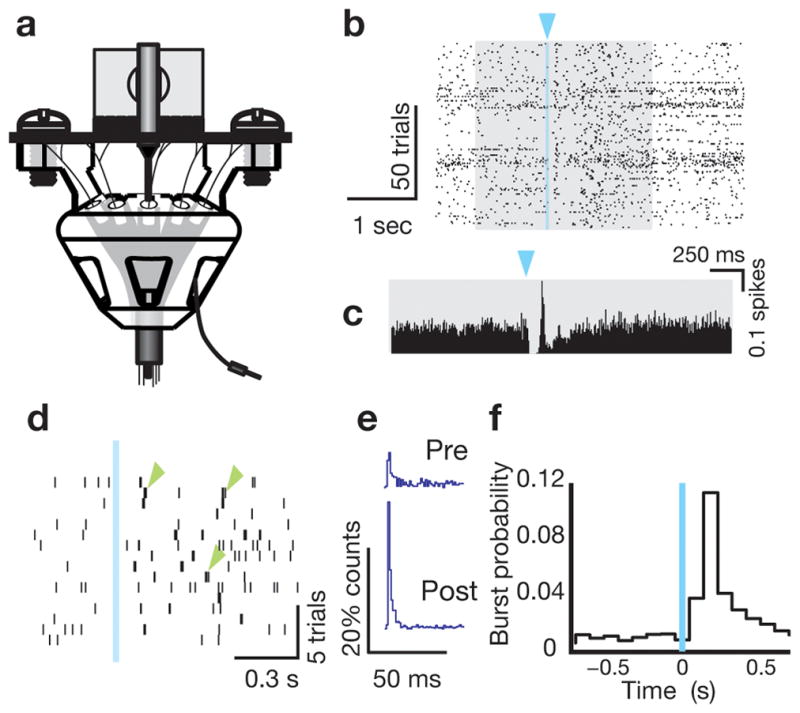
(a) The multi-electrode plus fiber-optic implant used for in vivo experiments. (b) A raster plot of a single TC unit’s spike times showing impact of a 20 msec laser pulse (blue triangle) delivered to neighboring TRN. (c) A PSTH of the same unit, gray background is matched to that in b. (d) Example of a TC unit where a single 20 msec laser pulse resulted in switching the firing mode from tonic to bursting (green arrow). (e) ISI histogram of the same cell in d, showing a robust change in ISIs < 4msec. (f) Histogram of burst probability across all cells shows a sustained increase in bursting for the 800 msec period post stimulation. All experiments were conducted according to the Institutional Animal Care and Use Committee guidelines at MIT.
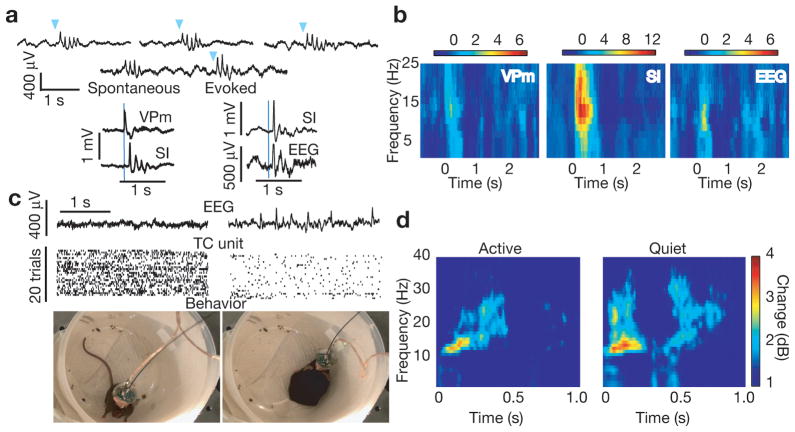
(a)
Top: Three examples of spindle generation by brief, 20 msec laser pulses (blue triangles) delivered to TRN and example of a spontaneous spindle followed by an optically-induced spindle, showing nearly identical waveforms. Bottom left: An example trace of thalamic LFP activity onset prior to neocortical spindling following laser stimulation (blue line). Bottom right: An example of a spindle oscillation appearing in the cortical LFP (SI) and the surface EEG. (b) Average spectrograms of ventral posteromedial thalamus (VPm) LFP, primary somatosensory cortex (SI) LFP, and surface EEG showing the emergence of oscillatory activity maximal at the spindle frequency range (7–15 Hz) following laser pulses to somatosensory TRN at time zero. Example from all stimulations (N = 204) of one animal (c) Example of a VGAT-ChR2 mouse exhibiting two states of activity, delineated by visual inspection of the EEG, TC firing rate, and high resolution video recording (d) Trial sorting based on visual inspection of these measures reveals a more robust optical induction of spindle oscillations in the EEG when the animal is quiet. Spectrogram of one animal. State-dependent spindle power increase after optical stimulation of the TRN shows a more robust impact when mice are quiet (N = 3 animals; p<0.001)
References
Publication types
MeSH terms
Substances
Grants and funding
LinkOut - more resources
Full Text Sources
Other Literature Sources
Molecular Biology Databases
