. 2011;17(11-12):1179-87.
doi: 10.2119/molmed.2011.00093. Epub 2011 Jul 13.

Overexpression of M₃ muscarinic receptor is a novel strategy for preventing sudden cardiac death in transgenic mice

Affiliations

Overexpression of M₃ muscarinic receptor is a novel strategy for preventing sudden cardiac death in transgenic mice

Yan Liu et al. Mol Med. 2011.

Abstract

The present study was designed to investigate the cardiac benefits of M₃ muscarinic receptor (M₃-mAChR) overexpression and whether these effects are related to the regulation of the inward rectifying K⁺ channel by microRNA-1 (miR-1) in a conditional overexpression mouse model. A cardiac-specific M₃-mAChR transgenic mouse model was successfully established for the first time in this study using microinjection, and the overexpression was confirmed by both reverse transcriptase-polymerase chain reaction and Western blot techniques. We demonstrated that M₃-mAChR overexpression dramatically reduced the incidence of arrhythmias and decreased the mortality in a mouse model of myocardial ischemia-reperfusion (I/R). By using whole-cell patch techniques, M₃-mAChR overexpression significantly shortened the action potential duration and restored the membrane repolarization by increasing the inward rectifying K⁺ current. By using Western blot techniques, M₃-mAChR overexpression also rescued the expression of the inward rectifying K⁺ channel subunit Kir2.1 after myocardial I/R injury. This result was accompanied by suppression of upregulation miR-1. We conclude that M₃-mAChR overexpression reduced the incidence of arrhythmias and mortality after myocardial I/R by protecting the myocardium from ischemia in mice. This effect may be mediated by increasing the inward rectifying K⁺ current by downregulation of arrhythmogenic miR-1 expression, which might partially be a novel strategy for antiarrhythmias, leading to sudden cardiac death.


Figures
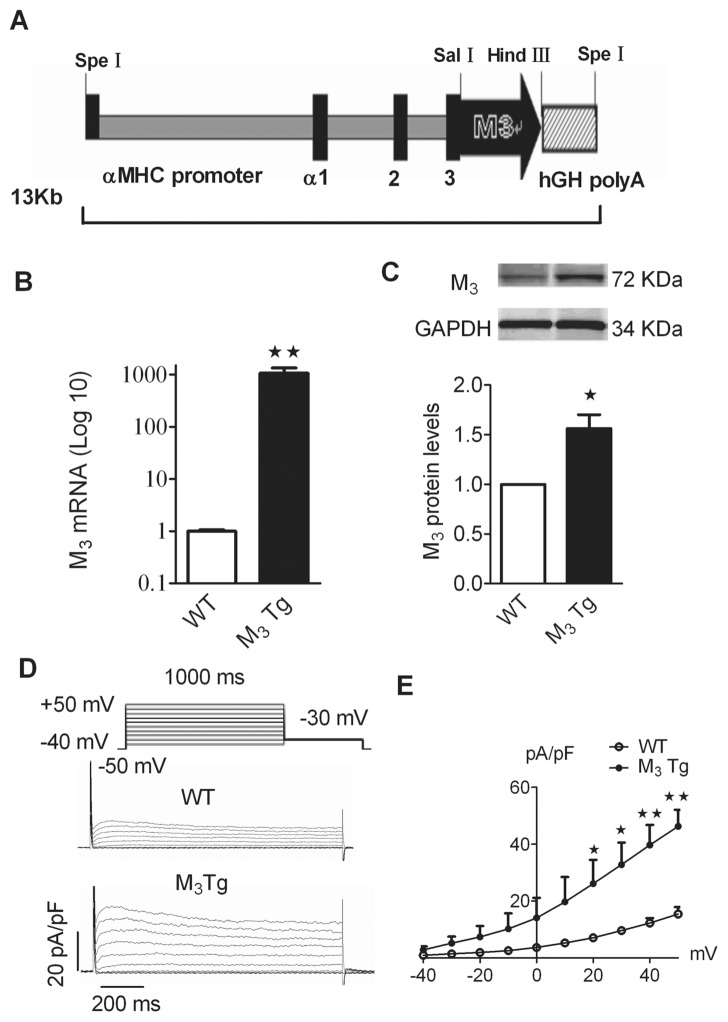
Figure 1
Figure 1
Characterization of expression levels of M3-mAChR in α-MHC promoter M3-mAChR transgenic gene (M3Tg) mice. (A) Schematic of the M3-mAChR gene constructed in the α-MHC promoter-M3Tg. The 13-kb transgene construct used to produce the transgenic mice was composed of cDNA (1,836 bp) of M3 from the UMR cDNA Resource Center, subcloned between SalI and HindIII of the α-MHC expression cassette. (B) The mRNA expression of M3-mAChR determined by real-time RT-PCR of total RNA in WT and M3Tg mice. (C) Top, examples of Western blot bands; bottom, expression levels of M3-mAChR. (D) Raw traces of IKM3 recorded from WT and M3Tg mice. (E) I-V relationships of IKM3 currents in WT and M3Tg mice. The average data presented were mean ± SEM; *P < 0.05, **P < 0.01 versus WT.
Figure 2
Figure 2
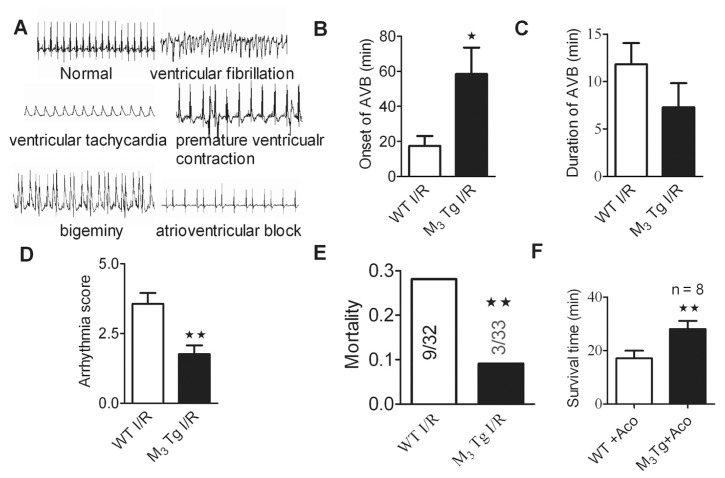
Cardiac beneficial effects of M3-mAChR overexpression against mice myocardial I/R and aconitine injury. (A) Representative electrocardiogram after mice myocardial I/R. The abnormalities include ventricular fibrillation, ventricular tachyarrhythmia, premature ventricular contraction, bigeminy and atrioventricular block. (B) Onset of atrial ventricular block (AVB). (C) Duration of AVB. (D) Arrhythmia score. (E) Mortality after experimental myocardial I/R. *P < 0.05, **P < 0.01 versus WT I/R. (F) Survival time after aconitine-induced arrhythmias in WT and M3Tg mice. **P < 0.01 versus WT + Aco. Aco, aconitine (5 mg/mL, 2 μg/10 g mice). The average data were presented as mean ± SEM.
Figure 3
Figure 3
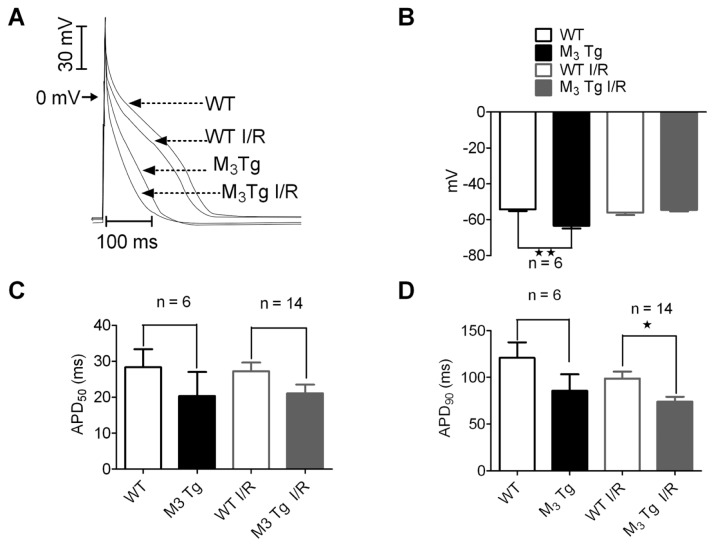
APD characteristics in M3Tg mice using a whole-cell patch-clamp. (A) Representative traces of AP recorded from both WT and M3Tg mice with or without myocardial I/R. (B) RMP. (C) Pooled data for APD at 50% (APD50) repolarization. (D) Pooled data for APD at 90% (APD90) repolarization. The average data were presented as mean ± SEM. *P < 0.05, **P < 0.01 versus WT or WT I/R.
Figure 4
Figure 4
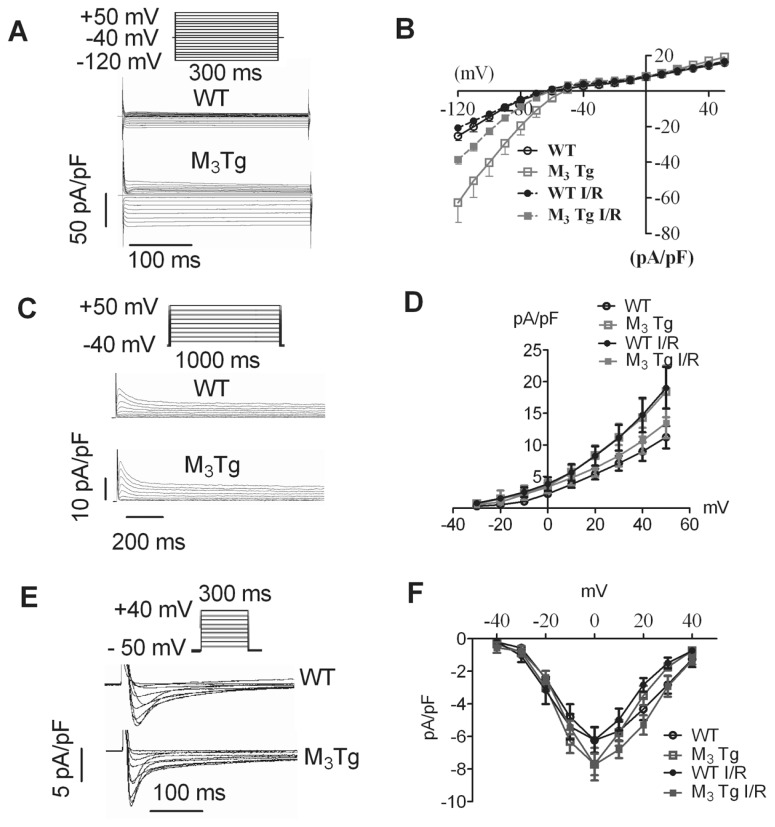
Comparison of the inward rectifier K+ current (IK1) and transient outward K+ currents (Ito) from both WT and M3Tg mice with or without myocardial I/R. (A) Raw traces of IK1 recorded from WT and M3Tg mice. (B) The averaged current density–voltage (I–V) relationships of IK1. (C) Raw traces of Ito recorded from WT and M3Tg mice. (D) In the average I–V relationships of Ito, there were no differences among the four groups. I–V curves, mean from at least eight cells for each condition. (E) Raw traces of ICa,L recorded from WT and M3Tg mice. (F) In the average I–V relationships of ICa,L, there were no significant differences between the four groups. I–V curves, mean from at least eight cells for each condition. The average data were presented as mean ± SEM.
Figure 5
Figure 5
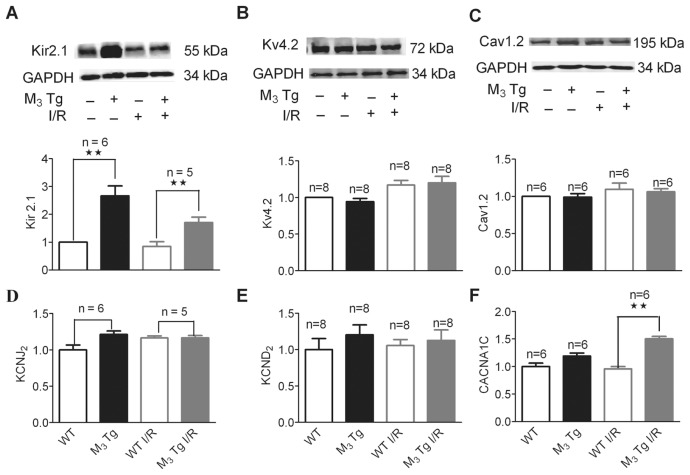
Alterations of protein and mRNA levels of IK1 and Ito revealed by Western blot analysis and real-time RT-PCR. (A) Top, examples of Western blot bands of Kir2.1; bottom, quantification of Kir2.1 (B) Top, examples of Western blot bands of Kv4.2; bottom, quantification of Kv4.2. (C) Top, examples of Western blot bands of Cav1.2; bottom, quantification of Cav1.2. (D) Effects of transgenic M3-mAChR on expression of KCNJ2 determined by real-time RT-PCR of total RNA from control and myocardial I/R mice. (E) Effects of transgenic M3-mAChR on expression of KCND2 determined by real-time RT-PCR of total RNA from healthy and myocardial I/R mice. (F) Effects of transgenic M3-mAChR on expression of CACNA1C determined by real-time RT-PCR of total RNA from control and myocardial I/R mice. The average data were presented as mean ± SEM. **P < 0.01 versus WT or WT I/R mice.
Figure 6
Figure 6
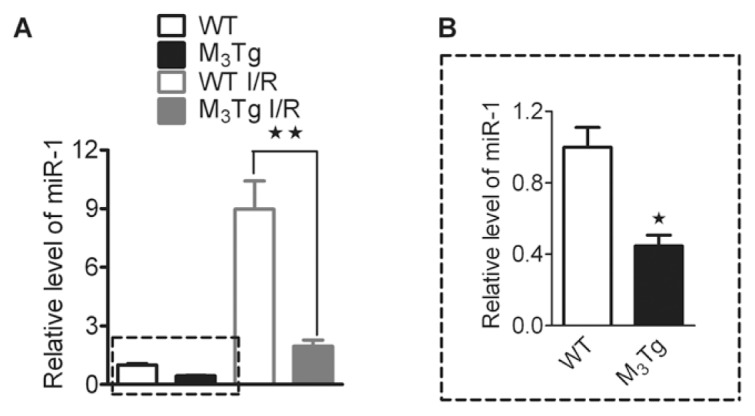
M3-mAChR overexpression on expression of miR-1 level in ventricular myocardium from control and myocardial I/R mice determined by real-time PCR. Data are expressed as mean ± SEM normalized to control. B is the magnification of part of A indicated by a dotted line. *P < 0.05. **P < 0.01 versus WT (n = 5) or WT I/R (n = 6).

References

    1. Adabag AS, Luepker RV, Roger VL, Gersh BJ. Sudden cardiac death: epidemiology and risk factors. Nat Rev Cardiol. 2010;7:216–25. - PMC - PubMed
    1. Zhang S. Sudden cardiac death in China. Pacing Clin Electrophysiol. 2009;32:1159–62. - PubMed
    1. Clements-Jewery H, Hearse DJ, Curtis MJ. Phase 2 ventricular arrhythmias in acute myocardial infarction: a neglected target for therapeutic antiarrhythmic drug development and for safety pharmacology evaluation. Br J Pharmacol. 2005;145:551–64. - PMC - PubMed
    1. Walker MJ. Antiarrhythmic drug research. Br. J. Pharmacol. 2006;147(Suppl 1):S222–31. - PMC - PubMed
    1. Shi H, Wang H, Wang Z. Identification and characterization of multiple subtypes of muscarinic acetylcholine receptors and their physiological functions in canine hearts. Mol Pharmacol. 1999;55:497–507. - PubMed

Publication types

MeSH terms