


The possible role of the kynurenine pathway in anhedonia in adolescents
- PMID: 21786117
- PMCID: PMC3679652
- DOI: 10.1007/s00702-011-0685-7
The possible role of the kynurenine pathway in anhedonia in adolescents
Abstract
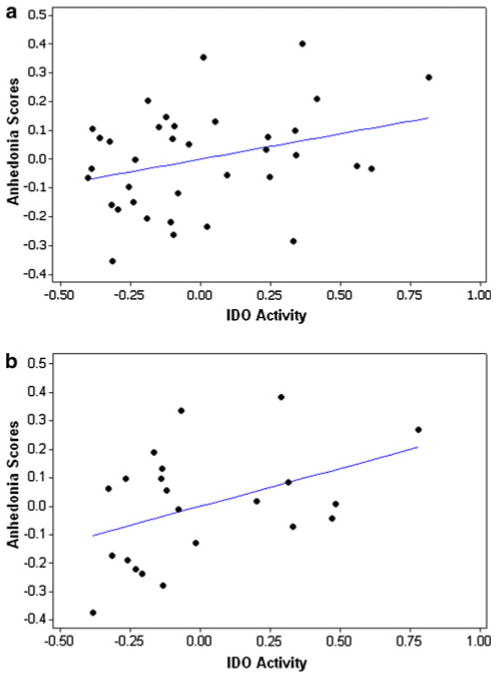
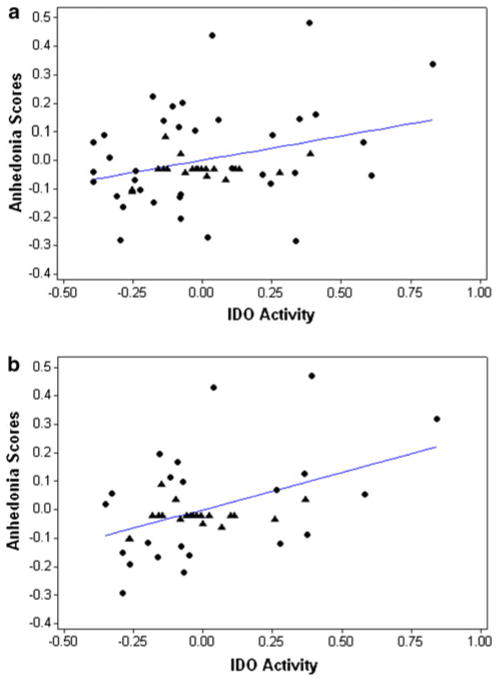
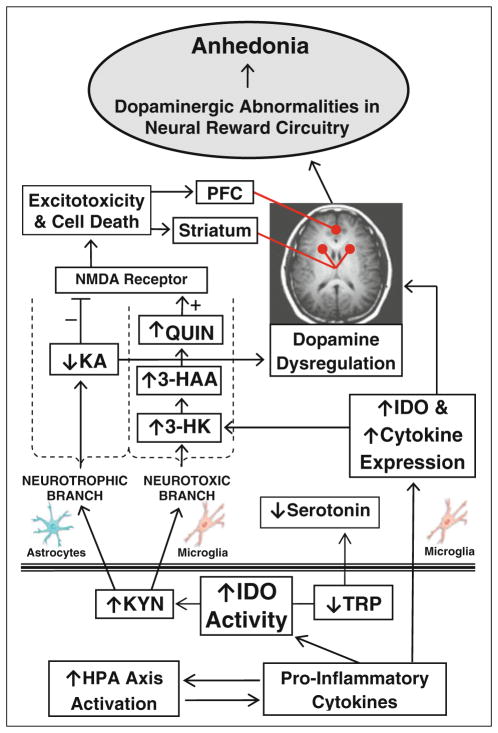
To address the heterogeneous nature of adolescent major depression (MDD), we investigated anhedonia, a core symptom of MDD. We recently reported activation of the kynurenine pathway (KP), a central neuroimmunological pathway which metabolizes tryptophan (TRP) into kynurenine (KYN) en route to several neurotoxins, in a group of highly anhedonic MDD adolescents. In this study, we aimed to extend our prior work and examine the relationship between KP activity and anhedonia, measured quantitatively, in a group of MDD adolescents and in a combined group of MDD and healthy control adolescents. Thirty-six adolescents with MDD (22 medication-free) and 20 controls were included in the analysis. Anhedonia scores were generated based on clinician- and subject-rated assessments and a semi-structured clinician interview. Blood KP metabolites, collected in the AM after an overnight fast, were measured using high-performance liquid chromatography. The rate-limiting enzyme of the KP, indoleamine 2,3-dioxygenase (IDO), was estimated by the ratio of KYN/TRP. Pearson correlation tests were used to assess correlations between anhedonia scores and KP measures while controlling for MDD severity. IDO activity and anhedonia scores were positively correlated in the group psychotropic medication-free adolescents with MDD (r = 0.42, P = 0.05) and in a combined group of MDD subjects and healthy controls (including medicated patients: r = 0.30, P = 0.02; excluding medicated patients: r = 0.44, P = 0.004). In conclusions, our findings provide further support for the role for the KP, particularly IDO, in anhedonia in adolescent MDD. These results emphasize the importance of dimensional approaches in the investigation of psychiatric disorders.
Figures
References
-
- Anderson IM, Parry-Billings M, Newsholme EA, Poortmans JR, Cowen PJ. Decreased plasma tryptophan concentration in major depression: relationship to melancholia and weight loss. J Affect Disord. 1990;20(3):185–191. - PubMed
-
- Araujo DM, Cherry SR, Tatsukawa KJ, Toyokuni T, Kornblum HI. Deficits in striatal dopamine D(2) receptors and energy metabolism detected by in vivo microPET imaging in a rat model of Huntington’s disease. Exp Neurol. 2000;166(2):287–297. - PubMed
-
- Badawy AB. Plasma free tryptophan revisited: what you need to know and do before measuring it. J Psychopharmacol. 2009;24:809–815. - PubMed
-
- Ball HJ, Yuasa HJ, Austin CJ, Weiser S, Hunt NH. Indoleamine 2, 3-dioxygenase-2; a new enzyme in the kynurenine pathway. Int J Biochem Cell Biol. 2009;41(3):467–471. - PubMed
Publication types
MeSH terms
Substances
Grants and funding
LinkOut - more resources
Full Text Sources
Research Materials
