


Review
doi: 10.1016/j.suc.2011.04.007.
Epub 2011 Jun 8.
Nutrition and gut immunity
Affiliations
- PMID: 21787966
- PMCID: PMC3144400
- DOI: 10.1016/j.suc.2011.04.007
Item in Clipboard
Review
Nutrition and gut immunity
Surg Clin North Am.
2011 Aug.
Abstract
The human intestine contains huge amounts of nonpathologic bacteria surviving in an environment that is beneficial to both the host and the bacterial populations. When short pauses in oral intake occur with minimal alterations in the mucosa-microbial interface, critical illness, with its attendant acidosis, prolonged gastrointestinal tract starvation, exogenous antibiotics, and breakdown in mucosal defenses, renders the host vulnerable to bacterial challenge and also threatens the survival of the bacteria. This review examines the altered innate and adaptive immunologic host defenses that occur as a result of altered oral or enteral intake and/or injury.
Copyright © 2011 Elsevier Inc. All rights reserved.
Figures
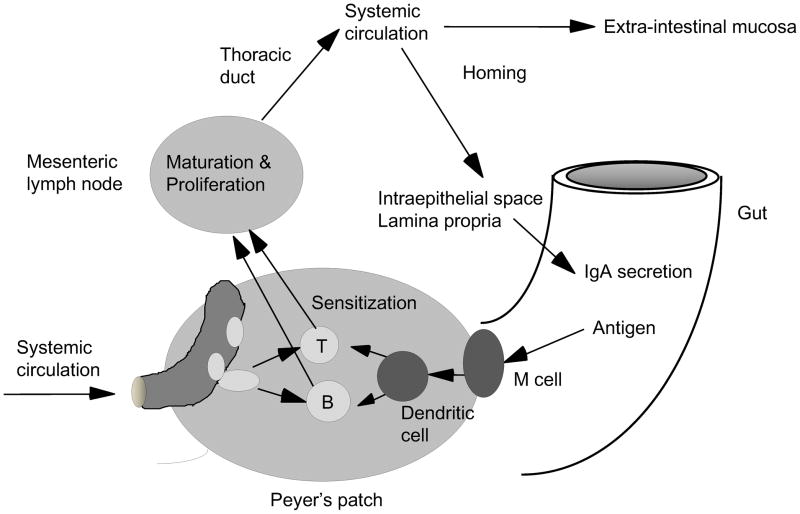
GALT is a center of systemic mucosal immunity. Naïve lymphocytes are sensitized at Peyer’s patches, migrate to mesenteric lymph nodes, enter to systemic circulation via thoracic duct, and home to mucosal sites.
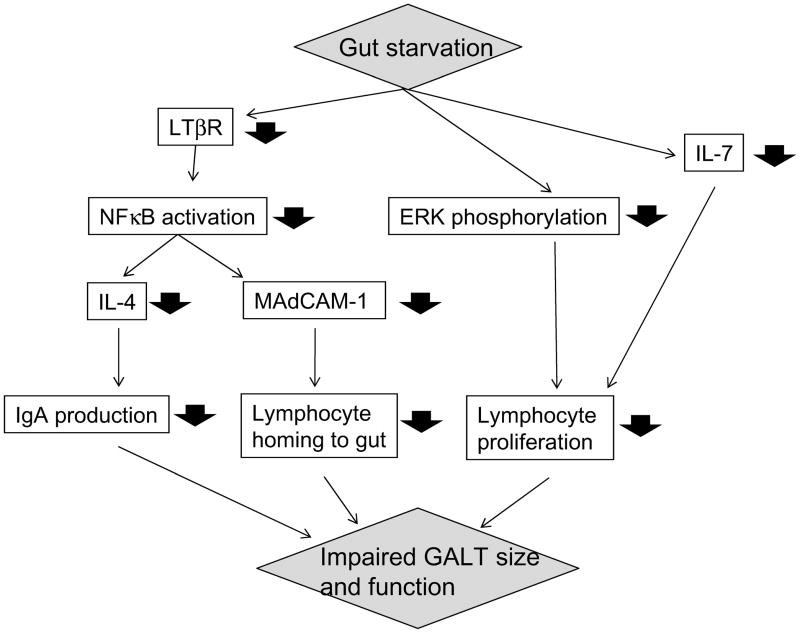
Impairment of gut immunity due to gut starvation is related to reduced LTβR expression, ERK phosphorylation, IL-7 production and other factors.
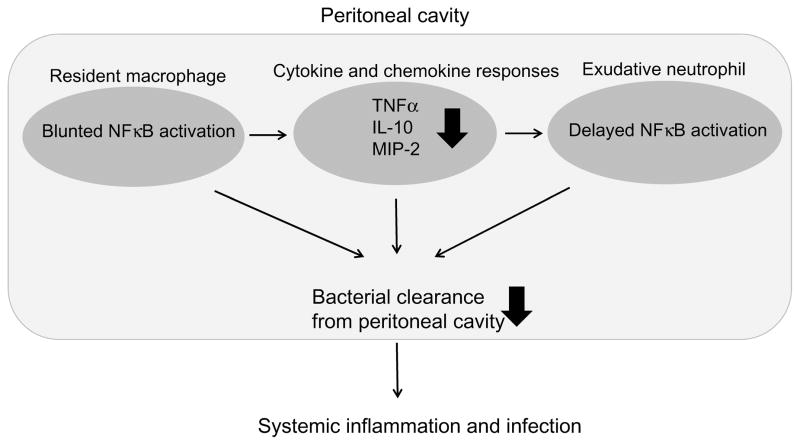
Gut starvation blunts NFκB activation in peritoneal resident macrophages and exudative neutrophils, impairing peritoneal host defense against bacterial contamination.
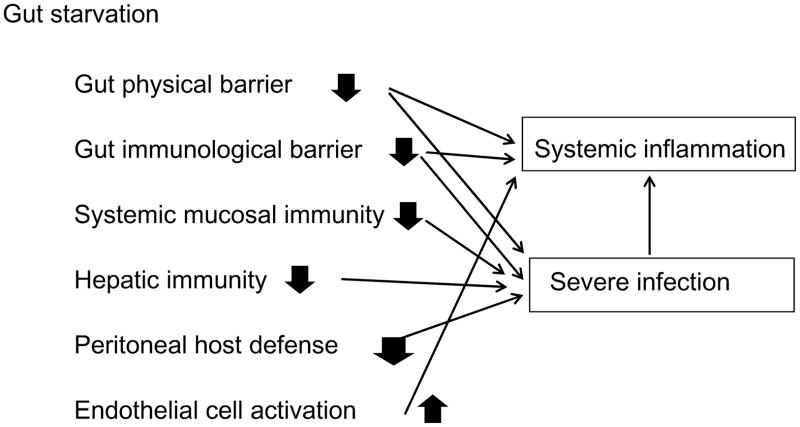
Gut starvation impairs various host defense systems, while causing inappropriate activation of endothelial cells.
References
-
- Beers SA, Buckland AG, Koduri RS, et al. The antibacterial properties of secreted phospholipase A2: a major physiological role for the group IIA enzyme that depends on the very high pI of the enzyme to allow penetration of the bacterial cell wall. Jour Biol Chem. 2002;277:1788–1793. - PubMed
-
- Koduri RS, Gronroos JO, Laine VJO, et al. Bacteridical properties of human and murine groups I, II, V, X, and XII secreted phospholipases A2. Jour biol chem. 2002;277:5849–5857. - PubMed
-
- McGhee JR, Mestecky J, Dertzbaugh MT, et al. The mucosal immune system: from fundamental concepts to vaccine development. Vaccine. 1992;10:75–88. - PubMed
-
- Guy-Grand D, Griscelli C, Vassalli P. The gut-associated lymphoid system: nature and properties of the large dividing cells. Eur J Immunol. 1974;4:435–443. - PubMed
-
- Roux ME, McWilliams M, Phillips-Quagliata JM, et al. Differentiation pathway of Peyer’s patch precursors of IgA plasma cells in the secretory immune system. Cell Immunol. 1981;61:141–153. - PubMed
Publication types
MeSH terms
Grants and funding
LinkOut - more resources
Full Text Sources
Other Literature Sources
Medical
