


Targeting the Hedgehog pathway in cancer
- PMID: 21789137
- PMCID: PMC3126020
- DOI: 10.1177/1758834010366430
Targeting the Hedgehog pathway in cancer
Abstract
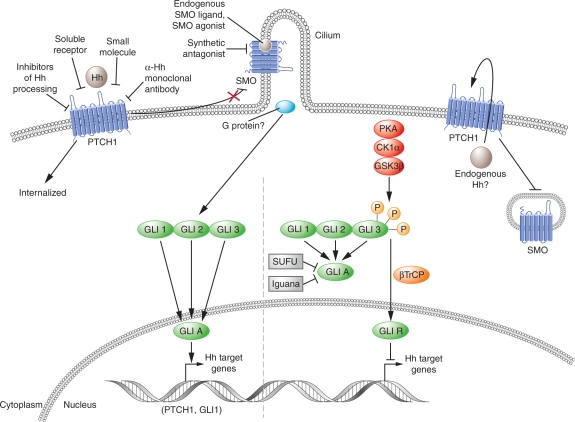
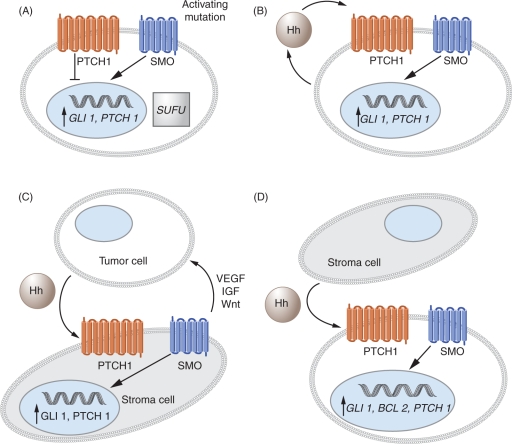
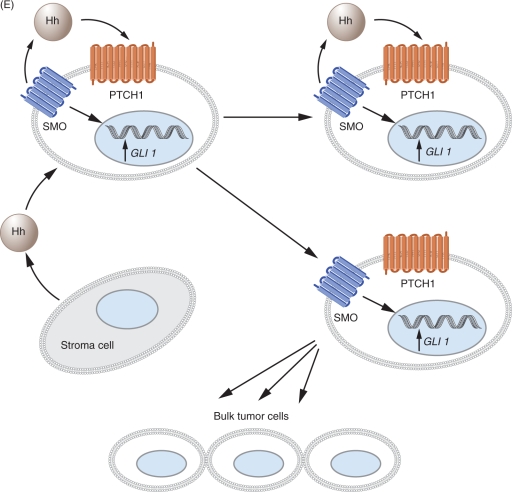
The Hedgehog (Hh) pathway is a major regulator of many fundamental processes in vertebrate embryonic development including stem cell maintenance, cell differentiation, tissue polarity and cell proliferation. Constitutive activation of the Hh pathway leading to tumorigenesis is seen in basal cell carcinomas and medulloblastoma. A variety of other human cancers, including brain, gastrointestinal, lung, breast and prostate cancers, also demonstrate inappropriate activation of this pathway. Paracrine Hh signaling from the tumor to the surrounding stroma was recently shown to promote tumorigenesis. This pathway has also been shown to regulate proliferation of cancer stem cells and to increase tumor invasiveness. Targeted inhibition of Hh signaling may be effective in the treatment and prevention of many types of human cancers. The discovery and synthesis of specific Hh pathway inhibitors have significant clinical implications in novel cancer therapeutics. Several synthetic Hh antagonists are now available, several of which are undergoing clinical evaluation. The orally available compound, GDC-0449, is the farthest along in clinical development. Initial clinical trials in basal cell carcinoma and treatment of select patients with medulloblastoma have shown good efficacy and safety. We review the molecular basis of Hh signaling, the current understanding of pathway activation in different types of human cancers and we discuss the clinical development of Hh pathway inhibitors in human cancer therapy.
Keywords: GDC-0449; Hedgehog; basal cell carcinoma; cancer stem cells; medulloblastoma.
Figures
References
-
- Al-Hajj M., Clarke M.F. (2004) Self-renewal and solid tumor stem cells. Oncogene 23: 7274–7282 - PubMed
-
- Aszterbaum M., Beech J., Epstein E.H., Jr (1999) Ultraviolet radiation mutagenesis of hedgehog pathway genes in basal cell carcinomas. J Investig Dermatol Symp Proc 4: 41–45 - PubMed
-
- Athar M., Li C., Tang X., Chi S., Zhang X., Kim A.L., et al. (2004) Inhibition of smoothened signaling prevents ultraviolet B-induced basal cell carcinomas through regulation of Fas expression and apoptosis. Cancer Res 64: 7545–7552 - PubMed
-
- Beachy P.A., Karhadkar S.S., Berman D.M. (2004) Tissue repair and stem cell renewal in carcinogenesis. Nature 432: 324–331 - PubMed
LinkOut - more resources
Full Text Sources
Other Literature Sources
