


Single and dual task gait training in people with Parkinson's disease: a protocol for a randomised controlled trial
- PMID: 21791117
- PMCID: PMC3155494
- DOI: 10.1186/1471-2377-11-90
Single and dual task gait training in people with Parkinson's disease: a protocol for a randomised controlled trial
Abstract
Background: Difficulty performing more than one task at a time (dual tasking) is a common and disabling problem experienced by people with Parkinson disease (PD). If asked to perform another task when walking, people with PD often take shorter steps or walk more slowly. Currently there is uncertainty about whether clinicians should teach people with PD to avoid dual tasking or whether they should encourage them to practice dual tasking with the hope that practice will lead to enhanced performance. This study will address this issue by comparing single to dual task gait training.
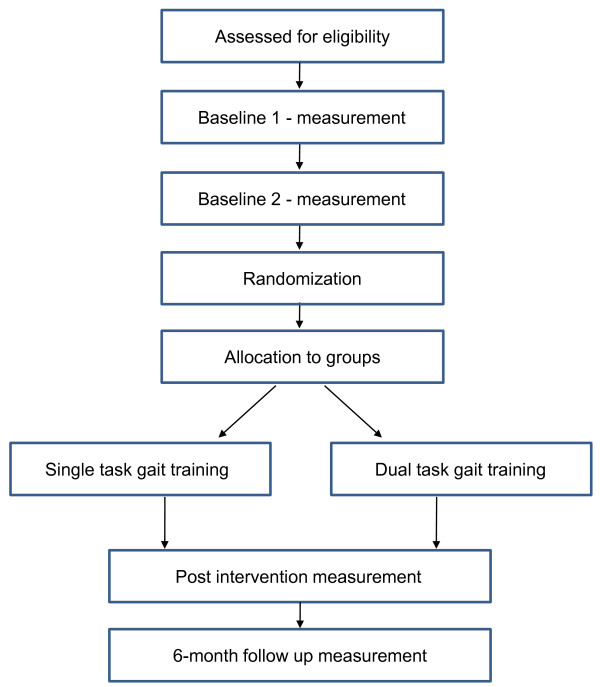
Methods and design: A prospective randomised clinical trial is being conducted. Sixty participants with idiopathic PD will be recruited, provided they score I-IV on the modified Hoehn and Yahr (1967) scale, and fulfil other inclusion criteria. Participants will be randomly allocated to either a single or dual task gait training group. Both groups will receive 12 hours of walking training over 4 weeks. The single task group will undertake gait training with cueing strategies to increase step length. The dual task group will train to improve step length when walking and performing a variety of added tasks. Both groups will receive a tailored home program for 6 months. Blinded assessors will conduct four assessments: two baseline assessments, one post intervention and one at 6 months follow-up. The primary outcome measure will be step length when dual tasking over 8 m. Secondary outcome measures include: spatiotemporal gait parameters when walking under single and dual task conditions, measures of executive function, the timed up and go test, measures of community mobility, and quality of life. All analyses will be based on intention to treat principle.
Discussion: This trial will examine the immediate and longer term effect of dual task walking training as compared to single task training in people with idiopathic PD, at the impairment, activity, and participation levels. It has the potential to identify a new intervention that may improve and maintain walking beyond the laboratory. The results of this trial will provide guidance for clinicians in the development of walking training programs for people with PD.
Trial registration: ACTRN12609000791235.
References
-
- Dorsey ER, Constantinescu R, Thompson JP, Biglan KM, Holloway RG, Kieburtz K, Marshall FJ, Ravina BM, Schifitto G, Siderowf A, Tanner CM. Projected number of people with Parkinson disease in the most populous nations, 2005 through 2030. Neurology. 2007;68:384–386. doi: 10.1212/01.wnl.0000247740.47667.03. - DOI - PubMed
-
- Carter JH, Stewart BJ, Archbold PG, Inoue I, Jaglin J, Lannon M, Rost-Ruffner E, Tennis M, McDermott MP, Amyot D. et al. Living with a person who has Parkinson's disease: the spouse's perspective by stage of disease. Parkinson's Study Group. Mov Disord. 1998;13:20–28. doi: 10.1002/mds.870130108. - DOI - PubMed
Publication types
MeSH terms
LinkOut - more resources
Full Text Sources
Medical
