Review
. 2011 Jul;6(5):879-98.
doi: 10.2217/nnm.11.78.

Toxicological studies on silver nanoparticles: challenges and opportunities in assessment, monitoring and imaging

Affiliations
Review

Toxicological studies on silver nanoparticles: challenges and opportunities in assessment, monitoring and imaging

Matthew Charles Stensberg et al. Nanomedicine (Lond). 2011 Jul.

Abstract

Silver nanoparticles (Ag NPs) are becoming increasingly prevalent in consumer products as antibacterial agents. The increased use of Ag NP-enhanced products may lead to an increase in toxic levels of environmental silver, but regulatory control over the use or disposal of such products is lagging due to insufficient assessment on the toxicology of Ag NPs and their rate of release into the environment. In this article we discuss recent research on the transport, activity and fate of Ag NPs at the cellular and organismic level, in conjunction with traditional and recently established methods of nanoparticle characterization. We include several proposed mechanisms of cytotoxicity based on such studies, as well as new opportunities for investigating the uptake and fate of Ag NPs in living systems.


Figures
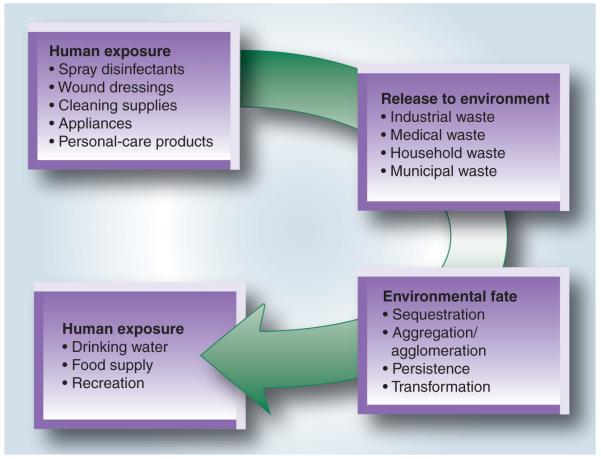
Figure 1
Figure 1
Potential human and environmental exposure routes for silver nanoparticles.
Figure 2
Figure 2. Real-time hydrogen peroxide efflux from a murine spinal cord segment exposed to 1 mg/l silver nanoparticles
The gap in the graph is a result of having to reposition the sample and probe after the addition of Ag NPs. A spike in efflux is visible approximately 7 min after the addition. Ag NP: Silver nanoparticles. Reproduced with permission from [Stensberg et al., Unpublished Data].
Figure 3
Figure 3. Proton efflux from Daphnia magna embryos when dosed with 130 and 650 ng/l (A) AgNO3 and (B) silver nanoparticles
Note the differences in scale on the Y axis between the two graphs. Ag NP: Silver nanoparticles. Reproduced with permission from [Stensberg et al., Unpublished Data].
Figure 4
Figure 4. Real-time ionic silver flux measured at the surface of a Pseudomonas aeruginosa biofilm exposed to 9 μM (1.5 ppm) silver nitrate
Reproduced with permission from [126].
Figure 5
Figure 5. Proton efflux from Daphnia magna embryos when dosed with 130 and 650 ng/l (A) AgNO3 and (B) silver nanoparticles
No notable differences were observed between the two treatments. NP: Nanoparticle. Reproduced with permission from [Stensberg et al., Unpublished Data].
Figure 6
Figure 6. Single-particle tracking (A–F) of a silver nanoparticles (in dashed circle) toward the chorionic space of a zebrafish embryo, using optical darkfield microscopy
Rectangular outline in (A) includes chorionic pore channels; scale bar = 15 μm. Reproduced with permission from [11].
Figure 7
Figure 7. Selected images of zebrafish larvae with various developmental deformities
Reproduced with permission from [11].
Figure 8
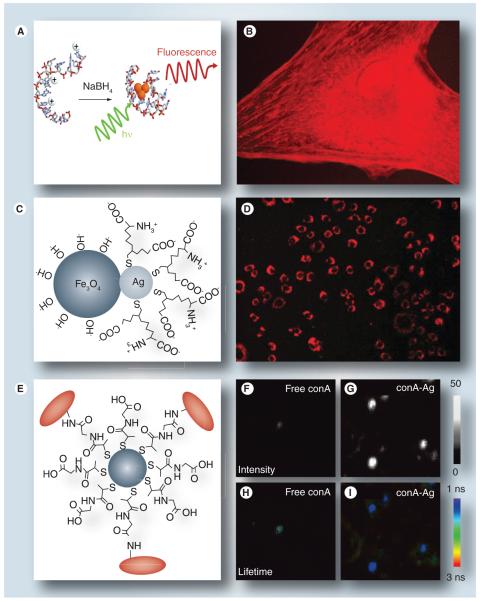
Figure 8. Silver nanoclusters and nanoparticles as fluorescent contrast agents
fluorescence; (C & D) two-photon excited luminescence; (E–I) surface-enhanced fluorescence imaging. (A) Production of DNA-encapsulated silver nanoclusters (Ag NCs); (B) fluorescence imaging of live NIH 3T3 cells with anti-actin silver nanoclusters (Ag NCs); (C & D) Ag–Fe3O4 nanoparticle (NP) heterodimer as a contrast agent for two-photon excited luminescence imaging in macrophage cells; (E) plasmon-coupled Ag NP–dye probe; (F & G) demonstration of 20–30-fold enhancement in fluorescence intensity, in the presence of Ag NPs; (H & I) Ag NP-enhanced fluorescence lifetime imaging. (A & B) Reproduced with permission from [137]. (C & D) Reproduced with permission from [145]. (F & G) Reproduced with permission from [147]. (H & I) Reproduced with permission from [148].
Figure 9
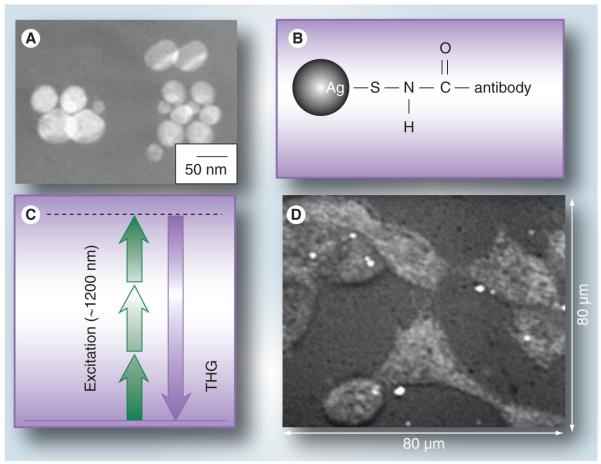
Figure 9. Silver nanoparticles used as contrast agents for third-harmonic generation imaging
(A) TEM images of silver nanoparticles (Ag NPs). (B) Ag NPs conjugated with anti-Her2 antibodies. (C) Transition state for THG. (D) THG image of mouse bladder carcinoma cells (MBT2) marked with antibody-labeled Ag NPs. THG: Third-harmonic generation. Reproduced with permission from [14].
Figure 10
Figure 10. Silver nanoparticles as contrast agents in biomedical imaging
(A) Scanning electron microscope image of Ag nanoshells. (B) Ultrasound (left), photoacoustic (middle) and merged image of Ag nanoshells in porcine pancreas (right). (C) Transmission electron microscope image of 125I-labeled 12-nm silver nanoparticles. (D) CT-SPECT images of 125I-labeled Ag NPs in rats at different time points after intravenous administration. (A) Reproduced with permission from [155]. (B) Reproduced with permission from [157].

References

Bibliography

    1. The Silver Institute . The future demand of silver: industrial demand. The Silver Institute; Washington DC, USA: 2011. pp. 27–32.
    1. Dhawan A, Sharma V. Toxicity assessment of nanomaterials: methods and challenges. Anal. Bioanal. Chem. 2010;398:589–605. - PubMed
    1. Duran N, Marcato PD, de Conti R, Alves OL, Costa FTM, Brocchi M. Potential use of silver nanoparticles on pathogenic bacteria, their toxicity and possible mechanisms of action. J. Brazil. Chem. Soc. 2010;21:949–959.
    1. Kahru A, Dubourguier H. From ecotoxicology to nanoecotoxicology. Toxicology. 2010;269:105–119. - PubMed
    1. Lubick N. Nanosilver toxicity: ions, nanoparticles – or both? Environ. Sci. Technol. 2008;42:8617. - PubMed

Patents

    1. Holladay RJ, Christensen H, Moeller WD. US09946834 2004
    1. Sawafta R, Haik Y, Hitchcock W, Kuturu V, Ciubotaru I, Lee YS. US11671675 2008

Websites

    1. Woodrow Wilson International Center for Scholars (WWICS) Project on emerging nanotechnologies. 2011 www.nanotechproject.org/inventories/consumer/ana lysis_draft/
    1. ATSDR . Agency for Toxic Substances and Disease Registry. Atlanta, GA: 1990. Toxicological profile for silver. 7440–22–4 www.atsdr.cdc.gov/toxprofiles/tp146.html. - PubMed

Publication types