


Regulation of embryonic stem cell self-renewal and pluripotency by leukaemia inhibitory factor
- PMID: 21793804
- PMCID: PMC3418323
- DOI: 10.1042/BJ20102152
Regulation of embryonic stem cell self-renewal and pluripotency by leukaemia inhibitory factor
Abstract
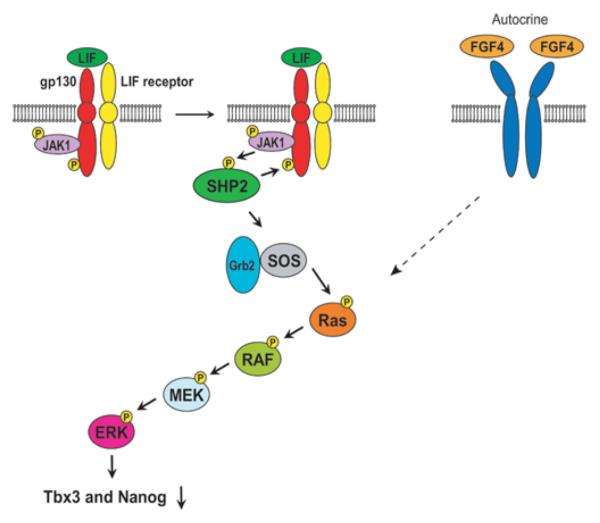
LIF (leukaemia inhibitory factor) is a key cytokine for maintaining self-renewal and pluripotency of mESCs (mouse embryonic stem cells). Upon binding to the LIF receptor, LIF activates three major intracellular signalling pathways: the JAK (Janus kinase)/STAT3 (signal transducer and activator of transcription 3), PI3K (phosphoinositide 3-kinase)/AKT and SHP2 [SH2 (Src homology 2) domain-containing tyrosine phosphatase 2]/MAPK (mitogen-activated protein kinase) pathways. These pathways converge to orchestrate the gene expression pattern specific to mESCs. Among the many signalling events downstream of the LIF receptor, activation and DNA binding of the transcription factor STAT3 plays a central role in transducing LIF's functions. The fundamental role of LIF for pluripotency was highlighted further by the discovery that LIF accelerates the conversion of epiblast-derived stem cells into a more fully pluripotent state. In the present review, we provide an overview of the three major LIF signalling pathways, the molecules that interact with STAT3 and the current interpretations of the roles of LIF in pluripotency.
© The Authors Journal compilation © 2011 Biochemical Society
Figures
References
-
- Smith AG. Embryo-derived stem cells: of mice and men. Annu. Rev. Cell Dev. Biol. 2001;17:435–462. - PubMed
-
- Chambers I, Smith A. Self-renewal of teratocarcinoma and embryonic stem cells. Oncogene. 2004;23:7150–7160. - PubMed
-
- Niwa H. How is pluripotency determined and maintained? Development. 2007;134:635–646. - PubMed
-
- Pera MF, Tam PP. Extrinsic regulation of pluripotent stem cells. Nature. 2010;465:713–720. - PubMed
-
- Nichols J, Smith A. The origin and identity of embryonic stem cells. Development. 2011;138:3–8. - PubMed
Publication types
MeSH terms
Substances
Grants and funding
LinkOut - more resources
Full Text Sources
Other Literature Sources
Miscellaneous
