


Review
doi: 10.1111/j.1749-6632.2011.06100.x.
Growth hormone-STAT5 regulation of growth, hepatocellular carcinoma, and liver metabolism
Affiliations
- PMID: 21793836
- PMCID: PMC3427656
- DOI: 10.1111/j.1749-6632.2011.06100.x
Item in Clipboard
Review
Growth hormone-STAT5 regulation of growth, hepatocellular carcinoma, and liver metabolism
Ann N Y Acad Sci.
2011 Jul.
Abstract
The liver is a primary target of growth hormone (GH). GH signals are mediated by the transcription factor signal transducer and activator of transcription 5 (STAT5). Here, we focus on recent discoveries about the role of GH-STAT5 signaling in hepatic physiology and pathophysiology. We discuss roles of the GH-STAT5 axis in body growth, lipid metabolism, and the cell cycle pertaining to hepatosteatosis, fibrosis, and hepatocellular carcinoma. Finally, we discuss recent discoveries about the role of GH-STAT5 in sex-specific gene expression and bile acid, steroid, and drug metabolism.
© 2011 New York Academy of Sciences.
Conflict of interest statement
Conflicts of interest
Figures
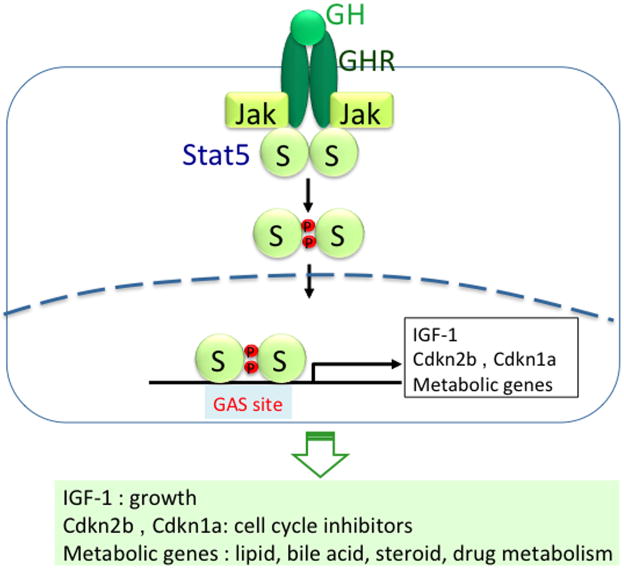
GH-STAT5 signaling pathway. GH binds its receptor and then activates Jak2, which in turn activates STAT5 by phosphorylation. Phosphorylated STAT5 goes to the nucleus, where it binds to gamma interferon–activated sequence (GAS) site of target gene's promoters. It activates transcription of Igf-1 gene., It activates cell cycle inhibitors Cdkn2b (cyclin-dependent kinase inhibitor 2B; p15INK4B) and Cdkn1a (p21CIP1). It also activates metabolic genes associated with lipid, bile acid, and steroid/drug metabolism. STAT5.
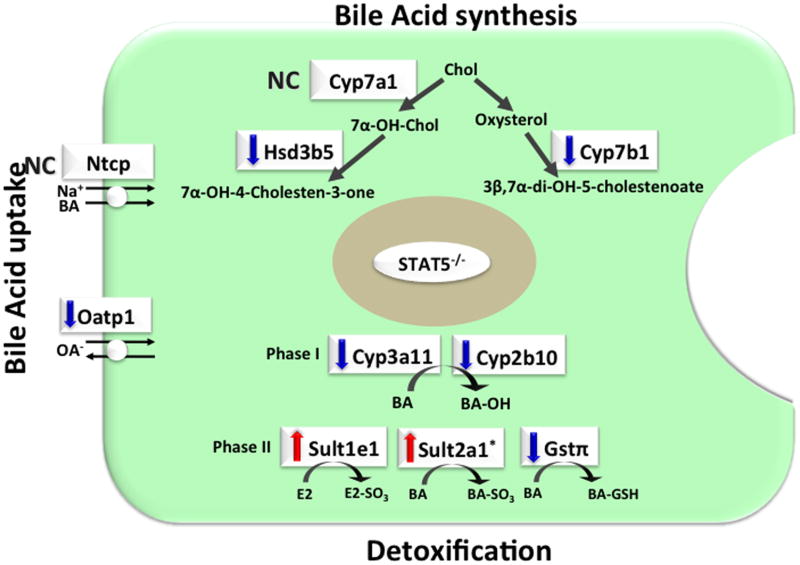
Changes in hepatic gene expression of BA metabolism in STAT5-deficient mice. STAT5-liver specific knockout mice (STAT5−/
−) exhibited changes in gene expression of BA metabolism including synthesis,,,, uptake,,, and detoxification.,, Sult2a1 gene was induced in GH-releasing hormone receptor-deficient little (lit/lit) mouse. Ntcp, Na+/taurocholate cotransporter; Oatp1, organic anion transporter 1; BA, bile acid; Gstπ, glutathione S-transferase pi class; Chol, cholesterol; E2, estradiol; OA-, organic anions; BA-OH, hydroxylated BA; BA-SO3, sulfated BA; GSH, glutathione. Arrows indicate changes in gene expression (up, down). NC, no change.
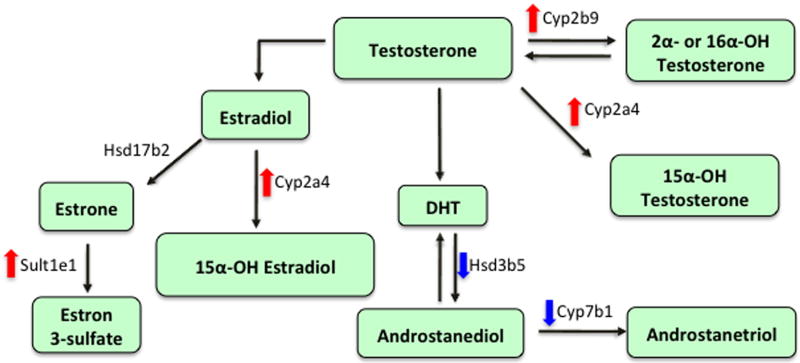
Changes in hepatic gene expression of testosterone and estrogen metabolism in STAT5-deficient mice. STAT5-liver specific knockout mice down-regulated expression of Hsd3b5, and Cyp7b1 genes,, whereas it up-regulated expression of Cyp2b9,,
Cyp2a4,, and Sult1e1 genes, in the liver. DHT, dihydrotestosterone; OH, hydroxylated. Arrows indicate changes in gene expression (up, down).
References
-
- Kofoed EM, Hwa V, Little B, et al. Growth hormone insensitivity associated with a STAT5b mutation. N Engl J Med. 2003;349:1139–1147. - PubMed
-
- Chia DJ, Ono M, Woelfle J, et al. Characterization of distinct Stat5b binding sites that mediate growth hormone-stimulated IGF-I gene transcription. J Biol Chem. 2006;281:3190–3197. - PubMed
Publication types
MeSH terms
Substances
Grants and funding
LinkOut - more resources
Full Text Sources
Medical
Miscellaneous
