


Major histocompatibility complex-dependent cytotoxic T lymphocyte repertoire and functional avidity contribute to strain-specific disease susceptibility after murine respiratory syncytial virus infection
- PMID: 21795345
- PMCID: PMC3196413
- DOI: 10.1128/JVI.00816-11
Major histocompatibility complex-dependent cytotoxic T lymphocyte repertoire and functional avidity contribute to strain-specific disease susceptibility after murine respiratory syncytial virus infection
Abstract
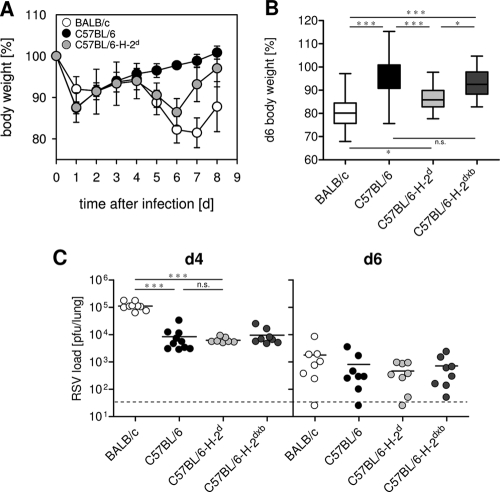
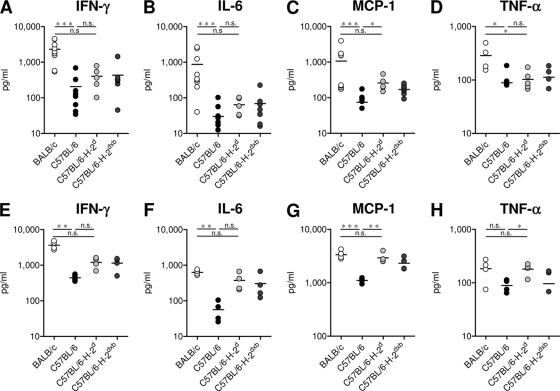
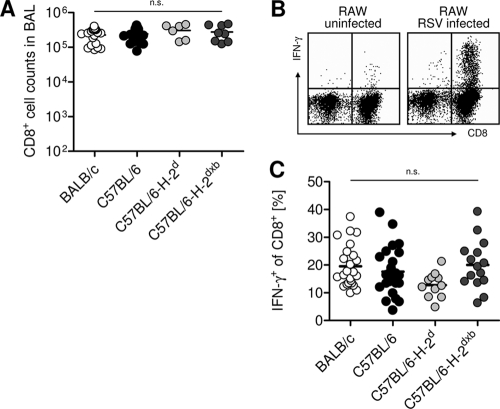
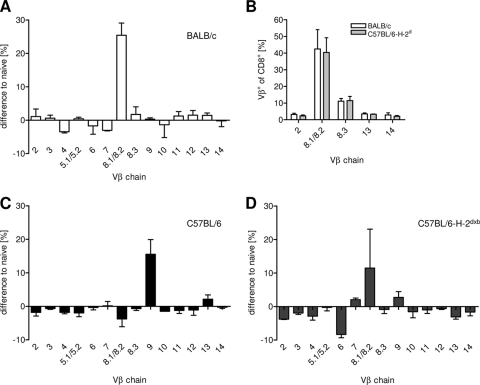
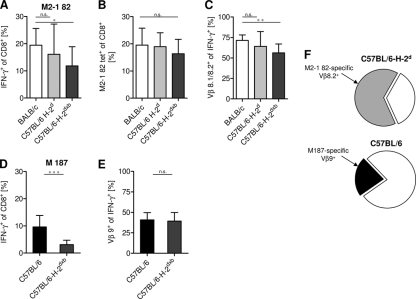
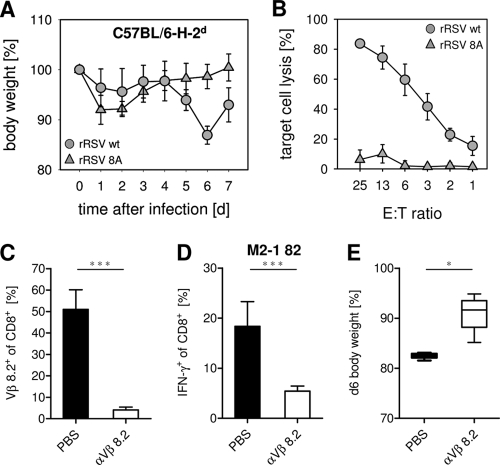
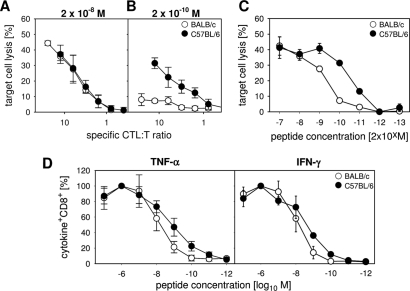
Susceptibility to respiratory syncytial virus (RSV) infection in mice is genetically determined. While RSV causes little pathology in C57BL/6 mice, pulmonary inflammation and weight loss occur in BALB/c mice. Using major histocompatibility complex (MHC)-congenic mice, we observed that the H-2(d) allele can partially transfer disease susceptibility to C57BL/6 mice. This was not explained by altered viral elimination or differences in the magnitude of the overall virus-specific cytotoxic T lymphocyte (CTL) response. However, H-2(d) mice showed a more focused response, with 70% of virus-specific CTL representing Vβ8.2(+) CTL directed against the immunodominant epitope M2-1 82, while in H-2(b) mice only 20% of antiviral CTL were Vβ9(+) CTL specific for the immunodominant epitope M187. The immunodominant H-2(d)-restricted CTL lysed target cells less efficiently than the immunodominant H-2(b) CTL, probably contributing to prolonged CTL stimulation and cytokine-mediated immunopathology. Accordingly, reduction of dominance of the M2-1 82-specific CTL population by introduction of an M187 response in the F1 generation of a C57BL/6N × C57BL/6-H-2(d) mating (C57BL/6-H-2(dxb) mice) attenuated disease. Moreover, disease in H-2(d) mice was less pronounced after infection with an RSV mutant failing to activate M2-1 82-specific CTL or after depletion of Vβ8.2(+) cells. These data illustrate how the MHC-determined diversity and functional avidity of CTL responses contribute to disease susceptibility after viral infection.
Figures
References
-
- Amanatidou V., Apostolakis S., Spandidos D. A. 2009. Genetic diversity of the host and severe respiratory syncytial virus-induced lower respiratory tract infection. Pediatr. Infect. Dis. J. 28:135–410 - PubMed
-
- Brandt C. D., et al. 1973. Epidemiology of respiratory syncytial virus infection in Washington, D.C. 3. Composite analysis of eleven consecutive yearly epidemics. Am. J. Epidemiol. 98:355–364 - PubMed
Publication types
MeSH terms
Substances
LinkOut - more resources
Full Text Sources
Other Literature Sources
Medical
Research Materials
