


The effect of lace-up ankle braces on injury rates in high school basketball players
- PMID: 21795671
- PMCID: PMC3213051
- DOI: 10.1177/0363546511406242
The effect of lace-up ankle braces on injury rates in high school basketball players
Abstract
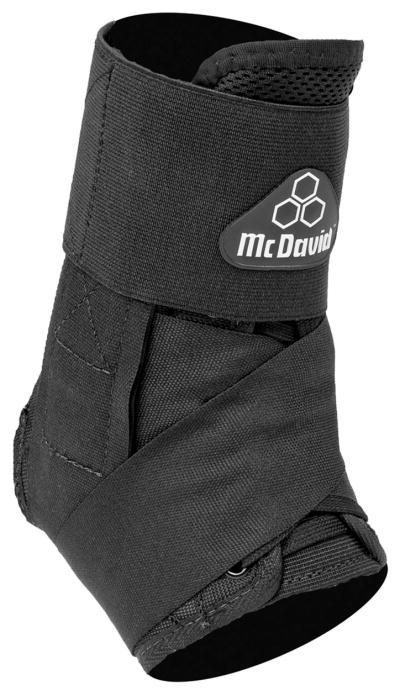
Background: Ankle injuries are the most common injury in basketball players. However, no prospective studies have been performed to determine if wearing lace-up ankle braces will reduce the incidence of ankle injuries in high school athletes.
Purpose: This trial was undertaken to determine if lace-up ankle braces reduce the incidence and severity of acute first-time and recurrent ankle injuries sustained by high school basketball players.
Design: Randomized controlled trial; Level of evidence, 1.
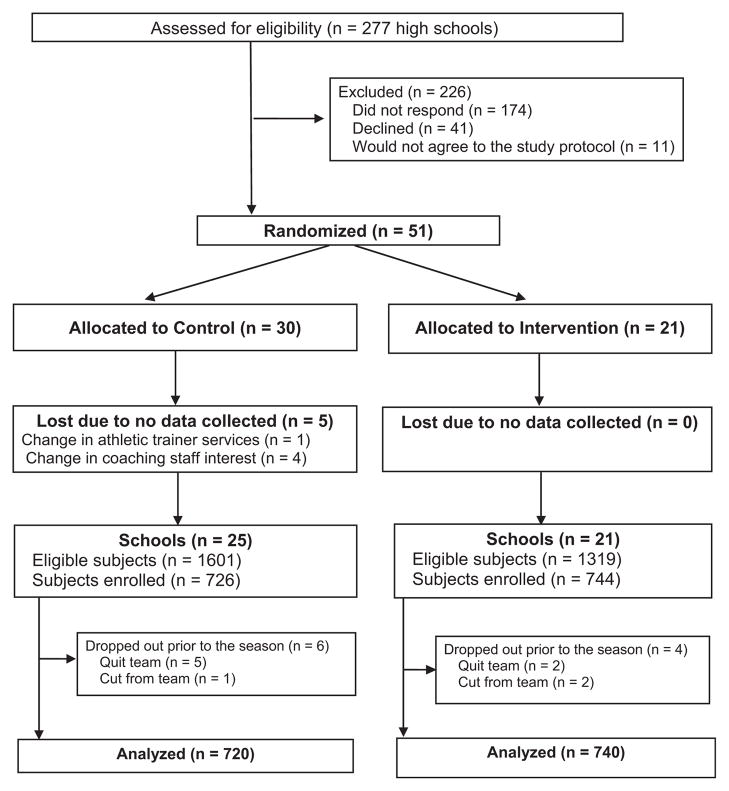
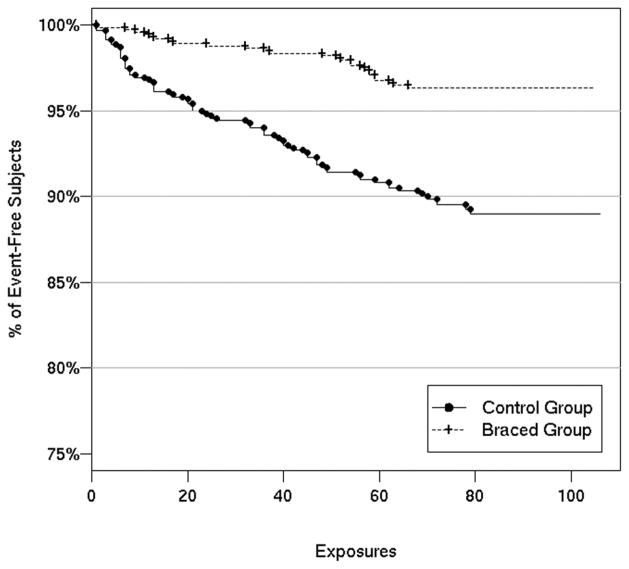
Methods: A total of 1460 male and female basketball players from 46 high schools were randomly assigned to a braced or control group. The braced group players wore lace-up ankle braces during the 2009-2010 basketball season. Athletic trainers recorded brace compliance, athlete exposures, and injuries. Cox proportional hazards models (adjusted for demographic covariates), accounting for intracluster correlation, were utilized to compare time to first acute ankle injury between groups. Injury severity (days lost) was tested with the Wilcoxon rank-sum test.
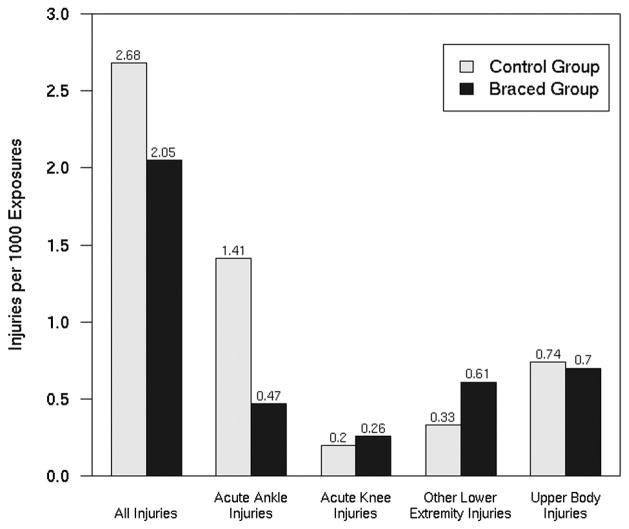
Results: The rate of acute ankle injury (per 1000 exposures) was 0.47 in the braced group and 1.41 in the control group (Cox hazard ratio [HR] 0.32; 95% confidence interval [CI] 0.20, 0.52; P < .001). The median severity of acute ankle injuries was similar (P = .23) in the braced (6 days) and control group (7 days). For players with a previous ankle injury, the incidence of acute ankle injury was 0.83 in the braced group and 1.79 in the control group (Cox HR 0.39; 95% CI 0.17, 0.90; P = .028). For players who did not report a previous ankle injury, the incidence of acute ankle injury was 0.40 in the braced group and 1.35 in the control group (Cox HR 0.30; 95% CI 0.17, 0.52, P < .001).
Conclusion: Use of lace-up ankle braces reduced the incidence but not the severity of acute ankle injuries in male and female high school basketball athletes both with and without a previous history of an ankle injury.
Figures
Comment in
-
Lace-up ankle braces reduced acute ankle injuries in high school basketball players.Clin J Sport Med. 2012 Jul;22(4):379-80. doi: 10.1097/JSM.0b013e3182603935. Clin J Sport Med. 2012. PMID: 22732347 No abstract available.
References
-
- Barrett J, Bilisko T. The role of shoes in the prevention of ankle sprains. Sports Med. 1995;20:277–280. - PubMed
-
- Borowski LA, Yard EE, Fields SK, Comstock RD. The epidemiology of US high school basketball injuries, 2005–2007. Am J Sports Med. 2008;36(12):2328–2335. - PubMed
-
- Cordova ML, Dorrough J, Kious K, Ingersoll C, Merrick M. Prophylactic ankle bracing reduces rearfoot motion during sudden inversion. Scand J Med Sci Sports. 2007;17:216–222. - PubMed
Publication types
MeSH terms
Grants and funding
LinkOut - more resources
Full Text Sources
Other Literature Sources
Medical
