. 2010 Jan 1;82(8):1609-1621.
doi: 10.1351/PAC-CON-09-09-29.

The role of G-quadruplex/i-motif secondary structures as cis-acting regulatory elements

Affiliations

The role of G-quadruplex/i-motif secondary structures as cis-acting regulatory elements

Samantha Kendrick et al. Pure Appl Chem. .

Abstract

The nature of DNA has captivated scientists for more than fifty years. The discovery of the double-helix model of DNA by Watson and Crick in 1953 not only established the primary structure of DNA, but also provided the mechanism behind DNA function. Since then, researchers have continued to further the understanding of DNA structure and its pivotal role in transcription. The demonstration of DNA secondary structure formation has allowed for the proposal that the dynamics of DNA itself can function to modulate transcription. This review presents evidence that DNA can exist in a dynamic equilibrium between duplex and secondary conformations. In addition, data demonstrating that intracellular proteins as well as small molecules can shift this equilibrium in either direction to alter gene transcription will be discussed, with a focus on the modulation of proto-oncogene expression.


Figures

Figure 1
Figure 1
Model of the transcriptionally induced supercoiling that occurs upstream and downstream of the RNAP. Adapted from Kouzine and Levens [12].
Figure 2
Figure 2
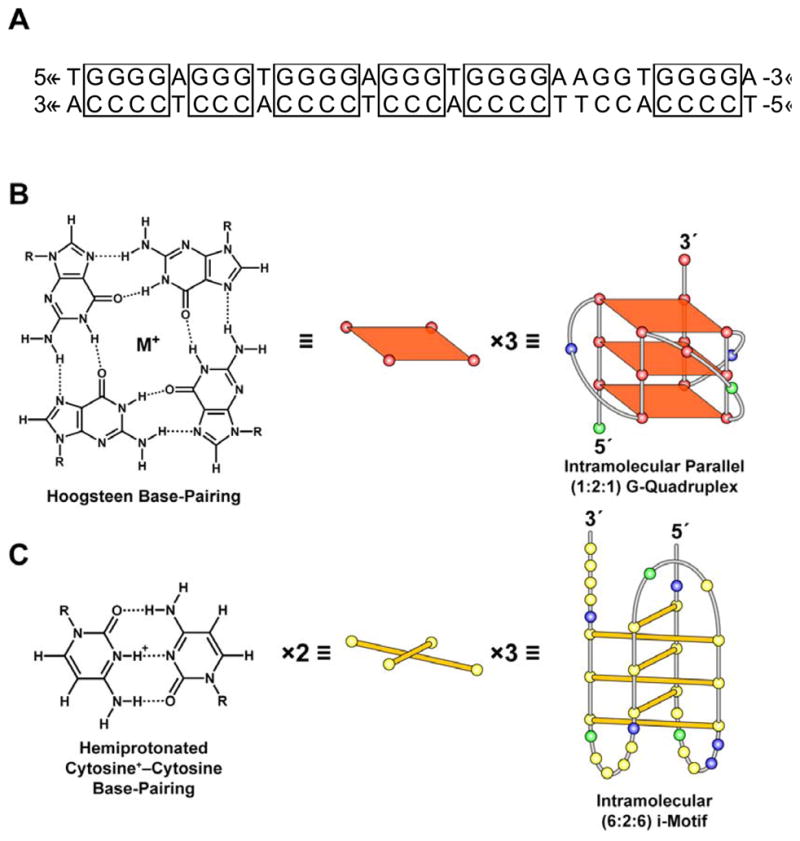
The c-myc GC-rich promoter sequence capable of adopting G-quadruplex and i-motif structures is provided in panel A. The building blocks of these secondary structures are guanine–guanine and cytosine+ –cytosine base pairings that give rise to the G-quadruplex (B) and i-motif (C) secondary structures. The previously proposed c-myc [9] G-quadruplex and i-motif structures formed under conditions of negative supercoiling serve as examples, with the yellow, green, red, and blue circles representing the nucleobases cytosine, adenine, guanine, and thymine, respectively.
Figure 3
Figure 3
The proposed model for the dynamic equilibrium of DNA topology induced by negative supercoiling. Negative supercoiling within duplex DNA (A) induces the local unwinding (B), which facilitates the transition from duplex DNA (A) to single-stranded (C) to G-quadruplex and i-motif DNA secondary formation (D).
Figure 4
Figure 4
A proposed model of c-myc transcriptional regulation that involves the resolution of the G-quadruplex by NM23-H2 for duplex DNA formation and subsequent transcriptional activation by Sp1. The binding of hnRNP K and CNBP to single-stranded DNA induced by negative supercoiling also leads to c-myc transcription activation. The stabilization of the G-quadruplex by nucleolin results in negative regulation of c-myc transcription.
Figure 5
Figure 5
The proposed folding patterns of the G-quadruplex structures formed within the c-myc, VEGF, c-kit-1, c-kit-2, RET, KRAS, hif-1α, bcl-2, and hTERT promoter regions. Structures were either determined by NMR (1) or biophysical methods (2), such as circular dichroism and DMS footprinting or both.

References

    1. Watson JD, Crick FHC. Nature. 1953;171:737–738. - PubMed
    1. Franklin RE, Gosling R. Nature. 1953;171:740–741. - PubMed
    1. Pohl FM, Jovin TM. J Mol Biol. 1972;67:375–396. - PubMed
    1. Wang AH-J, Quigley GJ, Kolpak FJ, Crawford JL, van Boom JH, van der Marel G, Rich A. Nature. 1979;282:680–686. - PubMed
    1. Drew H, Takano T, Tanaka T, Itakura K, Dickerson RE. Nature. 1980;286:567–573. - PubMed

LinkOut - more resources