Review
doi: 10.1631/jzus.B1101010.
Early reperfusion strategy for acute myocardial infarction: a need for clinical implementation
Affiliations
- PMID: 21796802
- PMCID: PMC3150715
- DOI: 10.1631/jzus.B1101010
Item in Clipboard
Review
Early reperfusion strategy for acute myocardial infarction: a need for clinical implementation
J Zhejiang Univ Sci B.
2011 Aug.
Abstract
Reperfusion is the key strategy in acute ST-segment elevation myocardial infarction (STEMI) care, and it is time-dependent. Shortening the time from symptom to reperfusion and choosing the optimal reperfusion strategy for STEMI patients are great challenges in practice. We need to improve upon the problems of low reperfusion rate, non-standardized treatment, and economic burden in STEMI care. This article briefly reviews the current status of reperfusion strategy in STEMI care, and also introduces what we will do to bridge the gap between the guidelines and implementation in the clinical setting through the upcoming China STEMI early reperfusion program.
Figures
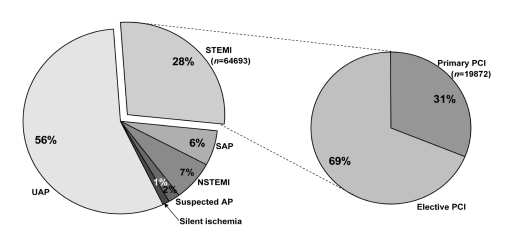
Numbers of patients receiving PCI procedures in China in 2010 AP: angina pectoris; SAP: stable angina pectoris; UAP: unstable angina pectoris; STEMI: ST-segment elevation myocardial infarction; NSTEMI: non ST-segment elevation myocardial infarction; PCI: percutaneous coronary intervention
References
-
- Assessment of the Safety and Efficacy of a New Treatment Strategy with Percutaneous Coronary Intervention (ASSENT-4 PCI) Investigators. Primary versus tenecteplase-facilitated percutaneous coronary intervention in patients with ST-segment elevation acute myocardial infarction (ASSENT-4 PCI): randomised trial. Lancet. 2006;367(9510):569–578. doi: 10.1016/S0140-6736(06)68147-6. - DOI - PubMed
-
- China Society of Cardiology of Chinese Medical Association, Editorial Board of Chinese Journal of Cardiology. Guideline for diagnosis and treatment of patients with ST-elevation myocardial infarction. Chin J Cardiol. 2010;38(8):675–690. (in Chinese) - PubMed
-
- Eagle KA, Nallamothu BK, Mehta RH, Granger CB, Steg PG, van de Werf F, López-Sendón J, Goodman SG, Quill A, Fox KA. Trends in acute reperfusion therapy for ST-segment elevation myocardial infarction from 1999 to 2006: we are getting better but we have got a long way to go. Eur Heart J. 2008;29(5):609–617. doi: 10.1093/eurheartj/ehn069. - DOI - PubMed
Publication types
MeSH terms
LinkOut - more resources
Full Text Sources
Medical
Miscellaneous