. 2011 Jul 28:8:373.
doi: 10.1186/1743-422X-8-373.

Molecular evolution of Azagny virus, a newfound hantavirus harbored by the West African pygmy shrew (Crocidura obscurior) in Côte d'Ivoire

Affiliations

Molecular evolution of Azagny virus, a newfound hantavirus harbored by the West African pygmy shrew (Crocidura obscurior) in Côte d'Ivoire

Hae Ji Kang et al. Virol J. .

Abstract

Background: Tanganya virus (TGNV), the only shrew-associated hantavirus reported to date from sub-Saharan Africa, is harbored by the Therese's shrew (Crocidura theresae), and is phylogenetically distinct from Thottapalayam virus (TPMV) in the Asian house shrew (Suncus murinus) and Imjin virus (MJNV) in the Ussuri white-toothed shrew (Crocidura lasiura). The existence of myriad soricid-borne hantaviruses in Eurasia and North America would predict the presence of additional hantaviruses in sub-Saharan Africa, where multiple shrew lineages have evolved and diversified.

Methods: Lung tissues, collected in RNAlater®, from 39 Buettikofer's shrews (Crocidura buettikoferi), 5 Jouvenet's shrews (Crocidura jouvenetae), 9 West African pygmy shrews (Crocidura obscurior) and 21 African giant shrews (Crocidura olivieri) captured in Côte d'Ivoire during 2009, were systematically examined for hantavirus RNA by RT-PCR.

Results: A genetically distinct hantavirus, designated Azagny virus (AZGV), was detected in the West African pygmy shrew. Phylogenetic analysis of the S, M and L segments, using maximum-likelihood and Bayesian methods, under the GTR+I+Γ model of evolution, showed that AZGV shared a common ancestry with TGNV and was more closely related to hantaviruses harbored by soricine shrews than to TPMV and MJNV. That is, AZGV in the West African pygmy shrew, like TGNV in the Therese's shrew, did not form a monophyletic group with TPMV and MJNV, which were deeply divergent and basal to other rodent- and soricomorph-borne hantaviruses. Ancestral distributions of each hantavirus lineage, reconstructed using Mesquite 2.74, suggested that the common ancestor of all hantaviruses was most likely of Eurasian, not African, origin.

Conclusions: Genome-wide analysis of many more hantaviruses from sub-Saharan Africa are required to better understand how the biogeographic origin and radiation of African shrews might have contributed to, or have resulted from, the evolution of hantaviruses.


Figures
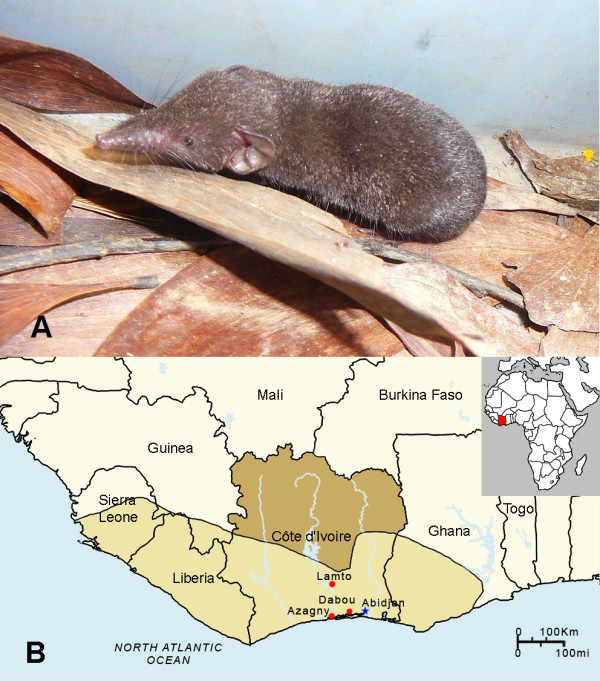
Figure 1
Figure 1
West African pygmy shrew and geographic distribution. (A) Crocidura obscurior (West African pygmy shrew). (B) Map of Côte d'Ivoire, showing sites where crocidurine shrews were captured in 2009, particularly Azagny National Park, where a West African pygmy shrew harboring a newfound hantavirus was captured. The geographic range of the West African pygmy shrew extends along the coast of Côte d'Ivoire and neighboring Ghana, Guinea, Liberia and Sierra Leone (shaded area).
Figure 2
Figure 2
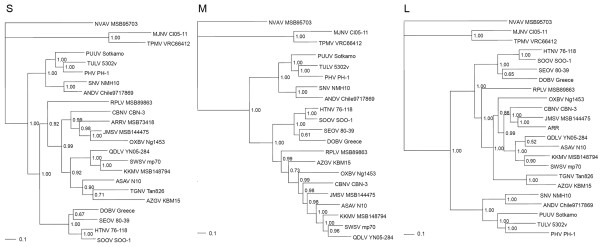
Phylogenetic trees. Similar tree topologies, based on the coding regions of the partial (S) 540-nucleotide S-, (M) 687-nucleotide M- and (L) 4,548-nucleotide L-genomic segments of AZGV, were generated by maximum-likelihood and Bayesian methods, under the GTR+I+Γ model of evolution. In these unrooted trees, the phylogenetic positions of AZGV are shown in relation to soricomorph-borne hantaviruses, including Tanganya virus (TGNV Tan826: EF050455, EF050454), Imjin virus (MJNV Cl05-11: EF641804, EF641798, EF641806), Thottapalayam virus (TPMV VRC66412: AY526097, EU001329, EU001330), Cao Bang virus (CBNV CBN-3: EF543524, EF543526, EF543525), Ash River virus (ARRV MSB73418: EF650086, EF619961), Jemez Springs virus (JMSV MSB144475: FJ593499, FJ593500, FJ593501), Seewis virus (SWSV mp70: EF636024, EF636025, EF636026), Kenkeme virus (KKMV MSB148794: GQ306148, GQ306149, GQ306150), Qiandao Lake virus (QDLV YN05-284: GU566023, GU566022, GU566021), Camp Ripley virus (RPLV MSB89863: FJ790772, EF540774, EF540771), Asama virus (ASAV N10: EU929072, EU929075, EU929078), Oxbow virus (OXBV Ng1453: FJ539166, FJ539167, FJ593497) and Nova virus (NVAV MSB95703: FJ539168, HQ840957, FJ593498). Also shown are Hantaan virus (HTNV 76-118: NC_005218, Y00386, NC_005222), Soochong virus (SOOV SOO-1: AY675349, AY675353, DQ562292), Dobrava virus (DOBV Greece: NC_005233, NC_005234, NC_005235), Seoul virus (SEOV HR80-39: NC_005236, NC_005237, NC_005238), Tula virus (TULV M5302v: NC_005227, NC_005228, NC_005226), Puumala virus (PUUV Sotkamo: NC_005224, NC_005223, NC_005225), Prospect Hill virus (PHV PH-1: Z49098, X55129, EF646763), Andes virus (ANDV Chile-9717869: NC_003466, NC_003467, NC_003468) and Sin Nombre virus (SNV NMH10: NC_005216, NC_005215, NC_005217). The numbers at each node are posterior probabilities, and the scale bars indicate nucleotide substitutions per site.
Figure 3
Figure 3
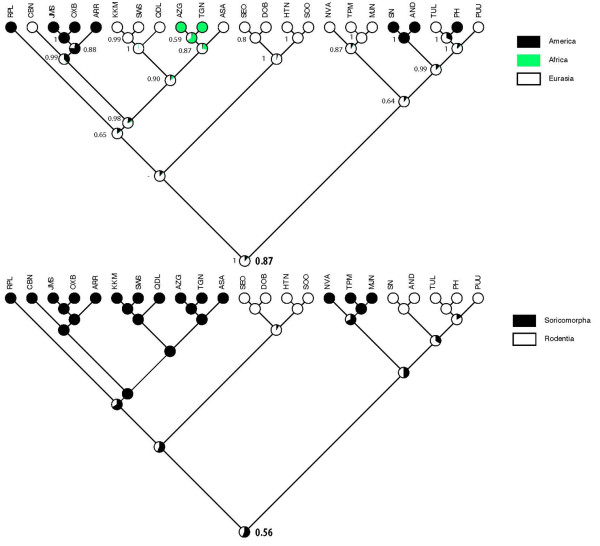
Phylogenetic distribution and reconstruction. Phylogenetic distribution and reconstruction of ancestral states for (A) the biogeographic origin (America, Eurasia or Africa) and (B) the host (Soricomorpha or Rodentia) of hantaviruses using Mesquite 2.74 (with a representation of ML supports for each state and node, and ML support [in bold] for the basal nodes). Bayesian posterior probabilities from BEAST are shown for each node in (A).

References

    1. Van Heuverswyn F, Peeters M. The origins of HIV and implications for the global epidemic. Curr Infect Dis Rep. 2007;9:338–346. doi: 10.1007/s11908-007-0052-x. - DOI - PubMed
    1. Sharp PM, Hahn BH. The evolution of HIV-1 and the origin of AIDS. Philos Trans R Soc Lond B Biol Sci. 2010;365:2487–2494. doi: 10.1098/rstb.2010.0031. - DOI - PMC - PubMed
    1. Leroy EM, Kumulungui B, Pourrut X, Rouquet P, Hassanin A, Yaba P, Délicat A, Paweska JT, Gonzalez JP, Swanepoel R. Fruit bats as reservoirs of Ebola virus. Nature. 2005;438:575–576. doi: 10.1038/438575a. - DOI - PubMed
    1. Biek R, Walsh PD, Leroy EM, Real LA. Recent common ancestry of Ebola Zaire virus found in a bat reservoir. PLoS Pathog. 2006;2:e90. doi: 10.1371/journal.ppat.0020090. - DOI - PMC - PubMed
    1. Frame JD, Baldwin JM Jr, Gocke DJ, Troup JM. Lassa fever, a new virus disease of man from West Africa. I. Clinical description and pathological findings. Am J Trop Med Hyg. 1970;19:670–676. - PubMed

Publication types

Associated data