. 2011 Jul 28:4:21.
doi: 10.1186/1754-6834-4-21.

Increased isobutanol production in Saccharomyces cerevisiae by overexpression of genes in valine metabolism

Affiliations

Increased isobutanol production in Saccharomyces cerevisiae by overexpression of genes in valine metabolism

Xiao Chen et al. Biotechnol Biofuels. .

Abstract

Background: Isobutanol can be a better biofuel than ethanol due to its higher energy density and lower hygroscopicity. Furthermore, the branched-chain structure of isobutanol gives a higher octane number than the isomeric n-butanol. Saccharomyces cerevisiae was chosen as the production host because of its relative tolerance to alcohols, robustness in industrial fermentations, and the possibility for future combination of isobutanol production with fermentation of lignocellulosic materials.

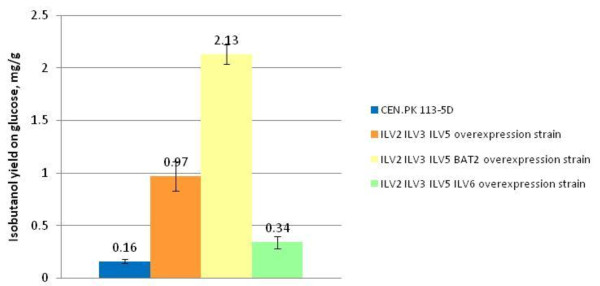
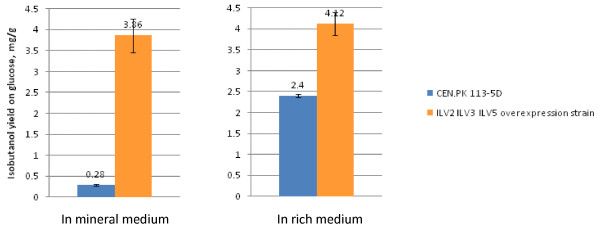
Results: The yield of isobutanol was improved from 0.16 to 0.97 mg per g glucose by simultaneous overexpression of biosynthetic genes ILV2, ILV3, and ILV5 in valine metabolism in anaerobic fermentation of glucose in mineral medium in S. cerevisiae. Isobutanol yield was further improved by twofold by the additional overexpression of BAT2, encoding the cytoplasmic branched-chain amino-acid aminotransferase. Overexpression of ILV6, encoding the regulatory subunit of Ilv2, in the ILV2 ILV3 ILV5 overexpression strain decreased isobutanol production yield by threefold. In aerobic cultivations in shake flasks in mineral medium, the isobutanol yield of the ILV2 ILV3 ILV5 overexpression strain and the reference strain were 3.86 and 0.28 mg per g glucose, respectively. They increased to 4.12 and 2.4 mg per g glucose in yeast extract/peptone/dextrose (YPD) complex medium under aerobic conditions, respectively.

Conclusions: Overexpression of genes ILV2, ILV3, ILV5, and BAT2 in valine metabolism led to an increase in isobutanol production in S. cerevisiae. Additional overexpression of ILV6 in the ILV2 ILV3 ILV5 overexpression strain had a negative effect, presumably by increasing the sensitivity of Ilv2 to valine inhibition, thus weakening the positive impact of overexpression of ILV2, ILV3, and ILV5 on isobutanol production. Aerobic cultivations of the ILV2 ILV3 ILV5 overexpression strain and the reference strain showed that supplying amino acids in cultivation media gave a substantial improvement in isobutanol production for the reference strain, but not for the ILV2 ILV3 ILV5 overexpression strain. This result implies that other constraints besides the enzyme activities for the supply of 2-ketoisovalerate may become bottlenecks for isobutanol production after ILV2, ILV3, and ILV5 have been overexpressed, which most probably includes the valine inhibition to Ilv2.


Figures
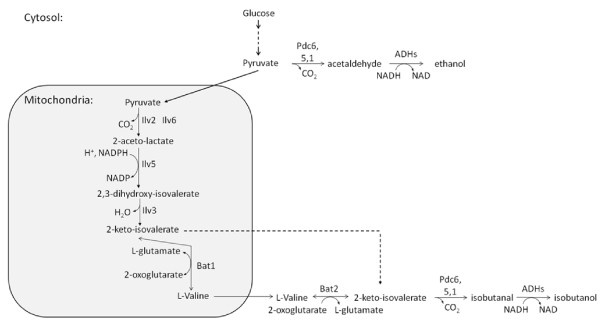
Figure 1
Figure 1
The metabolic pathways from pyruvate to isobutanol and ethanol in Saccharomyces cerevisiae. The enzymes that catalyse the pathway from pyruvate to L-valine in the mitochondria are: acetolactate synthase (Ilv2+Ilv6), acetohydroxyacid reductoisomerase (Ilv5), dihydroxyacid dehydratase (Ilv3), and branched-chain amino-acid aminotransferase (Bat1). Ilv2 is the catalytic subunit of acetolactate synthase, and Ilv6 is the regulatory subunit. The enzymes that catalyse the pathway from L-valine to isobutanol in the cytosol are pyruvate decarboxylases (Pdc6, 5, 1) and alcohol dehydrogenases (ADHs). Pyruvate decarboxylases and alcohol dehydrogenases also catalyse the pathway from pyruvate to ethanol in S. cerevisiae. The broken line indicates the export of 2-ketoisovalerate from mitochondria to cytosol.
Figure 2
Figure 2
Effects of overexpression of ILV genes on isobutanol yield under anaerobic conditions. Isobutanol yields (mg per g glucose) of the reference strain (CEN.PK 113-5D) and the ILV2 ILV3 ILV5, the ILV2 ILV3 ILV5 BAT2, and the ILV2 ILV3 ILV5 ILV6 overexpression strains were presented with columns with different colours, and the values are shown on the tops of each column. All cultivations were carried out in fermenters in mineral medium with 40 g glucose/l under anaerobic conditions.
Figure 3
Figure 3
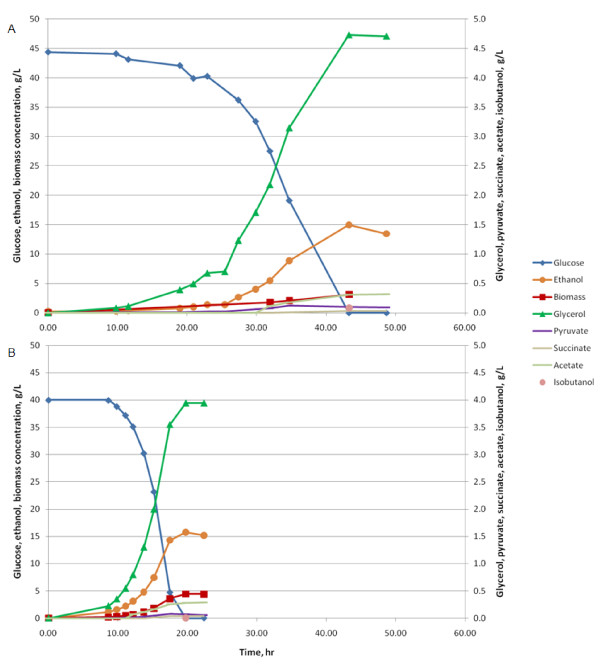
Time profiles of fermentations of ILV2 ILV3 ILV5 BAT2 overexpression (a) and reference strain (b). The ILV2 ILV3 ILV5 BAT2 overexpression strain and the reference strain CEN.PK 113-5D were cultivated under anaerobic batch fermentations in mineral medium with 40 g glucose/l. The concentrations of glucose, biomass, and products are plotted as a function of time. Isobutanol concentrations were measured after glucose depletion in both cases. Fermentations were performed in triplicate, representative cultivations are shown.
Figure 4
Figure 4
Effects of gene overexpression on isobutanol yield in various media under aerobic conditions. The isobutanol yields (mg per g glucose) of the reference strain (CEN.PK 113-5D) and the ILV2 ILV3 ILV5 overexpression strains are presented with columns with different colours, and the values are shown on the top of each column. All cultivations were carried out aerobically in shake flasks in either mineral medium with 40 g glucose/l or yeast extract/peptone/dextrose (YPD) complex medium with 17 g glucose/l.

References

    1. Connor MR, Liao JC. Microbial production of advanced transportation fuels in non-natural hosts. Curr Opin Biotechnol. 2009;20:307–315. doi: 10.1016/j.copbio.2009.04.002. - DOI - PubMed
    1. Cronk TC, Mattick LR, Steinkraus KH, Hackler LR. Production of higher alcohols during indonesian tape ketan fermentation. Appl Environ Microbiol. 1979;37:892–896. - PMC - PubMed
    1. Giudici P, Romano P, Zambonelli C. A biometric study of higher alcohol production in Saccharomyces cerevisiae. Can J Microbiol. 1990;36:61–64. doi: 10.1139/m90-012. - DOI - PubMed
    1. Atsumi S, Hanai T, Liao JC. Non-fermentative pathways for synthesis of branched-chain higher alcohols as biofuels. Nature. 2008;451:86–89. doi: 10.1038/nature06450. - DOI - PubMed
    1. Smith KM, Cho KM, Liao JC. Engineering Corynebacterium glutamicum for isobutanol production. Appl Microbiol Biotechnol. 2010;87:1045–1055. doi: 10.1007/s00253-010-2522-6. - DOI - PMC - PubMed