. 2011 Jan 24;1(1):2.
doi: 10.1186/2044-5040-1-2.

Treating cancer cachexia to treat cancer

Affiliations

Treating cancer cachexia to treat cancer

Se-Jin Lee et al. Skelet Muscle. .

Abstract

Skeletal muscle wasting is a major component of cachectic states found in a variety of disease settings, including cancer. As increasing caloric intake often provides little benefit in combating muscle loss in cachectic patients, a major research focus has been to develop strategies stimulating muscle anabolic pathways - in an attempt to fight the catabolic pathways induced during cachexia. Two recent papers have reported the beneficial effects of blocking the myostatin/activin signalling pathway in mouse models of cancer cachexia. We discuss the implications of their findings both with respect to the role that this signalling pathway may play in the aetiology of cachexia and with respect to the prospects for targeting this pathway as a therapeutic strategy in patients with cachexia.


Figures
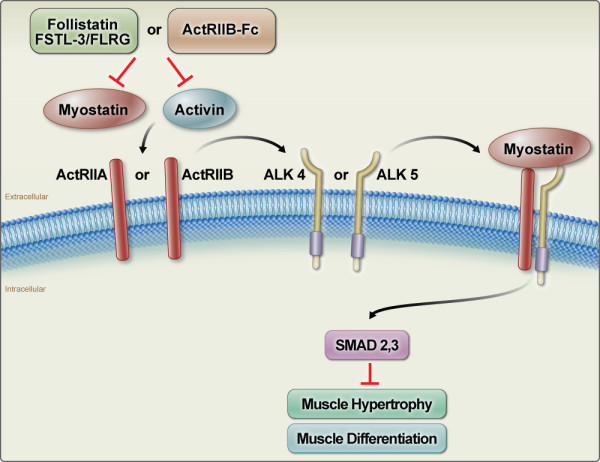
Figure 1
Figure 1
Inhibition of myostatin (MSTN) and activin signalling by the soluble activin type IIB receptor (ActRIB). MSTN and activin signal to target cells by binding initially to the two activin type II receptors, ActRIIA and/or ActRIIB (also called Acvr2 and Acvr2b, respectively) and then to the type I receptors, ALK4 and/or ALK5. The activated type I receptors phosphorylate the intracellular mediators of signalling, Smad2 and/or Smad3. Signalling through this pathway results in the inhibition of muscle differentiation and growth. The activities of MSTN and activin are regulated normally by a number of different extracellular binding proteins, such as follistatin and FSTL-3. The soluble form of ActRIIB (ActRIIB/Fc) can act as a ligand trap by binding MSTN and activin and preventing the ligands from binding to their true receptors.

References

    1. Glass DJ. Signaling pathways perturbing muscle mass. Curr Opin Clin Nutr Metab Care. 2010;13:225–229. doi: 10.1097/MCO.0b013e32833862df. - DOI - PubMed
    1. Benny Klimek ME, Aydogdu T, Link MJ, Pons M, Koniaris LG, Zimmers TA. Acute inhibition of myostatin-family proteins preserves skeletal muscle in mouse models of cancer cachexia. Biochem Biophys Res Commun. 2010;391:1548–1554. doi: 10.1016/j.bbrc.2009.12.123. - DOI - PubMed
    1. Zhou X, Wang JL, Lu J, Song Y, Kwak KS, Jiao Q, Rosenfeld R, Chen Q, Boone T, Simonet WS. et al. Reversal of cancer cachexia and muscle wasting by ActRIIB antagonism leads to prolonged survival. Cell. 2010;142:531–543. doi: 10.1016/j.cell.2010.07.011. - DOI - PubMed
    1. Lee S-J. Regulation of muscle mass by myostatin. Annu Rev Cell Dev Biol. 2004;20:61–86. doi: 10.1146/annurev.cellbio.20.012103.135836. - DOI - PubMed
    1. McPherron AC, Lawler AM, Lee S-J. Regulation of skeletal muscle mass in mice by a new TGF-β superfamily member. Nature. 1997;387:83–90. doi: 10.1038/387083a0. - DOI - PubMed
