Multicenter Study
. 2011 Sep;25(9):1207-18.
doi: 10.1038/eye.2011.175. Epub 2011 Jul 29.

Evaluation of early and late presentation of patients with ocular mucous membrane pemphigoid to two major tertiary referral hospitals in the United Kingdom

Affiliations
Multicenter Study

Evaluation of early and late presentation of patients with ocular mucous membrane pemphigoid to two major tertiary referral hospitals in the United Kingdom

G P Williams et al. Eye (Lond). 2011 Sep.

Abstract

Purpose: Ocular mucous membrane pemphigoid (OcMMP) is a sight-threatening autoimmune disease in which referral to specialists units for further management is a common practise. This study aims to describe referral patterns, disease phenotype and management strategies in patients who present with either early or established disease to two large tertiary care hospitals in the United Kingdom.

Patients and methods: In all, 54 consecutive patients with a documented history of OcMMP were followed for 24 months. Two groups were defined: (i) early-onset disease (EOD:<3 years, n=26, 51 eyes) and (ii) established disease (EstD:>5 years, n=24, 48 eyes). Data were captured at first clinic visit, and at 12 and 24 months follow-up. Information regarding duration, activity and stage of disease, visual acuity (VA), therapeutic strategies and clinical outcome were analysed.

Results: Patients with EOD were younger and had more severe conjunctival inflammation (76% of inflamed eyes) than the EstD group, who had poorer VA (26.7%=VA<3/60, P<0.01) and more advanced disease. Although 40% of patients were on existing immunosuppression, 48% required initiation or switch to more potent immunotherapy. In all, 28% (14) were referred back to the originating hospitals for continued care. Although inflammation had resolved in 78% (60/77) at 12 months, persistence of inflammation and progression did not differ between the two phenotypes. Importantly, 42% demonstrated disease progression in the absence of clinically detectable inflammation.

Conclusions: These data highlight that irrespective of OcMMP phenotype, initiation or escalation of potent immunosuppression is required at tertiary hospitals. Moreover, the conjunctival scarring progresses even when the eye remains clinically quiescent. Early referral to tertiary centres is recommended to optimise immunosuppression and limit long-term ocular damage.


Figures
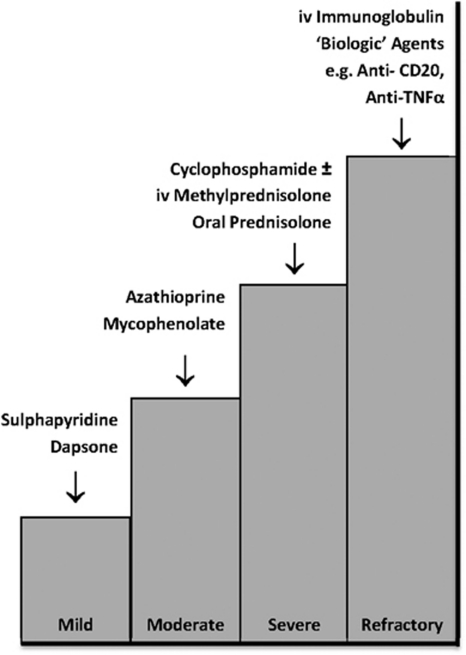
Figure 1
Figure 1
Immunosuppression strategies (based on Rauz et al). A step–ladder approach to treatment with agents having the fewest side effects to those that have the greatest side effects is adopted according to disease activity (mild, moderate or severe), which is used to guide therapy. Dapsone (25–50 mg twice a day) or sulphapyridine (500 mg twice a day) can be used for mild inflammation; azathioprine (1–2.5 mg/kg/day) or mycophenolate mofetil (500–1000 mg twice a day if intolerant to azathioprine) may be added or substituted for persistent disease. Severe inflammatory disease is treated with cyclophosphamide (1–2 mg/kg/day) and adjuvant prednisolone (1 mg/kg/day with or without supplementary loading doses of 1 g intravenous methylprednisolone preceding oral therapy) for up to 3 months until the optimal effects of cyclophosphamide have taken effect. Patients with refractory disease are managed through intravenous immunoglobulin or ‘biological' agents such as anti-CD 20 (rituximab) or anti-TNFα therapy.
Figure 2
Figure 2
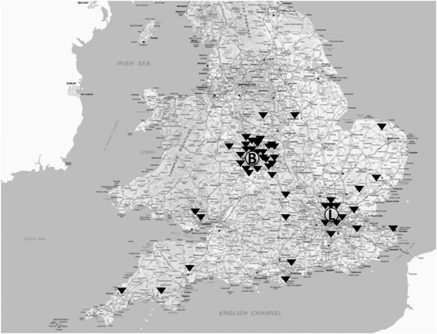
Map containing ordnance survey data (© Crown copyright and database right 2010) showing the combined geographical distribution of referrals (▾) to the two tertiary referral hospitals: Moorfields Eye Hospital, London, UK (circled, L) and the Birmingham and Midland Eye Centre, Birmingham, UK (circled, B). The furthest referral was for Newquay, Cornwall to Moorfields (238 miles).
Figure 3
Figure 3
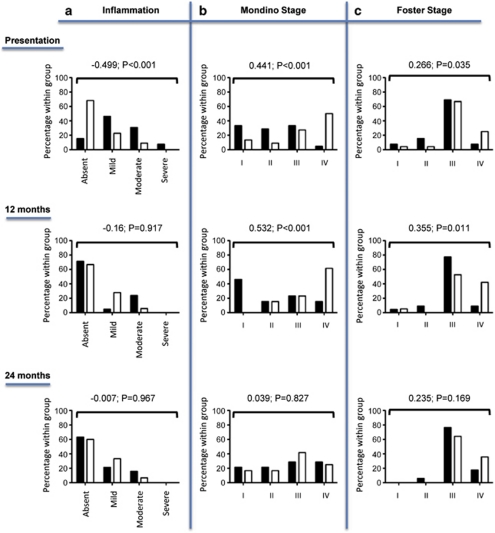
Cross-sectional analysis of clinically detected conjunctival inflammation (a) and ocular staging using Mondino (b) and Foster (c) systems in the worst eye at presentation, 12 months and 24 months follow-up in the EOD (▪) and EstD groups (□). Differences in the extent of conjunctival inflammation and stage of disease were compared between the two groups by rank correlation using Kendal's τ-b. At 12 months follow-up, inflammation had resolved in the majority of eyes within both groups, and there were no patients with severe inflammation. By 24 months, 30% of the remaining patients at the tertiary centres had residual inflammation not responsive to treatment. Note that patients in the EstD had more advanced stage of disease compared with the EOD throughout the follow-up period, but there was no difference in the progression rate (worsening of clinical stage of disease) between the two groups. NB 14 patients had been referred back to their original hospital by 24 months and 1 had died. These patients have been excluded from the analysis thereby accounting for the apparent increase in the percentage of patients at stage 1 and decrease in the percentage of patients at stage 4 disease during the 12 and 24 months according to the Mondino staging system.
Figure 4
Figure 4
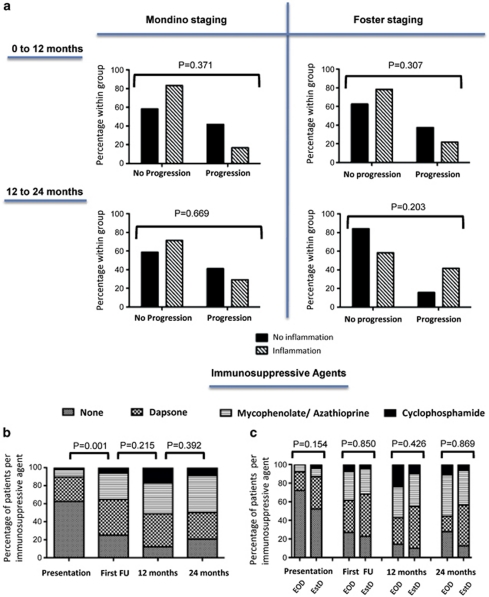
Progression rates, defined by worsening of either Mondino or Foster clinical staging of MMP, in the presence or absence of clinically detectable conjunctival inflammation are shown in the upper composite (a). Note there was no significant difference in progression between eyes with clinically detectable inflammation or those that were seemingly uninflamed (Fishers exact test). The percentage of patients requiring immunosuppression at presentation, following the first follow-up (FU) clinic visit, 12 months and 24 months follow-up time points are shown in the lower b and c. Immunosuppression strategies were ranked according to the hierarchy described by Rauz et al. Overall, a significant initiation or escalation in ‘strategic-step' was required at the first FU visit (b; McNemar's test), but this did not significantly differ when the early onset (EoD) and established disease (EstD) groups were compared (c; Kendal's τ-b). By 12 months follow-up, five patients stabilised on immunosuppression and were discharged back to their originating hospitals, and similarly a further 10 between the 12 and 24 months follow-up.
Figure 5
Figure 5
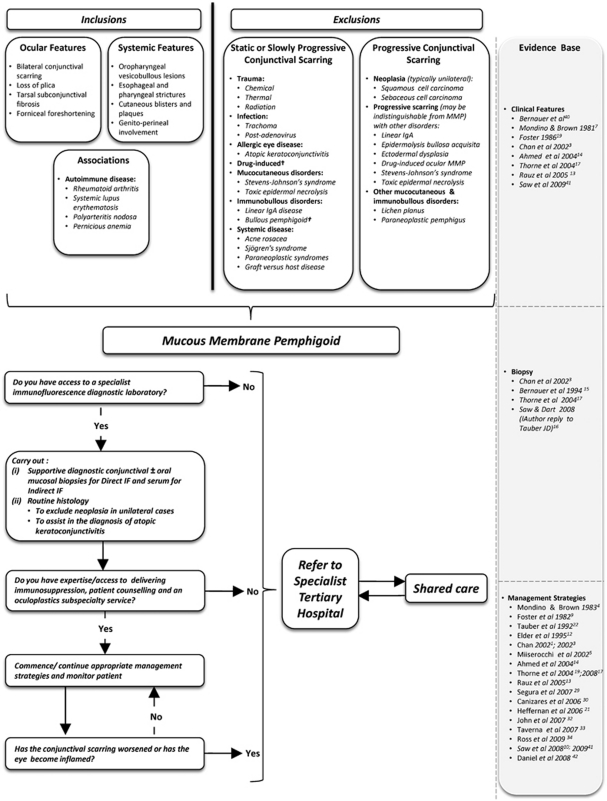
An algorithm highlighting clues to the diagnosis of OcMMP (ocular features, systemic involvement, autoimmune disease associations), together with differential diagnoses for conjunctival scarring subdivided into ‘static or slowly progressive' or ‘progressive' aetiologies is shown. A putative model for early referral to tertiary care hospitals is also suggested. †, A subset develop autoantibody-positive progressive conjunctival scarring similar to MMP; IF, immunofluorescence; MMP, mucous membrane pemphigoid.

Comment in

  • The evil curse of ocular pemphigoid.
    Hossain P. Hossain P. Eye (Lond). 2011 Sep;25(9):1107-8. doi: 10.1038/eye.2011.181. Eye (Lond). 2011. PMID: 21900957 Free PMC article. No abstract available.

References

    1. Chan LS. Mucous membrane pemphigoid. Clin Dermatol. 2001;19:703–711. - PubMed
    1. Risser J, Lewis K, Weinstock MA. Mortality of bullous skin disorders from 1979 through 2002 in the United States. Arch Dermatol. 2009;145 (9:1005–1008. - PubMed
    1. Chan LS, Ahmed AR, Anhalt GJ, Bernauer W, Cooper KD, Elder MJ, et al. The first international consensus on mucous membrane pemphigoid: definition, diagnostic criteria, pathogenic factors, medical treatment, and prognostic indicators. Arch Dermatol. 2002;138:370–379. - PubMed
    1. Mondino BJ, Brown SI. Immunosuppressive therapy in ocular cicatricial pemphigoid. Am J Ophthalmol. 1983;96:453–459. - PubMed
    1. Miserocchi E, Baltatzis S, Roque MR, Ahmed AR, Foster CS. The effect of treatment and its related side effects in patients with severe ocular cicatricial pemphigoid. Ophthalmology. 2002;109:111–118. - PubMed

Publication types

Substances