. 2011;6(7):e21842.
doi: 10.1371/journal.pone.0021842. Epub 2011 Jul 25.

Influence of early stress on social abilities and serotonergic functions across generations in mice

Affiliations

Influence of early stress on social abilities and serotonergic functions across generations in mice

Tamara B Franklin et al. PLoS One. 2011.

Abstract

Exposure to adverse environments during early development is a known risk factor for several psychiatric conditions including antisocial behavior and personality disorders. Here, we induced social anxiety and altered social recognition memory in adult mice using unpredictable maternal separation and maternal stress during early postnatal life. We show that these social defects are not only pronounced in the animals directly subjected to stress, but are also transmitted to their offspring across two generations. The defects are associated with impaired serotonergic signaling, in particular, reduced 5HT1A receptor expression in the dorsal raphe nucleus, and increased serotonin level in a dorsal raphe projection area. These findings underscore the susceptibility of social behaviors and serotonergic pathways to early stress, and the persistence of their perturbation across generations.


Conflict of interest statement

Competing Interests: This project is partially funded by Roche. This does not alter the authors' adherence to all the PLoS ONE policies on sharing data and materials.

Figures

Figure 1
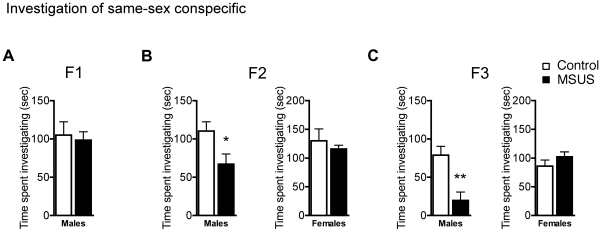
Figure 1. Abnormal sociability in F2 and F3 MSUS males.
a–c Level of investigation of a same-sex unfamiliar conspecific in (a) F1 MSUS and control males, and (b), F2 and (c) F3 MSUS and control males and females (F1: ns; F2 male: t(13) = 2.38, p<0.05; F2 female: ns; F3 male: t(21) = 3.73, p<0.01; F3 female: ns).
Figure 2
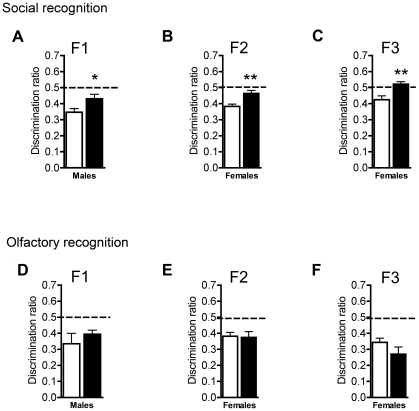
Figure 2. Abnormal social memory in F1, F2 and F3 MSUS mice.
a-c, Social recognition discrimination ratio in (a) F1, (b) F2, and (c) F3 control and MSUS mice (F1: t(14) = 2.224, p<0.05; F2: t(14) = 3.43, p<0.01; F3: t(13) = 3.52, p<0.01). d–f, Olfactory memory discrimination ratio in (d) F1 MSUS and control males, and (e) F2, and (f) F3 MSUS and control females. One-sample t-test demonstrates significant decrease from expected value (0.5) in F1, F2, and F3 MSUS and control mice in the olfactory recognition test. *, p<0.05, **, p<0.01 as indicated by unpaired t-test, or Fisher's PLSD post-hoc where appropriate.
Figure 3
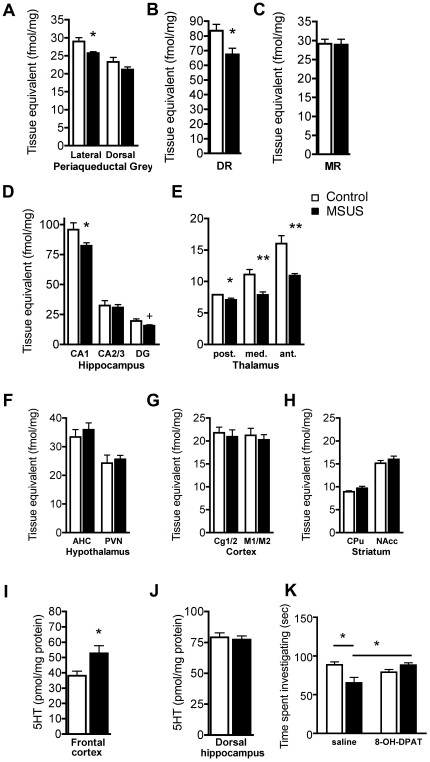
Figure 3. 5HT1AR binding and serotonin level in the brain of MSUS offspring.
a–e, 5HT1AR binding in (a) PAG, (b) DR, (c) MR, (d) hippocampus, (e) thalamus, (f) hypothalamus, (g) frontal cortex, and (h) striatum (lateral PAG: (t(8) = 2.79, p<0.05; DR: t(8) = 2.72, p<0.05; CA1: t(8) = 29.34, p<0.05; DG: t(8) = 2.26, p = 0.05); posterior thalamus: t(8) = 2.36, p<0.05; medial thalamus: t(8) = 3.67, p<0.01; anterior thalamus: t(8) = 3.81, p<0.01). Serotonin levels in (i) frontal cortex (t(16) = −2.54, p<0.05) and (j) dorsal hippocampus (t(16) = .43, ns) in MSUS and control males. (k) Effect of 8-OH-DPAT treatment on social exploration in MSUS and control males (F(1, 22) = 11.47, p<0.01). Abbreviations: Anterior hypothalamic area, AHC; anterior thalamus, ant. thal.; caudate putamen, CPu; cingulate cortex, Cg1/2; dentate gyrus, DG; dorsal raphe, DR; motor cortex, M1/M2; medial thalamus, med. thal.; median raphe, MR; nucleus accumbens, NAcc; paraventricular nucleus of the hypothalamus, PVN. periacqueductal grey, PAG; posterior thalamus, posterior thal. +, p = 0.05, *, p<0.05, **, p<0.01 as indicated by unpaired t-test, or Fisher's PLSD post-hoc when appropriate.
Figure 4
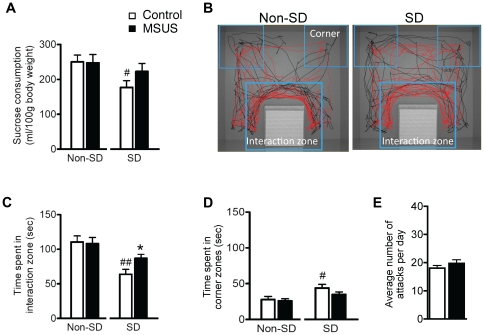
Figure 4. Altered response to social defeat in F2 MSUS males.
a, Sucrose consumption in F2 MSUS and control males subjected to SD and non-SD. b, Images of the SD test arena showing representative tracking of position and movements in defeated (SD, right) and non-defeated (non-SD, left) animals. Interaction and corner zones are outlined with blue boxes. Trace from a control male, black. Trace from a MSUS male, red. c, Time in the interaction zone, and (d) time in corners in F2 MSUS and control males subjected to SD and non-SD. e, Number of daily attacks over the 2-weeks of SD in F2 control and MSUS mice. # p<0.05, SD versus non-defeated (Non-SD) F2 MSUS or control males.* p<0.05, F2 MSUS versus F2 control within SD treatment, # p<0.05, ## p<0.001 SD versus non-SD F2 MSUS or F2 control animals.

References

    1. Beesdo K, Knappe S, Pine DS. Anxiety and anxiety disorders in children and adolescents: developmental issues and implications for DSM-V. Psychiatr Clin North Am. 2009;32:483–524. - PMC - PubMed
    1. Buwalda B, Geerdink M, Vidal J, Koolhaas JM. Neurosci Biobehav Rev; 2010. Social behavior and social stress in adolescence: A focus on animal models. - PubMed
    1. Knappe S, Lieb R, Beesdo K, Fehm L, Low NC, et al. The role of parental psychopathology and family environment for social phobia in the first three decades of life. Depress Anxiety. 2009;26:363–370. - PubMed
    1. McGowan ML, Lambrix MA. Are social networkers and genome testers one in the same? The limitations of public opinion research for guiding clinical practice. Am J Bioeth. 2009;9:21–23. - PMC - PubMed
    1. McGowan PO, Szyf M. The epigenetics of social adversity in early life: implications for mental health outcomes. Neurobiol Dis. 2010;39:66–72. - PubMed

Publication types