


A computational-experimental approach identifies mutations that enhance surface expression of an oseltamivir-resistant influenza neuraminidase
- PMID: 21799795
- PMCID: PMC3140507
- DOI: 10.1371/journal.pone.0022201
A computational-experimental approach identifies mutations that enhance surface expression of an oseltamivir-resistant influenza neuraminidase
Abstract
The His274→Tyr (H274Y) oseltamivir (Tamiflu) resistance mutation causes a substantial decrease in the total levels of surface-expressed neuraminidase protein and activity in early isolates of human seasonal H1N1 influenza, and in the swine-origin pandemic H1N1. In seasonal H1N1, H274Y only became widespread after the occurrence of secondary mutations that counteracted this decrease. H274Y is currently rare in pandemic H1N1, and it remains unclear whether secondary mutations exist that might similarly counteract the decreased neuraminidase surface expression associated with this resistance mutation in pandemic H1N1. Here we investigate the possibility of predicting such secondary mutations. We first test the ability of several computational approaches to retrospectively identify the secondary mutations that enhanced levels of surface-expressed neuraminidase protein and activity in seasonal H1N1 shortly before the emergence of oseltamivir resistance. We then use the most successful computational approach to predict a set of candidate secondary mutations to the pandemic H1N1 neuraminidase. We experimentally screen these mutations, and find that several of them do indeed partially counteract the decrease in neuraminidase surface expression caused by H274Y. Two of the secondary mutations together restore surface-expressed neuraminidase activity to wildtype levels, and also eliminate the very slight decrease in viral growth in tissue-culture caused by H274Y. Our work therefore demonstrates a combined computational-experimental approach for identifying mutations that enhance neuraminidase surface expression, and describes several specific mutations with the potential to be of relevance to the spread of oseltamivir resistance in pandemic H1N1.
Conflict of interest statement
Figures
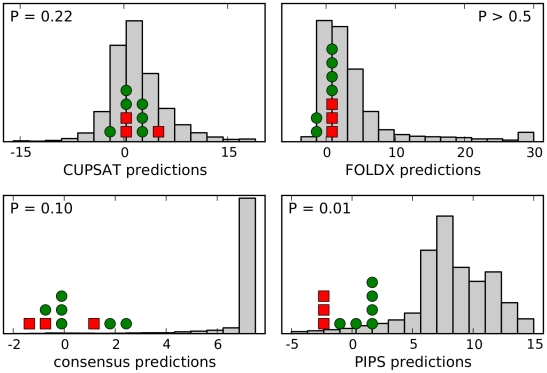
 -values for the hypothesis that the prediction method assigns more negative values to the known enhancing mutations (red squares) than the other six mutations (green circles), as determined using the Mann-Whitney test. The most successful computational approach appears to be PIPS, which correctly places all three red squares to the left of all six green circles.
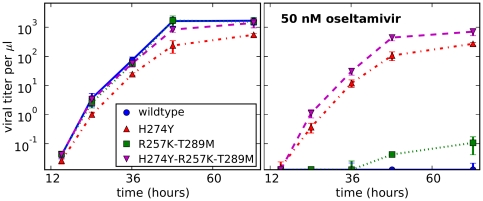
 infectious particles per cell. At the indicated times, viral supernatants were harvested and titered on fresh cells. Shown are the mean and standard error for four replicates.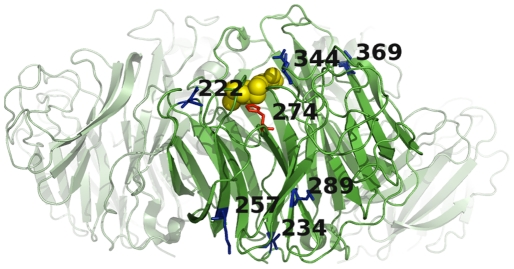
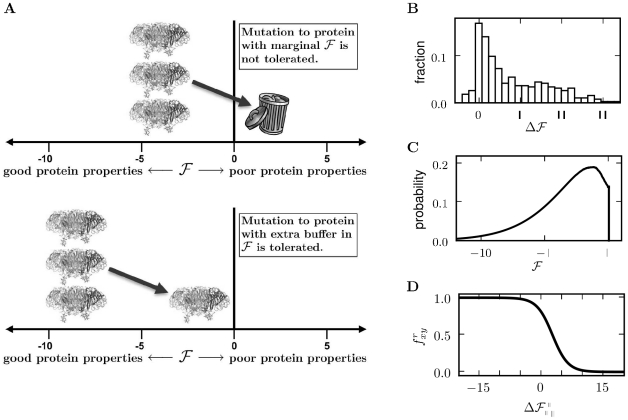
 ). A mutation deleterious to
  will not be tolerated by a protein that has a marginal value of
  (top panel). But the same mutation is tolerated by a protein with an extra buffer in
  (bottom panel). (B) Most mutations are deleterious to
  , and therefore have positive
  values. Shown is an example distribution of
  for all mutations to a protein, taken from . (C) The time-averaged probability distribution of
  for an evolving protein will tend towards values just marginally below the threshold. Shown is an example of this distribution, taken from . (D) As a consequence, mutations with negative
  values will generally be tolerated, but those with positive
  are less likely to be tolerated. Shown is a plot of the relationship between the probability
  that mutating residue
  from
from  to
to  will be tolerated as a function of the associated
  value, as defined in Equation 3.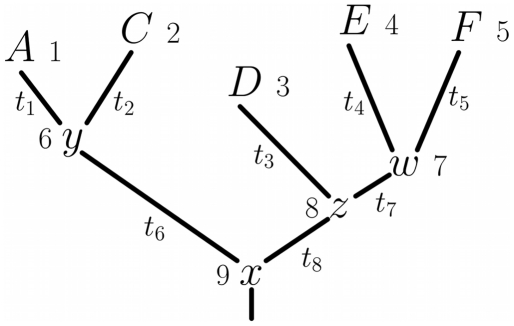
 for five sequences at a single site
  . The amino acid codes at the tips of the branches (
 ,
,  ,
,  ,
,  , and
, and  ) show the residue identities for the five sequences at this site. The variables at the internal nodes (
 ,
,  ,
,  ,
,  ) are the amino acid identities at the site for the ancestral sequences, and must be inferred. The numbers next to the nodes are unique identifiers for the nodes. The branch lengths (
 ,
,  ,…) are proportional to the time since the divergence of the sequences.
References
-
- Wang X, Minasov G, Shoichet BK. Evolution of an antibiotic resistance enzyme constrained by stability and activity trade–offs. J Mol Biol. 2002;320:85–95. - PubMed
-
- Weinreich DM, Delaney NF, DePristo MA, Hartl DL. Darwinian evolution can follow only very few mutational paths to fitter proteins. Science. 2006;312:111–114. - PubMed
Publication types
MeSH terms
Substances
Grants and funding
LinkOut - more resources
Full Text Sources
Other Literature Sources
