


Levels of spending and resource allocation to HIV programs and services in Latin America and the Caribbean
- PMID: 21799839
- PMCID: PMC3142155
- DOI: 10.1371/journal.pone.0022373
Levels of spending and resource allocation to HIV programs and services in Latin America and the Caribbean
Abstract
Background: An estimated 1.86 million people are living with HIV in Latin America and the Caribbean (LAC). The region is comprised of mainly middle-income countries with steady economic growth while simultaneously there are enormous social inequalities and several concentrated AIDS epidemics. This paper describes HIV spending patterns in LAC countries including analysis of the levels and patterns of domestic HIV spending from both public and international sources.
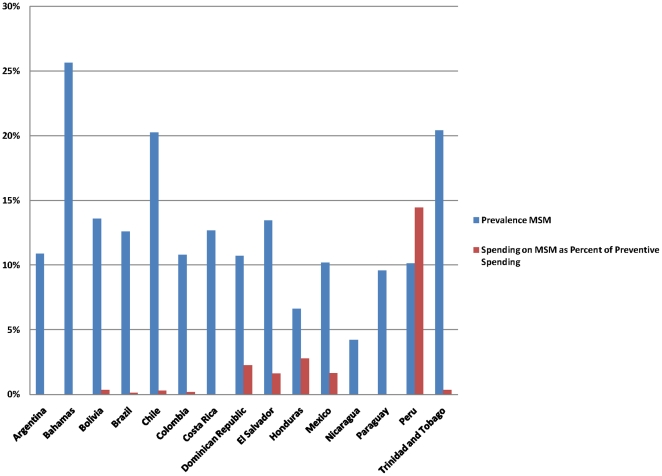
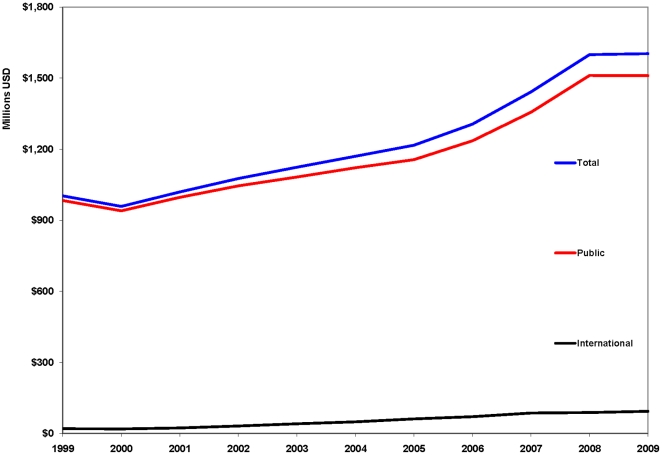
Methods and findings: We conducted an extensive analysis of the most recently available data from LAC countries using the National AIDS Spending Assessment tool. The LAC countries spent a total of US$ 1.59 billion on HIV programs and services during the latest reported year. Countries providing detailed information on spending showed that high percentages are allocated to treatment and care (75.1%) and prevention (15.0%). Domestic sources accounted for 93.6 percent of overall spending and 79 percent of domestic funds were directed to treatment and care. International funds represented 5.4 percent of total HIV funding in the region, but they supplied the majority of the effort to reach most-at-risk-populations (MARPs). However, prevalence rates among men who have sex with men (MSM) still reached over 25 percent in some countries.
Conclusions: Although countries in the region have increasingly sustained their response from domestic sources, still there are future challenges: 1) The growing number of new HIV infections and more people-living-with-HIV (PLWH) eligible to receive antiretroviral treatment (ART); 2) Increasing ART coverage along with high prices of antiretroviral drugs; and 3) The funding for prevention activities among MARPs rely almost exclusively on external donors. These threats call for strengthened actions by civil society and governments to protect and advance gains against HIV in LAC.
Conflict of interest statement
Figures
References
-
- HIV/AIDS in Latin America and the Caribbean. Lancet. 2008;372:263. - PubMed
-
- Bastos FI, Caceres C, Galvao J, Veras MA, Castilho EA. AIDS in Latin America: assessing the current status of the epidemic and the ongoing response. International Journal of Epidemiology. 2008;37:729–737. - PubMed
-
- Organization for Economic Co-operation and Development. System of Health Accounts. Paris: OECD; 2000. Available: http://www.oecd.org/dataoecd/41/4/1841456.pdf. Accessed 2010 March 10.
-
- World Bank & World Health Organization & USAID. A Guide to Producing National Health Accounts: with special applications for low-income and middle-income countries. Geneva: World Health Organization; 2003.
MeSH terms
LinkOut - more resources
Full Text Sources
Medical
Miscellaneous
