Review
. 2011:12:187-215.
doi: 10.1146/annurev-genom-082509-141802.

LINE-1 elements in structural variation and disease

Affiliations
Review

LINE-1 elements in structural variation and disease

Christine R Beck et al. Annu Rev Genomics Hum Genet. 2011.

Abstract

The completion of the human genome reference sequence ushered in a new era for the study and discovery of human transposable elements. It now is undeniable that transposable elements, historically dismissed as junk DNA, have had an instrumental role in sculpting the structure and function of our genomes. In particular, long interspersed element-1 (LINE-1 or L1) and short interspersed elements (SINEs) continue to affect our genome, and their movement can lead to sporadic cases of disease. Here, we briefly review the types of transposable elements present in the human genome and their mechanisms of mobility. We next highlight how advances in DNA sequencing and genomic technologies have enabled the discovery of novel retrotransposons in individual genomes. Finally, we discuss how L1-mediated retrotransposition events impact human genomes.


Figures
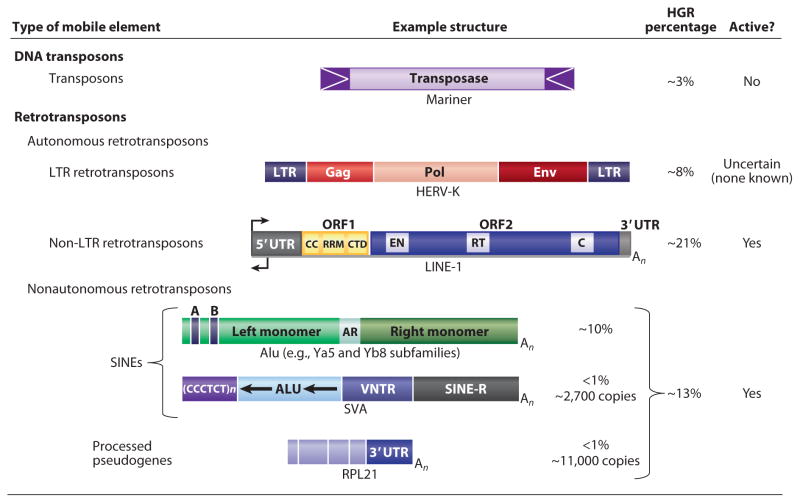
Figure 1
Figure 1
The classes of mobile genetic elements in the human genome, showing the type of mobile element, the structure of representative elements, the percentage of each element in the human genome reference sequence (HGR), and whether each class of elements is currently active (134). Abbreviations for human endogenous retrovirus-K (HERV-K): LTR, long terminal repeat; Gag, group-specific antigen; Pol, polymerase; Env, envelope protein (dysfunctional). For LINE-1: UTR, untranslated region; CC, coiled coil; RRM, RNA recognition motif; CTD, carboxyl-terminal domain; EN, endonuclease; RT, reverse transcriptase; C, cysteine-rich domain. For Alu: A and B, component sequences of the RNA polymerase III promoter; AR, the adenosine-rich segment separating the 7SL monomers. For SINE-R/VNTR/Alu (SVA): VNTR, variable number of tandem repeats; SINE-R, domain derived from a HERV-K. An signifies a poly(A) tail.
Figure 2
Figure 2
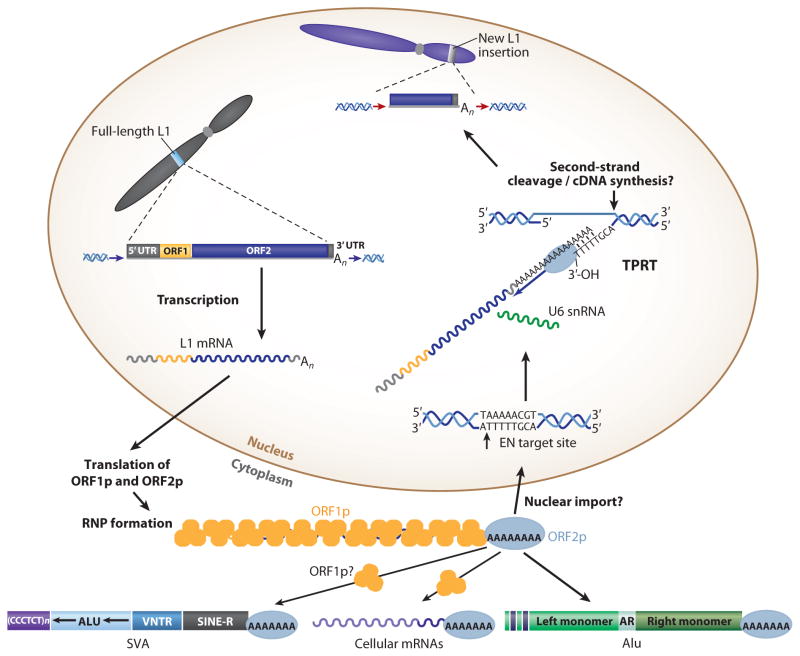
A LINE-1 retrotransposition cycle. A full-length L1 (light blue bar on gray chromosome) is transcribed, the L1 messenger RNA (mRNA) is exported to the cytoplasm, and translation of ORF1p ( yellow circles) and ORF2p (blue oval ) leads to ribonucleoprotein (RNP) formation. Components of the L1 RNP are transported to the nucleus, and retrotransposition occurs by target-site primed reverse transcription (TPRT). During TPRT, the L1 endonuclease (EN) nicks genomic DNA, exposing a free 3′-OH that can serve as a primer for reverse transcription of the L1 RNA. The processes of second-strand cleavage, second-strand complementary DNA (cDNA) synthesis, and completion of L1 integration require elucidation. TPRT results in the insertion of a new, often 5′-truncated L1 copy at a new genomic location ( gray bar on purple chromosome) that generally is flanked by target-site duplications (red arrows). Alu, SINE-R/VNTR/Alu (SVA), and cellular mRNAs may hijack the L1-encoded protein(s) in the cytoplasm to mediate their trans mobilization. U6 small nuclear RNA (snRNA) may be integrated with L1 during TPRT. Question marks denote steps in the retrotransposition pathway of unknown mechanism.
Figure 3
Figure 3
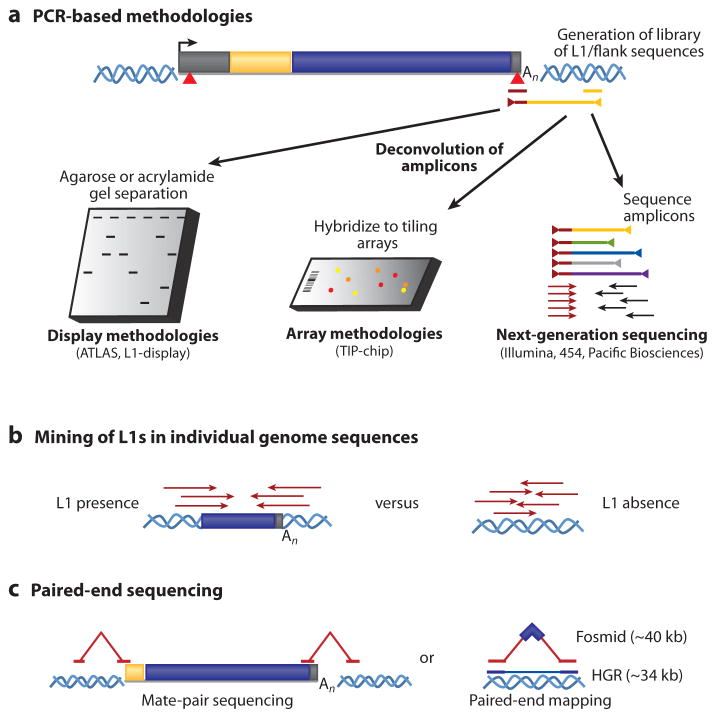
Methods to detect LINE-1-mediated polymorphic human retrotransposition events in individual genomes. Modifications of these assays can also be used to identify other polymorphic retrotransposons in human DNA. (a) Polymerase chain reaction (PCR)–based methodologies. PCR using primers specific to diagnostic sequence variants in the L1 (red triangles and the corresponding maroon primer) and arbitrary oligonucleotides or primers complementary to ligated linkers ( yellow line) can be used to amplify human-specific L1s and their associated flanking sequences (maroon/yellow line flanked by triangles). The amplicon libraries are then resolved using electrophoresis, and individual products are cloned and sequenced (left). Alternatively, the amplicons can be hybridized to genome tiling microarrays (center), or directly characterized using high-throughput sequencing methodologies (right). Abbreviations: ATLAS, amplification typing of L1 active subfamilies; TIP-chip, transposon insertion profiling by microarray. (b) Mining of L1s in individual genome sequences. Whole-genome sequences, comparative genomics, or mining trace sequence databases can discover dimorphic L1s in individual genomes that are absent from reference genome assemblies. (c) Paired-end sequencing. Mate-pair reads containing one sequence from a uniquely mapping portion of genomic DNA and one sequence from an L1 can be used to identify novel retrotransposons (left) in individual genomes. Paired-end sequencing of fosmid inserts with restricted size distributions (~40 kb) allows the discovery of novel ~6-kb insertions (right) as well as deletions and inversions relative to a reference sequence. Fosmids containing insertions can then be screened for the presence of human-specific L1s. Abbreviation: HGR, human genome reference sequence. These methods are also described in another recent review (182).
Figure 4
Figure 4
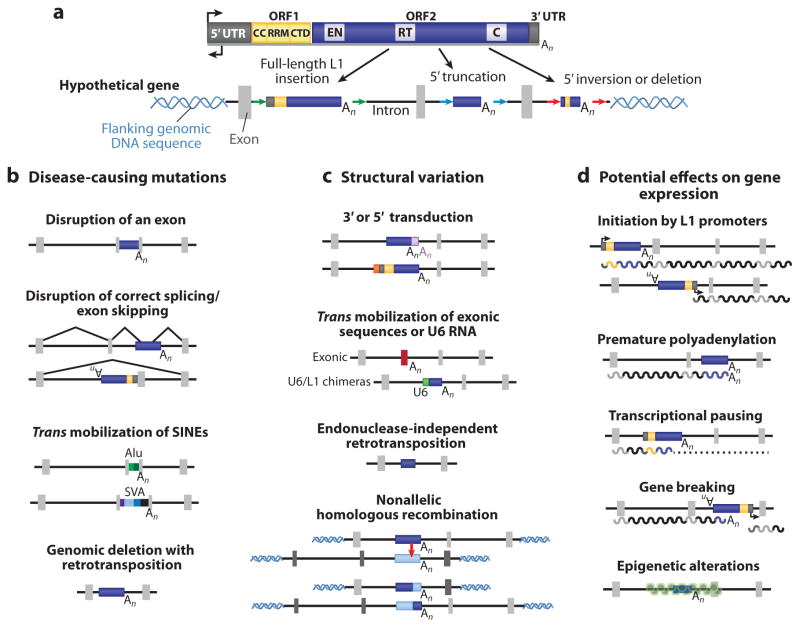
Schematics highlighting the various ways that LINE-1-mediated retrotransposition events can impact the human genome. (a) A hypothetical wild-type gene locus. Light-gray rectangles represent exons, black lines represent introns, and helical lines represent flanking genomic DNA sequence. A full-length (left), 5′-truncated (center), and inverted or deleted L1 formed by twin priming (right) (189) are shown as intronic insertions. The arrows indicate target-site duplications (TSDs), and for simplicity are shown only in this panel. (b) Examples of L1-mediated processes that may result in disease. (c) Examples of structural variation caused by L1 insertions. The transduction figures show a 3′ transduction in light purple with its own poly(A) tail, and a 5′ transduction in orange. The nonallelic homologous recombination figure shows L1s at different loci (light and dark gray exons) acting as substrates for aberrant recombination (red arrow). (d ) Potential effects on gene expression caused by L1 insertion. Note that L1s in all the depicted events would generally contain TSDs, with the exception of endonuclease (EN)–independent retrotransposition events and some genomic deletions. Abbreviations: C, cysteine-rich domain; CC, coiled coil; CTD, carboxyl-terminal domain; RRM, RNA recognition motif; RT, reverse transcriptase; SVA, SINE-R/VNTR/Alu; UTR, untranslated region.

References

    1. Alisch RS, Garcia-Perez JL, Muotri AR, Gage FH, Moran JV. Unconventional translation of mammalian LINE-1 retrotransposons. Genes Dev. 2006;20:210–24. - PMC - PubMed
    1. Alves G, Tatro A, Fanning T. Differential methylation of human LINE-1 retrotransposons in malignant cells. Gene. 1996;176:39–44. - PubMed
    1. Arcot SS, Wang Z, Weber JL, Deininger PL, Batzer MA. Alu repeats: a source for the genesis of primate microsatellites. Genomics. 1995;29:136–44. - PubMed
    1. Asch HL, Eliacin E, Fanning TG, Connolly JL, Bratthauer G, Asch BB. Comparative expression of the LINE-1 p40 protein in human breast carcinomas and normal breast tissues. Oncol Res. 1996;8:239–47. - PubMed
    1. Athanikar JN, Badge RM, Moran JV. A YY1-binding site is required for accurate human LINE-1 transcription initiation. Nucleic Acids Res. 2004;32:3846–55. - PMC - PubMed

Publication types

LinkOut - more resources