


GP referral of patients with osteoarthritis for consideration of total joint replacement: a longitudinal study
- PMID: 21801538
- PMCID: PMC3145529
- DOI: 10.3399/bjgp11X588420
GP referral of patients with osteoarthritis for consideration of total joint replacement: a longitudinal study
Abstract
Background: Individuals with hip or knee osteoarthritis (OA) are referred to orthopaedic surgeons if considered by their GP as potential candidates for total joint replacement (TJR). It is not clear which patients end up having this surgery.
Aim: The aim of the study was to investigate symptom variation in individuals with OA newly referred by GPs to an orthopaedic surgeon for consideration for TJR, and to determine the predictors of having this procedure.
Design and setting: A longitudinal study of patients at a regional orthopaedic centre with follow-up at 3, 6, and 12 months by postal questionnaire.
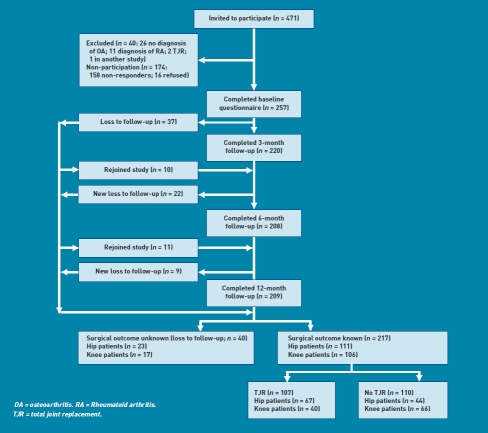
Method: GP referrals of patients with OA to orthopaedic surgeons were consecutively sampled. Of the 431 eligible patients, 257 (59.6%) were recruited. Validated measurement tools were used to measure pain, physical functioning, severity of OA, and health-related quality of life.
Results: Over half the participants were in constant pain, taking pain medication more than once per day. Only 67 of 134 (50%) hip and 40 of 123 (33%) knee patients had a TJR within 12 months. Those who had a replacement had been diagnosed with OAfora shorter time, reported more frequent pain, were more likely to use a walking stick, and had worse pain, stiffness, and physical functioning.
Conclusion: Many individuals considered for TJR ultimately may not have surgery, and more effective strategies of management need to be developed between primary and secondary care to achieve better outcomes and to improve quality of care.
Figures
References
-
- Birchfield PC. Osteoarthritis overview. Geriatr Nurs. 2001;22(3):124–130. - PubMed
-
- Victor CR, Ross F, Axford J. Capturing lay perspectives in a randomized control trial of a health promotion intervention for people with osteoarthritis of the knee. J Eval Clin Prac. 2004;10(1):63–70. - PubMed
-
- McHugh GA, Luker KA, Campbell M, et al. A longitudinal study exploring pain control, treatment and service provision for individuals with end-stage lower limb osteoarthritis. Rhuematology. 2007;46(4):631–637. - PubMed
-
- Fitzpatrick R, Shortall E, Sculpher M, et al. Primary total hip replacement surgery: a systematic review of outcomes and modelling of cost-effectiveness associated with different prosthesis. Health Technol Assess. 1998;2(20):1–64. - PubMed
-
- Hawker G, Wright J, Coyte P, et al. Health-related quality of life after knee replacement. Results of the knee replacement patient outcomes research team study. J Bone Joint Surg Am. 1998;80(2):163–173. - PubMed
MeSH terms
Grants and funding
LinkOut - more resources
Full Text Sources
Medical
