Review
. 2011 Jun;22(3):121-30.
doi: 10.1016/j.cytogfr.2011.06.001. Epub 2011 Jul 29.

CXCL10/IP-10 in infectious diseases pathogenesis and potential therapeutic implications

Affiliations
Review

CXCL10/IP-10 in infectious diseases pathogenesis and potential therapeutic implications

Mingli Liu et al. Cytokine Growth Factor Rev. 2011 Jun.

Abstract

C-X-C motif chemokine 10 (CXCL10) also known as interferon γ-induced protein 10 kDa (IP-10) or small-inducible cytokine B10 is a cytokine belonging to the CXC chemokine family. CXCL10 binds CXCR3 receptor to induce chemotaxis, apoptosis, cell growth and angiostasis. Alterations in CXCL10 expression levels have been associated with inflammatory diseases including infectious diseases, immune dysfunction and tumor development. CXCL10 is also recognized as a biomarker that predicts severity of various diseases. A review of the emerging role of CXCL10 in pathogenesis of infectious diseases revealed diverse roles of CXCL10 in disease initiation and progression. The potential utilization of CXCL10 as a therapeutic target for infectious diseases is discussed.


Figures

Fig. 1
Fig. 1
A model of CXCL10 signaling in human airway epithelial cells and vascular pericytes. ERK and p38 MAPK and PI3K/Akt , , are all activated by interaction of CXCL10 with its receptor CXCR3. P38, PI3K/Akt and cAMP-dependent protein kinase A (PKA) signaling pathways appear to regulate chemotaxis in human eosinophils, pneumocyte and epithelial cells. Activation of Ras/ERK, Src and PI3K/Akt , controls cell migration and proliferation in human vascular pericytes.
Fig. 2
Fig. 2
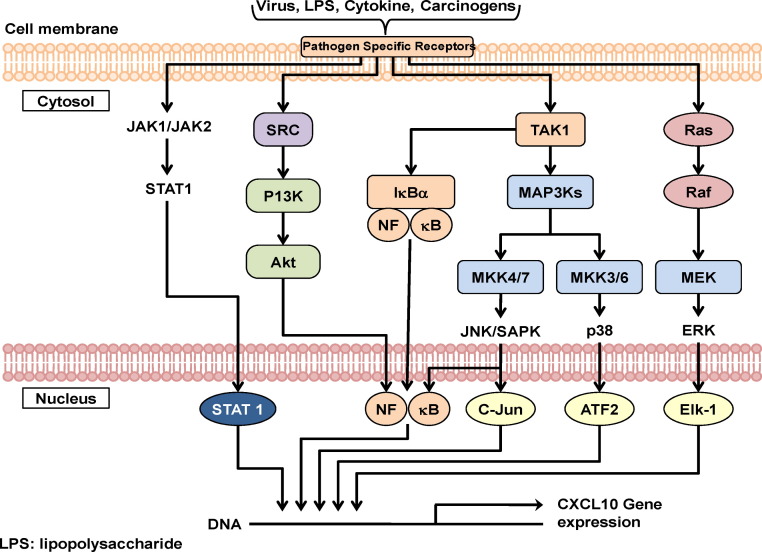
Schematic model of the signaling pathways involved in the induction of CXCL10 in human macrophages, microglia, epithelial and cancer cells in response to various stimulus. The major signaling pathways activated include p38, JNK, ERK, Akt and NFκB , , , , . The activation of corresponding downstream nuclear signaling of above molecules, along with the activation of STAT1, results in the transcription of CXCL10 , . P38 and ERK are able to converge on NFκB (not shown for clarity).
Fig. 3
Fig. 3
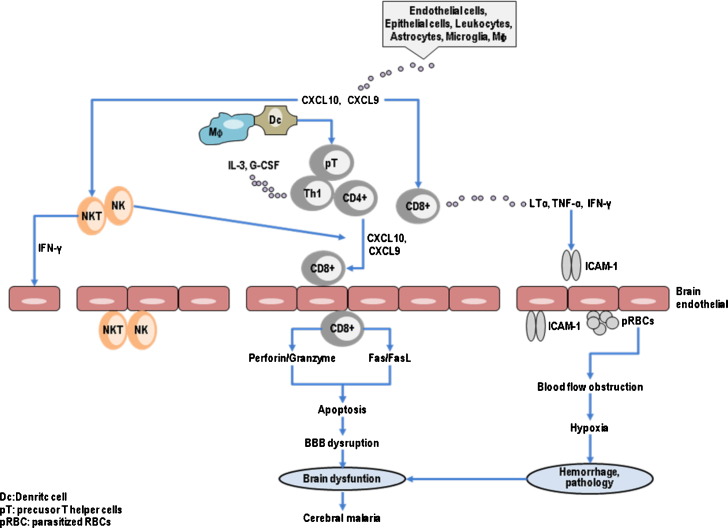
Proposed cellular pathway of CXCL10-mediated severe malaria. Endothelial cell, astrocytes and microglia are a prominent source of CXCL10 and CXCL9. (1) Through T cells sequestration , , , . CXCL10 could attract activated T cells and mediate Th1-type response, characterized by the sequestration of monocytes and T cells (mainly CD8+) in cerebral microvessels. Granule exocytosis and Fas/Fas ligand activation pathways are two distinct mechanisms involved in the death of brain endothelial cells by CD8+ lymphocytes. (2) Through NK cell sequestration , , NK cells mediate direct cytotoxic activity or reconstitution of capacity of T cells to migrate in response to CXCL10 to the CNS. (3) Through upregulation of ICAM-1 on brain microvascular endothelial cells , LTα and IFN-γ are required for P. berghei ANKA(PbA)-induced endothelial ICAM-1 up regulation, increased in cytoadherence of sequestration of parasitized RBC (pRBC) to the endothelium of cerebral vessels, resulting in hypoxia, hemorrhage and pathology representing another potential mechanism of CM pathogenesis.

References

    1. Dyer K.D., Percopo C.M., Fischer E.R., Gabryszewski S.J., Rosenberg H.F. Pneumoviruses infect eosinophils and elicit MyD88-dependent release of chemoattractant cytokines and interleukin-6. Blood. 2009;114:2649–2656. - PMC - PubMed
    1. Luster A.D., Ravetch J.V. Biochemical characterization of a gamma interferon-inducible cytokine (IP-10) J Exp Med. 1987;166:1084–1097. - PMC - PubMed
    1. Lo B.K., Yu M., Zloty D., Cowan B., Shapiro J., McElwee K.J. CXCR3/ligands are significantly involved in the tumorigenesis of basal cell carcinomas. Am J Pathol. 2010:12. - PMC - PubMed
    1. Loetscher M., Gerber B., Loetscher P., Jones S.A., Piali L., Clark-Lewis I. Chemokine receptor specific for IP10 and mig: structure, function, and expression in activated T-lymphocytes. J Exp Med. 1996;184:963–969. - PMC - PubMed
    1. Sallusto F., Lenig D., Mackay C.R., Lanzavecchia A. Flexible programs of chemokine receptor expression on human polarized T helper 1 and 2 lymphocytes. J Exp Med. 1998;187:875–883. - PMC - PubMed

Publication types

MeSH terms