


Aberrant frontal lobe maturation in adolescents with fragile X syndrome is related to delayed cognitive maturation
- PMID: 21802660
- PMCID: PMC3191299
- DOI: 10.1016/j.biopsych.2011.05.038
Aberrant frontal lobe maturation in adolescents with fragile X syndrome is related to delayed cognitive maturation
Abstract
Background: Fragile X syndrome (FXS) is the most common known heritable cause of intellectual disability. Prior studies in FXS have observed a plateau in cognitive and adaptive behavioral development in early adolescence, suggesting that brain development in FXS may diverge from typical development during this period.
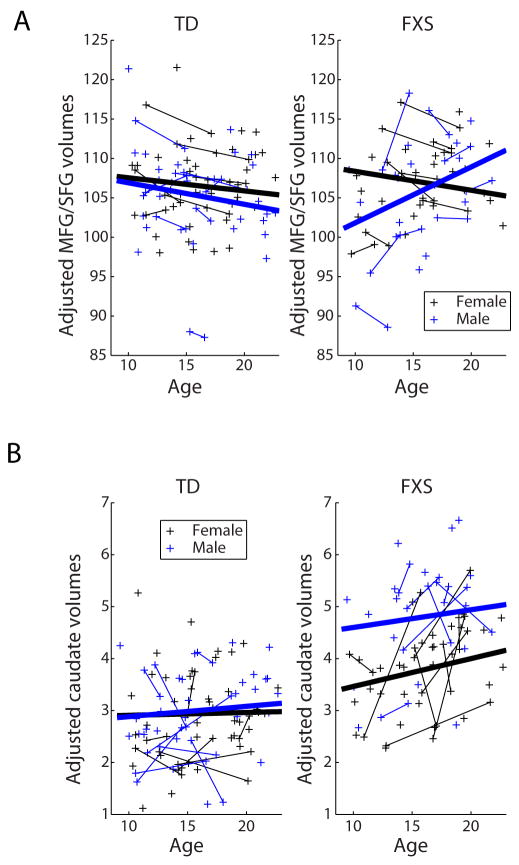
Methods: In this study, we examined adolescent brain development using structural magnetic resonance imaging data acquired from 59 individuals with FXS and 83 typically developing control subjects aged 9 to 22, a subset of whom were followed up longitudinally (1-5 years; typically developing: 17, FXS: 19). Regional volumes were modeled to obtain estimates of age-related change.
Results: We found that while structures such as the caudate showed consistent volume differences from control subjects across adolescence, prefrontal cortex (PFC) gyri showed significantly aberrant maturation. Furthermore, we found that PFC-related measures of cognitive functioning followed a similarly aberrant developmental trajectory in FXS.
Conclusions: Our findings suggest that aberrant maturation of the PFC during adolescence may contribute to persistent or increasing intellectual deficits in FXS.
Copyright © 2011 Society of Biological Psychiatry. Published by Elsevier Inc. All rights reserved.
Conflict of interest statement
The authors report no biomedical financial interests or potential conflicts of interest.
Figures


Comment in
-
The fragile X-associated disorders: time to order fragile X DNA testing.Biol Psychiatry. 2011 Nov 1;70(9):802-3. doi: 10.1016/j.biopsych.2011.09.009. Biol Psychiatry. 2011. PMID: 21986091 No abstract available.
References
-
- Turner G, Webb T, Wake S, Robinson H. Prevalence of fragile X syndrome. Am J Med Genet. 1996;64:196–7. - PubMed
-
- Till SM. The developmental roles of FMRP. Biochem Soc Trans. 2010;38:507–10. - PubMed
-
- Reiss AL, Dant CC. The behavioral neurogenetics of fragile X syndrome: analyzing gene-brain-behavior relationships in child developmental psychopathologies. Dev Psychopathol. 2003;15:927–68. - PubMed
Publication types
MeSH terms
Grants and funding
LinkOut - more resources
Full Text Sources
Medical
Miscellaneous
