


Use of acid treatment and a selective medium to enhance the recovery of Francisella tularensis from water
- PMID: 21803910
- PMCID: PMC3187174
- DOI: 10.1128/AEM.05226-11
Use of acid treatment and a selective medium to enhance the recovery of Francisella tularensis from water
Abstract
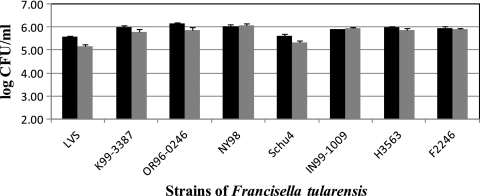
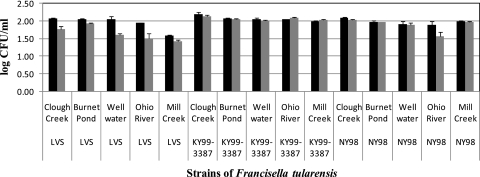
Francisella tularensis has been associated with naturally occurring waterborne outbreaks and is also of interest as a potential biological weapon. Recovery of this pathogen from water using cultural methods is challenging due to the organism's fastidious growth requirements and interference by indigenous bacteria. A 15-min acid treatment procedure prior to culture on a selective agar was evaluated for recovery of F. tularensis from seeded water samples. Mean levels of reduction of virulent strains of F. tularensis subsp. holarctica and subsp. tularensis were less than 20% following acid treatment. The attenuated live vaccine strain (LVS) was less resistant to acid exposure. The acid treatment procedure coupled with plating on cystine heart agar with rabbit blood and antibiotics (CHARBab) allowed the isolation of F. tularensis seeded into five natural water samples.
Figures
References
-
- Broekhuijsen M., et al. 2003. Genome-wide DNA microarray analysis of Francisella tularensis strains demonstrates extensive genetic conservation within the species but identifies regions that are unique to the highly virulent F. tularensis subsp. tularensis. J. Clin. Microbiol. 41:2924–2931 - PMC - PubMed
-
- Dennis D. T., et al. 2001. Tularemia as a biological weapon, medical and public health management. JAMA 285:2763–2773 - PubMed
Publication types
MeSH terms
Substances
LinkOut - more resources
Full Text Sources
