


The role of the individual Lhcas in photosystem I excitation energy trapping
- PMID: 21806943
- PMCID: PMC3145314
- DOI: 10.1016/j.bpj.2011.06.045
The role of the individual Lhcas in photosystem I excitation energy trapping
Abstract
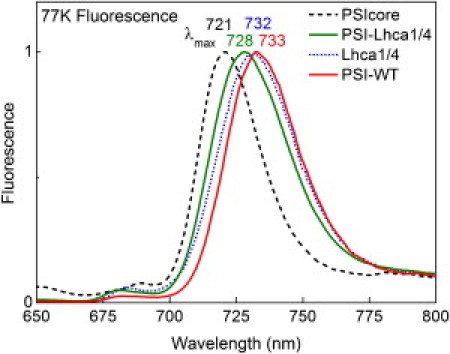
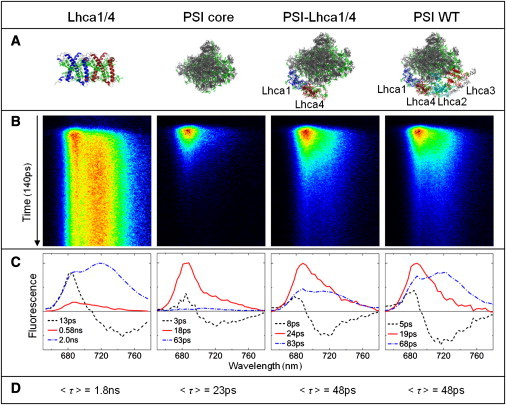
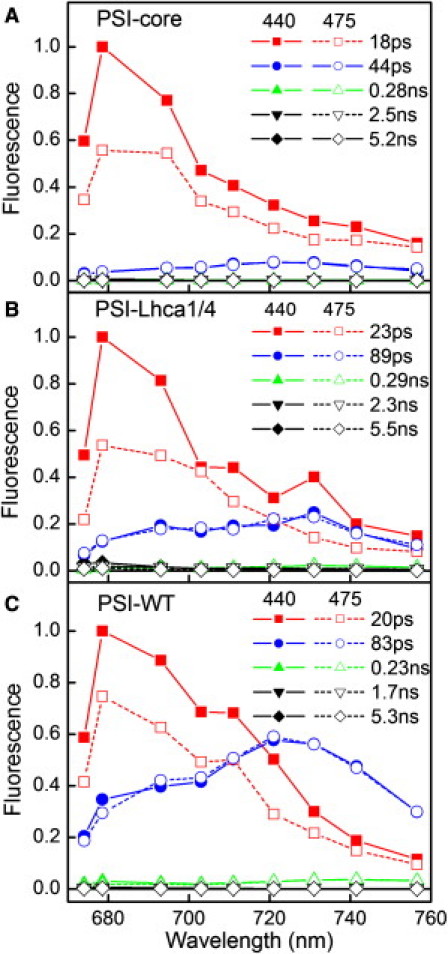
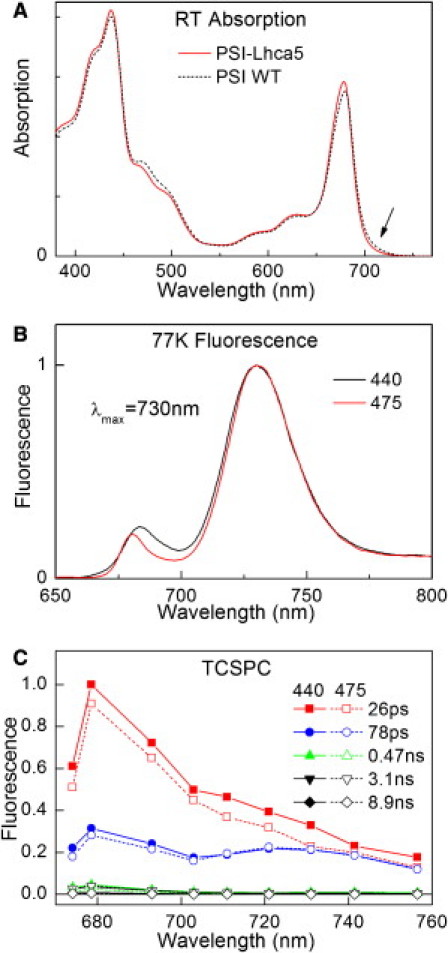
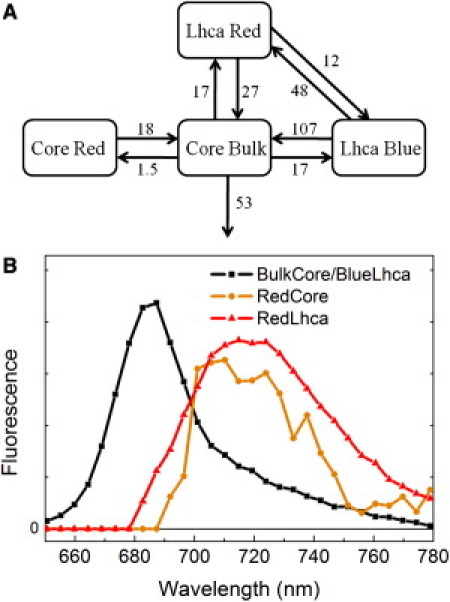
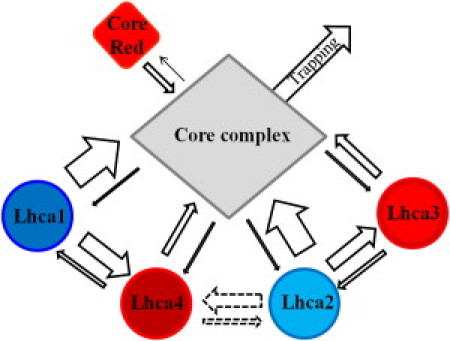
In this work, we have investigated the role of the individual antenna complexes and of the low-energy forms in excitation energy transfer and trapping in Photosystem I of higher plants. To this aim, a series of Photosystem I (sub)complexes with different antenna size/composition/absorption have been studied by picosecond fluorescence spectroscopy. The data show that Lhca3 and Lhca4, which harbor the most red forms, have similar emission spectra (λ(max) = 715-720 nm) and transfer excitation energy to the core with a relative slow rate of ∼25/ns. Differently, the energy transfer from Lhca1 and Lhca2, the "blue" antenna complexes, occurs about four times faster. In contrast to what is often assumed, it is shown that energy transfer from the Lhca1/4 and the Lhca2/3 dimer to the core occurs on a faster timescale than energy equilibration within these dimers. Furthermore, it is shown that all four monomers contribute almost equally to the transfer to the core and that the red forms slow down the overall trapping rate by about two times. Combining all the data allows the construction of a comprehensive picture of the excitation-energy transfer routes and rates in Photosystem I.
Copyright © 2011 Biophysical Society. Published by Elsevier Inc. All rights reserved.
Figures
References
-
- Ben-Shem A., Frolow F., Nelson N. Crystal structure of plant photosystem I. Nature. 2003;426:630–635. - PubMed
-
- Jordan P., Fromme P., Krauss N. Three-dimensional structure of cyanobacterial photosystem I at 2.5 A resolution. Nature. 2001;411:909–917. - PubMed
-
- Boekema E.J., Jensen P.E., Dekker J.P. Green plant photosystem I binds light-harvesting complex I on one side of the complex. Biochemistry. 2001;40:1029–1036. - PubMed
-
- Croce R., Morosinotto T., Bassi R. The Lhca antenna complexes of higher plants photosystem I. Biochim. Biophys. Acta. 2002;1556:29–40. - PubMed
-
- Wientjes E., Croce R. The light-harvesting complexes of higher-plant Photosystem I: Lhca1/4 and Lhca2/3 form two red-emitting heterodimers. Biochem. J. 2011;433:477–485. - PubMed
Publication types
MeSH terms
Substances
LinkOut - more resources
Full Text Sources
Molecular Biology Databases
Miscellaneous
