. 2011 Oct;31(19):3988-96.
doi: 10.1128/MCB.05673-11. Epub 2011 Aug 1.

The LYR protein Mzm1 functions in the insertion of the Rieske Fe/S protein in yeast mitochondria

Affiliations

The LYR protein Mzm1 functions in the insertion of the Rieske Fe/S protein in yeast mitochondria

Aaron Atkinson et al. Mol Cell Biol. 2011 Oct.

Abstract

The assembly of the cytochrome bc(1) complex in Saccharomyces cerevisiae is shown to be conditionally dependent on a novel factor, Mzm1. Cells lacking Mzm1 exhibit a modest bc(1) defect at 30°C, but the defect is exacerbated at elevated temperatures. Formation of bc(1) is stalled in mzm1Δ cells at a late assembly intermediate lacking the Rieske iron-sulfur protein Rip1. Rip1 levels are markedly attenuated in mzm1Δ cells at elevated temperatures. Respiratory growth can be restored in the mutant cells by the overexpression of the Rip1 subunit. Elevated levels of Mzm1 enhance the stabilization of Rip1 through physical interaction, suggesting that Mzm1 may be an important Rip1 chaperone especially under heat stress. Mzm1 may function primarily to stabilize Rip1 prior to inner membrane (IM) insertion or alternatively to aid in the presentation of Rip1 to the inner membrane translocation complex for extrusion of the folded domain containing the iron-sulfur center.


Figures
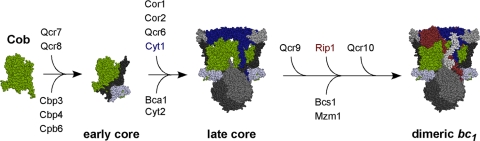
Fig. 1.
Fig. 1.
Schematic for assembly of the bc1 complex in yeast mitochondria. The Cob translational activator Cbp6 and assembly factor Cbp3 associate with the nascent polypeptide as it exits the mitochondrial ribosome. Cbp3 and Cbp6 remain bound to the newly synthesized Cob, and Cbp4 is recruited to this complex. The supernumerary subunits Qcr7 and Qcr8 associate with Cob (green) to form the early core complex. The core protein subunits, Cor1 and Cor2, along with Qcr6 subunits and the catalytic subunits of Cyt1 (blue), are added to form the late core complex. Bca1 is a recently identified assembly factor for bc1 that acts prior to formation of the late core, and Cyt2 is the heme lyase. The assembly factors Bcs1 and Mzm1 assist in formation of the functional homodimeric bc1 complex by assisting in the insertion of Rip1 (shown in ruby). Qcr9 and Qcr10 subunits are also added at a late step. Protein subunits of the bc1 enzyme complex are listed above the arrows; nonsubunit proteins are listed below.
Fig. 2.
Fig. 2.
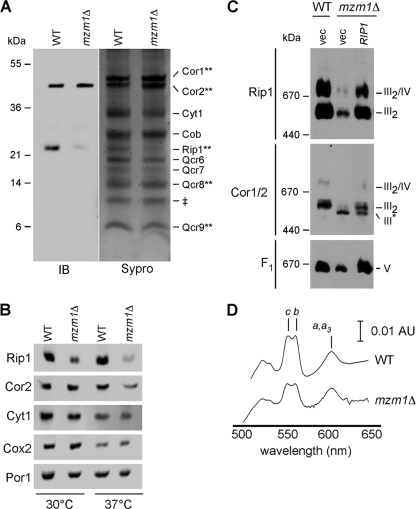
Characterization of bc1 complex components and supercomplex formation in mzm1Δ cells. (A) bc1 complex purification via tandem affinity purification of Cor2::TAP in strains with and without Mzm1 from mitochondria solubilized by 1% digitonin. SDS-PAGE gels of the purification products were stained with Sypro ruby, and the bands were identified by mass spectrometry (where indicated by **) along with immunoblotting (IB) to identify Cor2 (anti-TAP) and Rip1 (anti-Rip1). ‡, a band with a mass similar to that of Qcr10 was observed by Sypro staining; we failed to confirm its identity as Qcr10. (B) SDS-PAGE immunoblot of mitochondria isolated from cultures grown at 30 and 37°C. (C) BN-PAGE immunoblot of mitochondria solubilized by 1% digitonin. The late core subassembly intermediate is designated by III*. (D) Optical absorbance spectra were recorded of reduced minus oxidized cytochromes in WT and mzm1Δ mitochondrial detergent lysates. AU, absorbance unit.
Fig. 3.
Fig. 3.
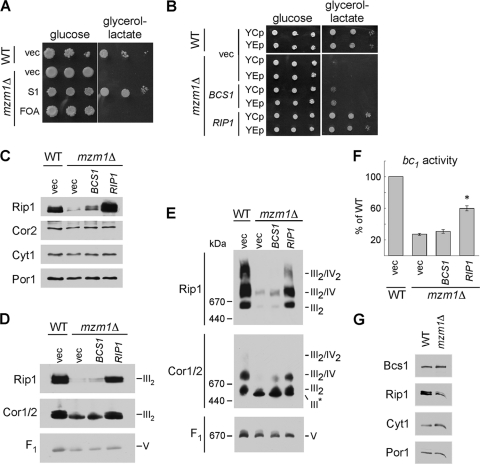
Suppression of the 37°C growth defect and rescue of the reduced Rip1 levels, supercomplex formation, and bc1 complex activity of mzm1Δ. (A) Growth test at 37°C on glucose or glycerol-lactate medium of mzm1Δ cells transformed with vector control (vec) or a plasmid isolated from the suppression screen (S1), which was identified by sequencing to contain RIP1. Loss of this RIP1-containing plasmid was induced by 5-fluoroorotic acid treatment (FOA). (B) Growth test at 37°C on glucose or glycerol-lactate medium of mzm1Δ cells transformed with low-copy-number (YCp) and high-copy-number (YEp) vector control or plasmids containing BCS1 or RIP1. (C to E) SDS-PAGE (C) and BN-PAGE immunoblots with either 1% dodecylmaltoside solubilization (D) or 1% digitonin solubilization (E) of mitochondria from mzm1Δ cells transformed with YEp vector control or plasmids containing BCS1 or RIP1. The late core subassembly intermediate is designated by III*. (F) bc1 complex activity of mitochondria from mzm1Δ cells transformed with high-copy-number vector control or plasmids containing BCS1 or RIP1, shown as a percentage of WT activity, with the asterisk indicating significantly increased activity relative to mzm1Δ with vector control (n = 6 ± standard deviation). Statistical significance was determined by analysis of variance with Bonferroni's post hoc test in Kaleidagraph. (G) SDS-PAGE immunoblot of mitochondria from Bcs1::Myc cultures with and without Mzm1. Bcs1 protein levels were identified using anti-Myc antibody.
Fig. 4.
Fig. 4.
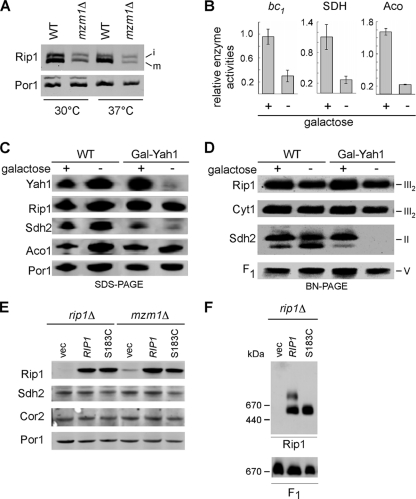
Rip1 processing and Fe/S cluster insertion are not impaired in mzm1Δ cells. (A) SDS-PAGE immunoblot of mitochondria isolated from WT and mzm1Δ cultures grown at 30 and 37°C. Intermediate (i) and mature (m) forms of Rip1 are indicated. (B) Analysis of cytochrome c reductase (bc1), succinate dehydrogenase (SDH), and aconitase (Aco) activities of mitochondria from WT or Gal-YAH1 cells grown in either galactose-replete (+) or -deficient (−) medium, where the depletion of Yah1 by lactate replacement of galactose results in a lack of Fe/S cluster biogenesis. The results are presented relative to the activities measured for the mitochondrial enzymes of either WT or Gal-YAH1 cells grown in the presence of galactose (+). Error bars indicate standard deviations; n = 3. (C and D) SDS-PAGE (C) and BN-PAGE (D) with 1% dodecylmaltoside solubilization of mitochondria from WT or Gal-YAH1 cells grown in either galactose or lactate-replete medium. (E) SDS-PAGE and immunoblotting of mitochondria from rip1Δ or mzm1Δ cells transformed with high-copy-number vector control or plasmids containing WT or S183C Rip1. (F) BN-PAGE with 1% digitonin solubilization of mitochondria isolated from rip1Δ cells expressing either WT or S183C Rip1 (mutant lacking a Fe/S cluster).
Fig. 5.
Fig. 5.
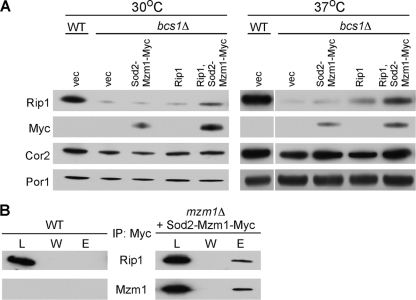
Mzm1 stabilizes and interacts with Rip1. (A) SDS-PAGE immunoblot of mitochondria from WT and bcs1Δ cells cultured at either 30 or 37°C expressing indicated plasmids. Mzm1 levels were identified with anti-Myc antibody. (B) Immunoprecipitation of WT or mzm1Δ cells overexpressing Sod2-Mzm1-Myc with anti-Myc-agarose beads. Three percent of the total extracts (L), the entire fraction of the last wash (W), and 20% of the bead eluate (E) were analyzed by SDS-PAGE and immunoblotting with anti-Rip1 or anti-Myc (Mzm1) antibodies.
Fig. 6.
Fig. 6.
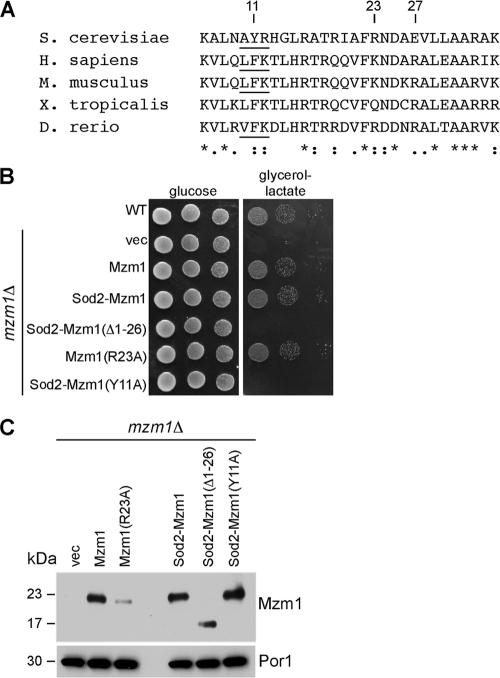
The LYR motif of Mzm1 is important for its function. (A) Mzm1 protein sequences are shown with conserved segments in the N-terminal region. The Tyr in the LYR (AYR) motif is residue 11. H. sapiens, Homo sapiens; M. musculus, Mus musculus; X. tropicalis, Xenopus tropicalis; D. rerio, Danio rerio. (B) WT cells and mzm1Δ cells expressing vector, high-copy-number Mzm1, low-copy-number Sod2-Mzm1, low-copy-number Sod2-Mzm1 (Δ1-26), high-copy-number Mzm1 (R23A), and low-copy-number Sod2-Mzm1 (Y11A) were grown in synthetic selective medium, serially diluted, and spotted on yeast extract-peptone medium containing glucose or glycerol-lactate carbon sources. Cells were incubated at 37°C. (C) Mitochondria from the respective strains in panel B were analyzed by SDS-PAGE and immunoblotted with anti-Myc antibody to visualize Mzm1.

References

    1. Atkinson A., et al. 2010. Mzm1 influences a labile pool of mitochondrial zinc important for respiratory function. J. Biol. Chem. 285:19450–19459 - PMC - PubMed
    1. Brandt U., Uribe S., Schagger H., Trumpower B. L. 1994. Isolation and characterization of QCR10, the nuclear gene encoding the 8.5-kDa subunit 10 of the Saccharomyces cerevisiae cytochrome bc1 complex. J. Biol. Chem. 269:12947–12953 - PubMed
    1. Crivellone M. D., Wu M. A., Tzagoloff A. 1988. Assembly of the mitochondrial membrane system. Analysis of structural mutants of the yeast coenzyme QH2-cytochrome c reductase complex. J. Biol. Chem. 263:14323–14333 - PubMed
    1. Cruciat C. M., Brunner S., Baumann F., Neupert W., Stuart R. A. 2000. The cytochrome bc1 and cytochrome c oxidase complexes associate to form a single supracomplex in yeast mitochondria. J. Biol. Chem. 275:18093–18098 - PubMed
    1. Cruciat C. M., Hell K., Folsch H., Neupert W., Stuart R. A. 1999. Bcs1, an AAA-family member, is a chaperone for the assembly of the cytochrome bc1 complex. EMBO J. 18:5226–5233 - PMC - PubMed

Publication types

MeSH terms

Substances