


Social conflict drives the evolutionary divergence of quorum sensing
- PMID: 21807995
- PMCID: PMC3158151
- DOI: 10.1073/pnas.1102923108
Social conflict drives the evolutionary divergence of quorum sensing
Abstract
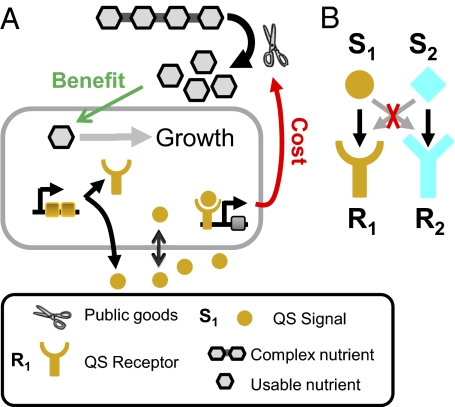
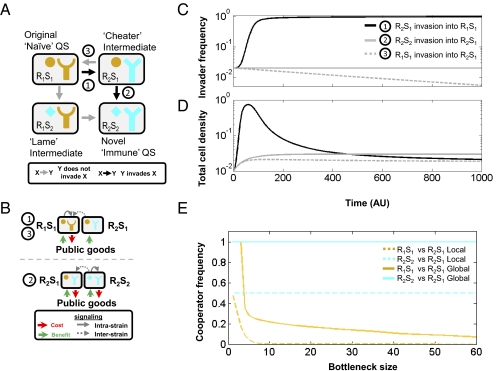
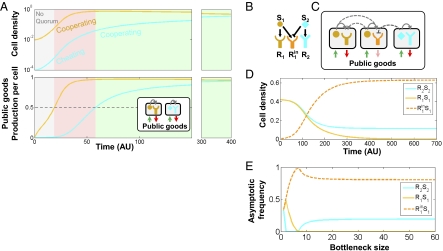
In microbial "quorum sensing" (QS) communication systems, microbes produce and respond to a signaling molecule, enabling a cooperative response at high cell densities. Many species of bacteria show fast, intraspecific, evolutionary divergence of their QS pathway specificity--signaling molecules activate cognate receptors in the same strain but fail to activate, and sometimes inhibit, those of other strains. Despite many molecular studies, it has remained unclear how a signaling molecule and receptor can coevolve, what maintains diversity, and what drives the evolution of cross-inhibition. Here I use mathematical analysis to show that when QS controls the production of extracellular enzymes--"public goods"--diversification can readily evolve. Coevolution is positively selected by cycles of alternating "cheating" receptor mutations and "cheating immunity" signaling mutations. The maintenance of diversity and the evolution of cross-inhibition between strains are facilitated by facultative cheating between the competing strains. My results suggest a role for complex social strategies in the long-term evolution of QS systems. More generally, my model of QS divergence suggests a form of kin recognition where different kin types coexist in unstructured populations.
Conflict of interest statement
The author declares no conflict of interest.
Figures
References
-
- Waters CM, Bassler BL. Quorum sensing: Cell-to-cell communication in bacteria. Annu Rev Cell Dev Biol. 2005;21:319–346. - PubMed
-
- Ji G, Beavis R, Novick RP. Bacterial interference caused by autoinducing peptide variants. Science. 1997;276:2027–2030. - PubMed
-
- Tran L-SP, Nagai T, Itoh Y. Divergent structure of the ComQXPA quorum-sensing components: Molecular basis of strain-specific communication mechanism in Bacillus subtilis. Mol Microbiol. 2000;37:1159–1171. - PubMed
Publication types
MeSH terms
LinkOut - more resources
Full Text Sources
