


Direct and indirect effects of biological factors on extinction risk in fossil bivalves
- PMID: 21808004
- PMCID: PMC3158225
- DOI: 10.1073/pnas.1100572108
Direct and indirect effects of biological factors on extinction risk in fossil bivalves
Abstract
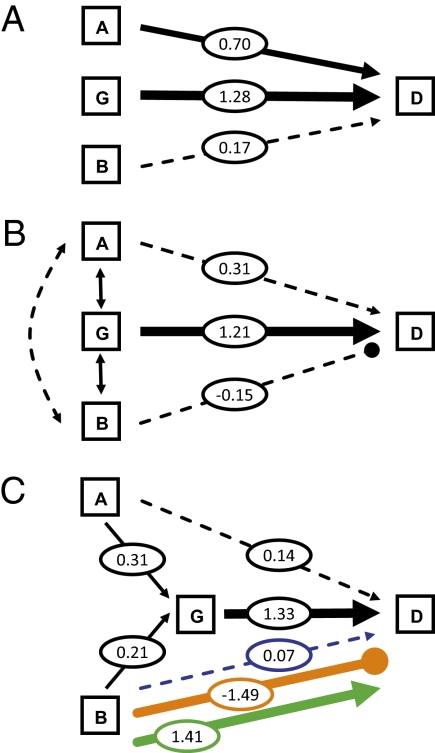
Biological factors, such as abundance and body size, may contribute directly to extinction risk and indirectly through their influence on other biological characteristics, such as geographic range size. Paleontological data can be used to explicitly test many of these hypothesized relationships, and general patterns revealed through analysis of the fossil record can help refine predictive models of extinction risk developed for extant species. Here, I use structural equation modeling to tease apart the contributions of three canonical predictors of extinction--abundance, body size, and geographic range size--to the duration of bivalve species in the early Cenozoic marine fossil record of the eastern United States. I find that geographic range size has a strong direct effect on extinction risk and that an apparent direct effect of abundance can be explained entirely by its covariation with geographic range. The influence of geographic range on extinction risk is manifest across three ecologically disparate bivalve clades. Body size also has strong direct effects on extinction risk but operates in opposing directions in different clades, and thus, it seems to be decoupled from extinction risk in bivalves as a whole. Although abundance does not directly predict extinction risk, I reveal weak indirect effects of both abundance and body size through their positive influence on geographic range size. Multivariate models that account for the pervasive covariation between biological factors and extinction are necessary for assessing causality in evolutionary processes and making informed predictions in applied conservation efforts.
Conflict of interest statement
The author declares no conflict of interest.
Figures
References
-
- Purvis A, Jones KE, Mace GM. Extinction. Bioessays. 2000;22:1123–1133. - PubMed
-
- Jablonski D. Mass extinctions and macroevolution. Paleobiology. 2005;31:192–210.
-
- Purvis A, Cardillo M, Grenyer R, Collen B. In: Phylogeny and Conservation. Purvis A, Gittleman JL, Brooks T, editors. Cambridge, UK: Cambridge University Press; 2005. pp. 295–316.
-
- McKinney ML. Extinction vulnerability and selectivity: Combining ecological and paleontological views. Annu Rev Ecol Syst. 1997;28:495–516.
-
- Wootton JT. Predicting direct and indirect effects: An integrated approach using experiments and path analysis. Ecology. 1994;75:151–165.
Publication types
MeSH terms
LinkOut - more resources
Full Text Sources
