. 2011 Aug 16;108(33):13746-51.
doi: 10.1073/pnas.1108667108. Epub 2011 Aug 1.

In vitro reconstitution of Bluetongue virus infectious cores

Affiliations

In vitro reconstitution of Bluetongue virus infectious cores

Sofia Lourenco et al. Proc Natl Acad Sci U S A. .

Abstract

Bluetongue virus (BTV) is a vector-borne, nonenveloped icosahedral particle that is organized in two capsids, an outer capsid of two proteins, VP2 and VP5, and an inner capsid (or core) composed of two major proteins, VP7 and VP3, in two layers. The VP3 layer (subcore) encloses viral transcription complex (VP1 polymerase, VP4 capping enzyme, VP6 helicase) and a 10-segmented double-stranded (dsRNA) genome. Although much is known about the BTV capsids, the order of the core assembly and the mechanism of genome packaging remain unclear. Here, we established a cell-free system to reconstitute subcore and core structures with the proteins and ssRNAs, demonstrating that reconstituted cores are infectious in insect cells. Furthermore, we showed that the BTV ssRNAs are essential to drive the assembly reaction and that there is a distinct order of internal protein recruitment during the assembly process. The in vitro engineering of infectious BTV cores is unique for any member of the Reoviridae and will facilitate future studies of RNA-protein interactions during BTV core assembly.


Conflict of interest statement

The authors declare no conflict of interest.

Figures
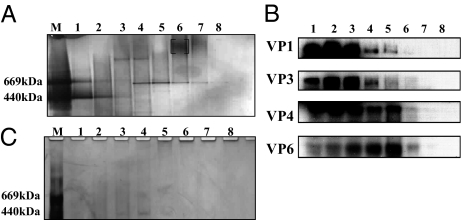
Fig. 1.
Fig. 1.
Assembly of a complex with subcore components. After the assembly assay, the reaction mixture was purified on a continuous sucrose gradient; the fractions (1–8) were analyzed on native gel followed by silver staining (A) and on 10% SDS-PAGE followed by Western blots (B). The complex formation is indicated. (C) Wheat germ extracts lacking any BTV protein or RNA were tested similarly and analyzed on native gel followed by silver staining.
Fig. 2.
Fig. 2.
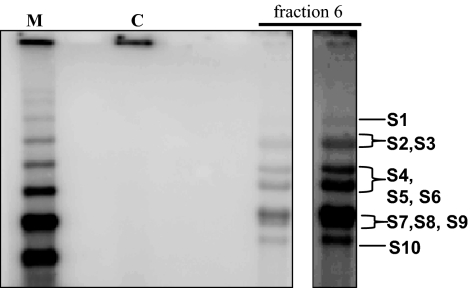
Recruitment of ssRNAs by the putative subcore complex. The sucrose fraction containing the complex (fraction 6) was phenol/chlorophorm-extracted, precipitated, and resuspended in denaturing formaldehyde loading buffer and analyzed by 1% agarose denaturing gel. The ssRNAs of the fraction 6 and the position of each segment are indicated. (Right) The longer exposure of the same. C: fraction 9 processed similarly as negative control. M: 32P-labeled marker ssRNAs (Promega).
Fig. 3.
Fig. 3.
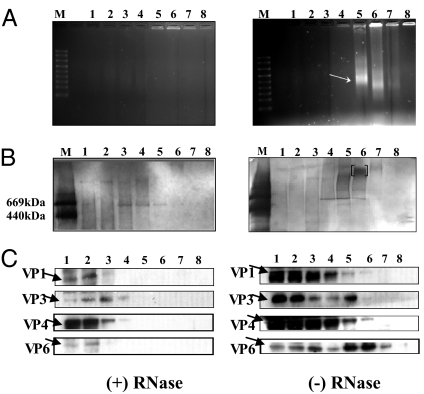
RNase sensitivity of ssRNAs in the subcore complex. (A) The subcore assembly reaction was directly loaded onto the sucrose gradient or treated with 0.125 U/μL Rnase One (Promega) at 37 °C for 30 min before fractionation. The fractions (1–8) were analyzed by 1% denaturing agarose gel followed by ethidium bromide staining. Although the RNase One untreated sample (Right) shows the presence of ssRNAs (arrow), the treated sample (Left) has no RNA. (B) Samples were also analyzed by native gels followed by silver staining. The RNA-protein complex (putative subcores) is indicated. (C) Western blots of the same samples. Arrows show the position of each protein.
Fig. 4.
Fig. 4.
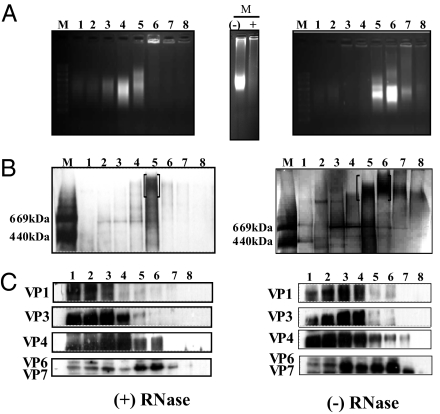
Putative cores protect ssRNAs from RNase treatment. (A) The core assembly reaction was directly (Right) loaded onto the sucrose gradient or treated (Left) with 0.125 U/μL Rnase One (Promega) at 37 °C for 30 min before fractionation and fractions were analyzed by 1% denaturing agarose gel followed by ethidium bromide staining. A control reaction of RNA marker mixed with wheat germ extracts and 45% sucrose was processed similarly (Center). (B) Samples were also analyzed by native gels and silver-stained. Putative cores are indicated. (C) Western blots of the same samples.
Fig. 5.
Fig. 5.
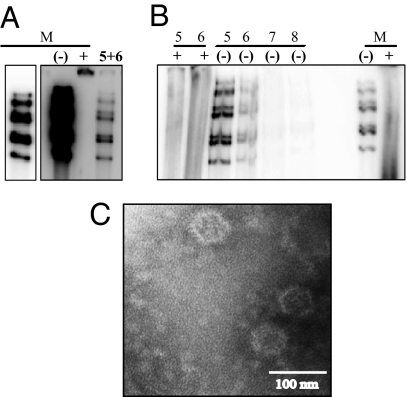
Polymerase activity of putative cores and dsRNA packaging assay. (A) Synthesis of dsRNAs from the packaged ssRNAs templates in the transcription complex was undertaken in the presence of rNTPs and 32P labeled CTP, as described in Materials and Methods. The products of the polymerase assay were treated with RNase A (Sigma), fractionated, phenol-chlorophorm extracted, and analyzed on 9% native PAGE (lanes 5 and 6). As a positive control, purified dsRNAs of BTV1 (lane M) were 32P-labeled at the 3′ ends, analyzed similarly, or treated with RNase A before analysis; (Left) the untreated marker at a lower exposure. (B) The same assembly assay was performed in presence of 32P-labeled dsRNAs, gradient-fractionated, and either directly analyzed on a 9% PAGE, or after RNase A treatment. Lanes 5 and 6: RNase A treated (+); lanes 5 to 8: fractions 5 to 8, untreated (−); M: Purified 32P-labeled dsRNAs of BTV1, treated (+) or untreated (−) with RNase A. (C) Sample from fraction 6 was processed by EM. (Scale bar, 100 nm.)
Fig. 6.
Fig. 6.
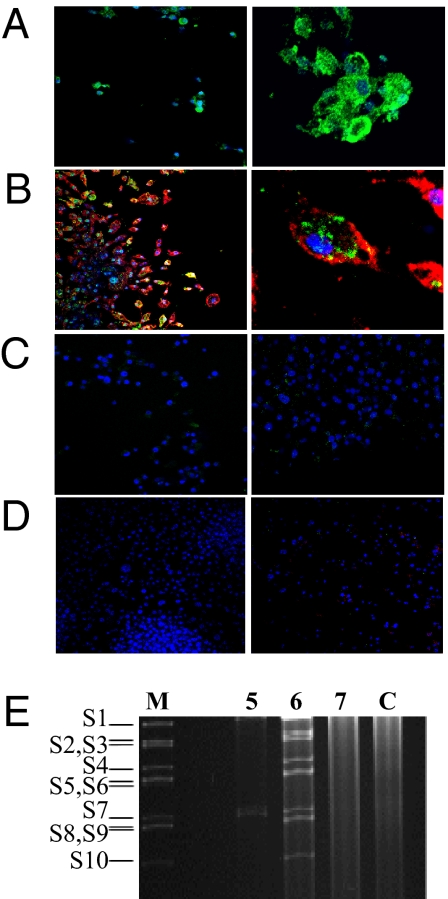
In vitro-generated cores are infectious in insect cells. Core assembly reaction mix was processed as above; KC cells were infected with each fraction and expression of BTV proteins were examined by immunofluorescence assay. (A) NS1 staining (green) of fraction 6-infected KC cells (Magnification: 20×). (Right) Higher amplification (Magnification: 40×). (B) NS2 (green) and VP5 (red) staining of the same (Magnification: 20×). (Right) Higher amplification (Magnification: 40×). (C) Representative of uninfected (Left) and fraction 4-infected KC cells (Right) stained with anti-NS1 (Magnification: 20×). (D) Representative of uninfected (Left) and fraction 4-infected KC cells (Right) stained with both anti-NS2 and anti-VP5 (Magnification: 20×). (E) Putative virus was passaged in KC cells four times and dsRNAs were extracted and analyzed on a 9% native-PAGE followed by ethidium bromide staining. Lanes, 5, 6, 7: dsRNAs extracted from KC cells infected with fractions 5, 6, and 7, respectively; lane M: dsRNAs extracted from BTV1 infected cells; lane C: uninfected KC cells processed similarly, as a negative control.
Fig. 7.
Fig. 7.
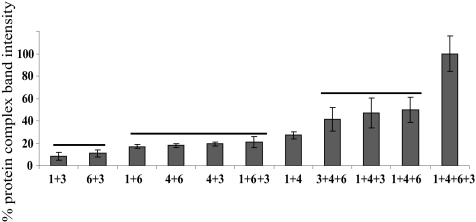
Assembly of subcore intermediates. The different protein combinations were used for assembly (either two or three), fractionated and the fractions were analyzed by native gels, followed by silver staining (see Fig. S2 for an example of the relevant fractions). The bands corresponding to a protein complex were quantified by ImageJ software, normalized to the bands of the native high molecular-weight marker (GE Healthcare), and calculated in percentages for the intensity of the bands. As a positive control, assembly of all four subcore proteins was similarly analyzed and was set as 100% of assembly efficiency. The graph of these values is shown. The SD was calculated from three independent experiments. Each group marked by a bar is significantly different from each other, P < 0.05 by Student t test.

References

    1. Fukusho A, Yu Y, Yamaguchi S, Roy P. Completion of the sequence of bluetongue virus serotype 10 by the characterization of a structural protein, VP6, and a non-structural protein, NS2. J Gen Virol. 1989;70:1677–1689. - PubMed
    1. Roy P. Functional mapping of bluetongue virus proteins and their interactions with host proteins during virus replication. Cell Biochem Biophys. 2008;50(3):143–157. - PubMed
    1. Verwoerd DW, Huismans H. Studies on the in vitro and the in vivo transcription of the bluetongue virus genome. Onderstepoort J Vet Res. 1972;39(4):185–191. - PubMed
    1. Roy P. Bluetongue virus: Dissection of the polymerase complex. J Gen Virol. 2008;89:1789–1804. - PMC - PubMed
    1. Verwoerd DW, Els HJ, De Villiers EM, Huismans H. Structure of the bluetongue virus capsid. J Virol. 1972;10:783–794. - PMC - PubMed

Publication types

LinkOut - more resources