


Homogeneous catalytic O2 reduction to water by a cytochrome c oxidase model with trapping of intermediates and mechanistic insights
- PMID: 21808032
- PMCID: PMC3161539
- DOI: 10.1073/pnas.1104698108
Homogeneous catalytic O2 reduction to water by a cytochrome c oxidase model with trapping of intermediates and mechanistic insights
Abstract
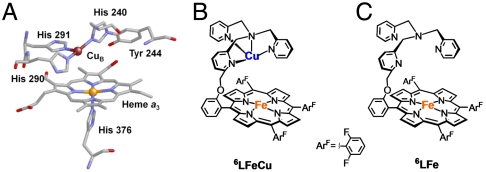
An efficient and selective four-electron plus four-proton (4e(-)/4H(+)) reduction of O(2) to water by decamethylferrocene and trifluoroacetic acid can be catalyzed by a synthetic analog of the heme a(3)/Cu(B) site in cytochrome c oxidase ((6)LFeCu) or its Cu-free version ((6)LFe) in acetone. A detailed mechanistic-kinetic study on the homogeneous catalytic system reveals spectroscopically detectable intermediates and that the rate-determining step changes from the O(2)-binding process at 25 °C room temperature (RT) to the O-O bond cleavage of a newly observed Fe(III)-OOH species at lower temperature (-60 °C). At RT, the rate of O(2)-binding to (6)LFeCu is significantly faster than that for (6)LFe, whereas the rates of the O-O bond cleavage of the Fe(III)-OOH species observed (-60 °C) with either the (6)LFeCu or (6)LFe catalyst are nearly the same. Thus, the role of the Cu ion is to assist the heme and lead to faster O(2)-binding at RT. However, the proximate Cu ion has no effect on the O-O bond cleavage of the Fe(III)-OOH species at low temperature.
Conflict of interest statement
The authors declare no conflict of interest.
Figures
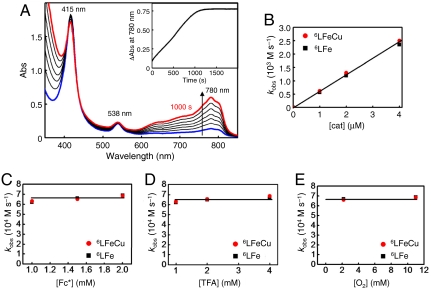
 at -60 °C. (C) Plots of kobs vs. [Fc*] for 6LFeCu and 6LFe at -60 °C. (D) Plots of kobs vs. [TFA] for 6LFeCu and
  at -60 °C. (E) Plots of kobs vs. [O2] for 6LFeCu and 6LFe at -60 °C.


References
-
- Ferguson-Miller S, Babcock GT. Heme/copper terminal oxidases. Chem Rev. 1996;96:2889–2908. - PubMed
-
- Tsukihara T, et al. Structures of metal sites of oxidized bovine heart cytochrome c oxidase at 28 A. Science. 1995;269:1069–1074. - PubMed
-
- Yoshikawa JS, et al. Redox-coupled crystal structural changes in bovine heart cytochrome c oxidase. Science. 1998;280:1723–1723. - PubMed
-
- Pereira MM, Santana M, Teixeira M. A novel scenario for the evolution of haem-copper oxygen reductases. Biochim Biophys Acta. 2001;1505:185–208. - PubMed
-
- Cracknell JA, Vincent KA, Armstrong A. Enzymes as working or inspirational electrocatalysts for fuel cells and electrolysis. Chem Rev. 2008;108:2439–2461. - PubMed
Publication types
MeSH terms
Substances
Grants and funding
LinkOut - more resources
Full Text Sources
