


Satellite methods underestimate indirect climate forcing by aerosols
- PMID: 21808047
- PMCID: PMC3158199
- DOI: 10.1073/pnas.1018526108
Satellite methods underestimate indirect climate forcing by aerosols
Abstract
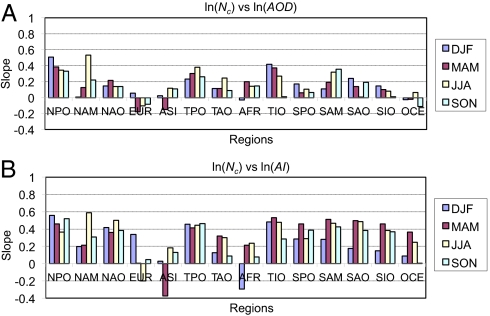
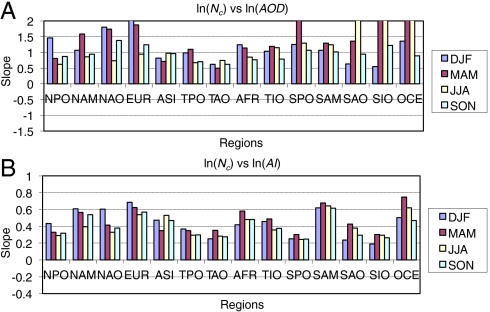
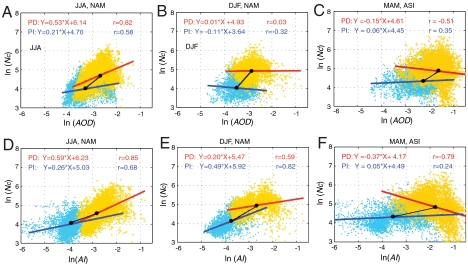
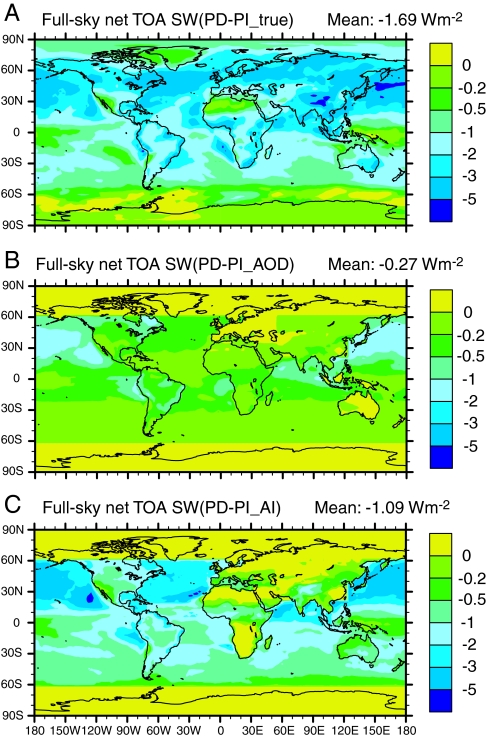
Satellite-based estimates of the aerosol indirect effect (AIE) are consistently smaller than the estimates from global aerosol models, and, partly as a result of these differences, the assessment of this climate forcing includes large uncertainties. Satellite estimates typically use the present-day (PD) relationship between observed cloud drop number concentrations (N(c)) and aerosol optical depths (AODs) to determine the preindustrial (PI) values of N(c). These values are then used to determine the PD and PI cloud albedos and, thus, the effect of anthropogenic aerosols on top of the atmosphere radiative fluxes. Here, we use a model with realistic aerosol and cloud processes to show that empirical relationships for ln(N(c)) versus ln(AOD) derived from PD results do not represent the atmospheric perturbation caused by the addition of anthropogenic aerosols to the preindustrial atmosphere. As a result, the model estimates based on satellite methods of the AIE are between a factor of 3 to more than a factor of 6 smaller than model estimates based on actual PD and PI values for N(c). Using ln(N(c)) versus ln(AI) (Aerosol Index, or the optical depth times angstrom exponent) to estimate preindustrial values for N(c) provides estimates for N(c) and forcing that are closer to the values predicted by the model. Nevertheless, the AIE using ln(N(c)) versus ln(AI) may be substantially incorrect on a regional basis and may underestimate or overestimate the global average forcing by 25 to 35%.
Conflict of interest statement
The authors declare no conflict of interest.
Figures
Comment in
-
Which of satellite- or model-based estimates is closer to reality for aerosol indirect forcing?Proc Natl Acad Sci U S A. 2011 Nov 15;108(46):E1099; author reply E1100-1. doi: 10.1073/pnas.1114634108. Epub 2011 Nov 3. Proc Natl Acad Sci U S A. 2011. PMID: 22052880 Free PMC article. No abstract available.
References
-
- Twomey S. The influence of pollution on the shortwave albedo of clouds. J Atmos Sci. 1977;34:1149–1152.
-
- Quaas J, Boucher O, Lohmann U. Constraining the total aerosol indirect effect in the LMDZ and ECHAM4 GCMs using MODIS satellite data. Atmos Chem Phys. 2006;6:947–955.
-
- Quaas J, Boucher O, Bellouin N, Kinne S. Satellite-based estimate of the direct and indirect aerosol climate forcing. J Geophys Res. 2008;113 . - DOI
-
- Lohmann U, Feichter J. Global indirect aerosol effects: A review. Atmos Chem Phys. 2005;5:715–737.
-
- Wang M, Penner JE. Aerosol indirect forcing in a global model with particle nucleation. Atmos Chem Phys. 2009;9:239–260.
Publication types
MeSH terms
Substances
LinkOut - more resources
Full Text Sources
Research Materials
Miscellaneous
