


Spino-pelvic sagittal balance of spondylolisthesis: a review and classification
- PMID: 21809015
- PMCID: PMC3175928
- DOI: 10.1007/s00586-011-1932-1
Spino-pelvic sagittal balance of spondylolisthesis: a review and classification
Abstract
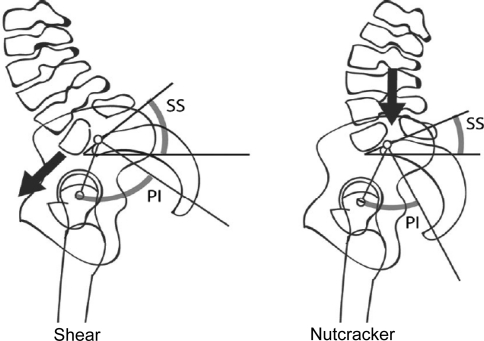
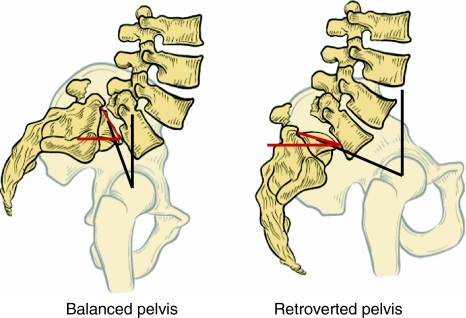
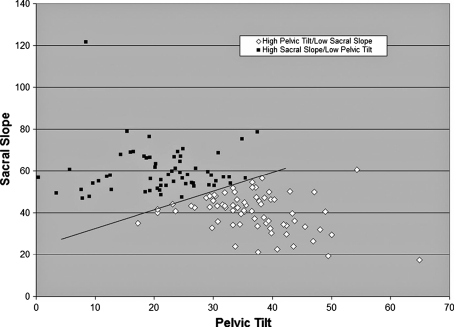
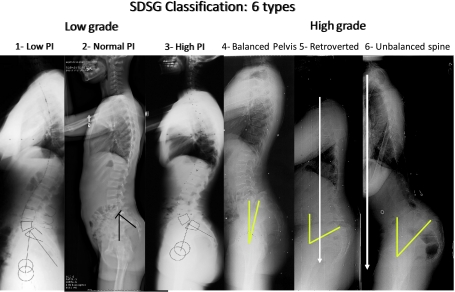
Introduction: In L5-S1 spondylolisthesis, it has been clearly demonstrated over the past decade that sacro-pelvic morphology is abnormal and that it can be associated to an abnormal sacro-pelvic orientation as well as to a disturbed global sagittal balance of the spine. The purpose of this article is to review the work done within the Spinal Deformity Study Group (SDSG) over the past decade, which has led to a classification incorporating this recent knowledge.
Material and methods: The evidence presented has been derived from the analysis of the SDSG database, a multi-center radiological database of patients with L5-S1 spondylolisthesis, collected from 43 spine surgeons in North America and Europe.
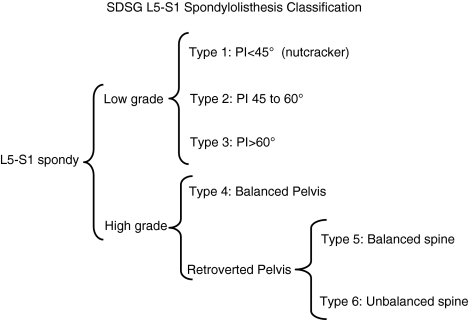
Results: The classification defines 6 types of spondylolisthesis based on features that can be assessed on sagittal radiographs of the spine and pelvis: (1) grade of slip, (2) pelvic incidence, and (3) spino-pelvic alignment. A reliability study has demonstrated substantial intra- and inter-observer reliability similar to other currently used classifications for spinal deformity. Furthermore, health-related quality of life measures were found to be significantly different between the 6 types, thus supporting the value of a classification based on spino-pelvic alignment.
Conclusions: The clinical relevance is that clinicians need to keep in mind when planning treatment that subjects with L5-S1 spondylolisthesis are a heterogeneous group with various adaptations of their posture. In the current controversy on whether high-grade deformities should or should not be reduced, it is suggested that reduction techniques should preferably be used in subjects with evidence of abnormal posture, in order to restore global spino-pelvic balance and improve the biomechanical environment for fusion.
Figures
References
-
- Mardjetko S, Albert T, Andersson G, Bridwell K, DeWald C, Gaines R, Geck M, Hammerberg K, Herkowitz H, Kwon B, Labelle H, Lubicky J, McAfee P, Ogilvie J, Shufflebarger H, Whitesides T (2005) Spine/SRS Spondylolisthesis Summary Statement. Spine, 30(6 Suppl):S3 - PubMed
-
- Wiltse LL, Newman PH, Macnab I. Classification of spondylolysis and spondylolisthesis. Clin Orthop. 1976;117:23–29. - PubMed
-
- Marchetti PC, Bartolozzi P (1997) Classification of spondylolisthesis as a guideline for treatment. In: Bridwell KH, DeWald RL, Hammerberg KW, et al., (eds) The textbook of spinal surgery, 2 edn. Lippincott-Raven, Philadelphia pp 1211–1254
-
- Labelle H, Roussouly P, Berthonnaud E, Mac-Thiong JM, Hresko T, Dimar, J, Parent S, Weidenbaum M, Brown C, Hu S (2009) Spondylolisthesis classification based on spino-pelvic alignment, Podium presentation at the 2009 Scoliosis Research Society Annual Meeting, San Antonio, USA
Publication types
MeSH terms
LinkOut - more resources
Full Text Sources
Miscellaneous
