


Midlife vascular risk factor exposure accelerates structural brain aging and cognitive decline
- PMID: 21810696
- PMCID: PMC3146307
- DOI: 10.1212/WNL.0b013e318227b227
Midlife vascular risk factor exposure accelerates structural brain aging and cognitive decline
Abstract
Objective: Our aim was to test the association of vascular risk factor exposure in midlife with progression of MRI markers of brain aging and measures of cognitive decline.
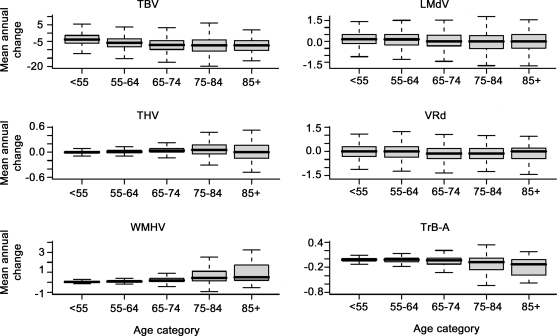
Methods: A total of 1,352 participants without dementia from the prospective Framingham Offspring Cohort Study were examined. Multivariable linear and logistic regressions were implemented to study the association of midlife vascular risk factor exposure with longitudinal change in white matter hyperintensity volume (WMHV), total brain volume (TBV), temporal horn volume, logical memory delayed recall, visual reproductions delayed-recall (VR-d), and Trail-Making Test B-A (TrB-A) performance a decade later.
Results: Hypertension in midlife was associated with accelerated WMHV progression (p < 0.001) and worsening executive function (TrB-A score; p = 0.012). Midlife diabetes and smoking were associated with a more rapid increase in temporal horn volume, a surrogate marker of accelerated hippocampal atrophy (p = 0.017 and p = 0.008, respectively). Midlife smoking also predicted a more marked decrease in total brain volume (p = 0.025) and increased risk of extensive change in WMHV (odds ratio = 1.58 [95%confidence interval 1.07-2.33], p = 0.021). Obesity in midlife was associated with an increased risk of being in the top quartile of change in executive function (1.39 [1.02-1.88], p = 0.035) and increasing waist-to-hip ratio was associated with marked decline in TBV (10.81 [1.44-81.01], p = 0.021). Longitudinal changes in brain structure were significantly correlated with decline in memory and executive function.
Conclusions: Midlife hypertension, diabetes, smoking, and obesity were associated with an increased rate of progression of vascular brain injury, global and hippocampal atrophy, and decline in executive function a decade later.
Figures
References
-
- Kivipelto M, Ngandu T, Laatikainen T, Winblad B, Soininen H, Tuomilehto J. Risk score for the prediction of dementia risk in 20 years among middle aged people: a longitudinal, population-based study. Lancet Neurol 2006;5:735–741 - PubMed
-
- Tzourio C, Dufouil C, Ducimetiere P, Alperovitch A. Cognitive decline in individuals with high blood pressure: a longitudinal study in the elderly: EVA Study Group: Epidemiology of Vascular Aging. Neurology 1999;53:1948–1952 - PubMed
-
- Prins ND, van Dijk EJ, den Heijer T, et al. Cerebral white matter lesions and the risk of dementia. Arch Neurol 2004;61:1531–1534 - PubMed
Publication types
MeSH terms
Substances
Grants and funding
LinkOut - more resources
Full Text Sources
Other Literature Sources
Medical
