Circulating long-chain ω-3 fatty acids and incidence of congestive heart failure in older adults: the cardiovascular health study: a cohort study
- PMID: 21810709
- PMCID: PMC3371768
- DOI: 10.7326/0003-4819-155-3-201108020-00006
Circulating long-chain ω-3 fatty acids and incidence of congestive heart failure in older adults: the cardiovascular health study: a cohort study
Abstract
Background: Few previous studies have evaluated associations between long-chain ω-3 fatty acids and incidence of congestive heart failure (CHF), and those that have are typically based on diet questionnaires and yield conflicting results. Circulating fatty acid concentrations provide objective biomarkers of exposure.
Objective: To determine whether plasma phospholipid concentrations of long-chain ω-3 fatty acids, including eicosapentaenoic acid (EPA), docosapentaenoic acid (DPA), and docosahexaenoic acid (DHA), were associated with incident CHF.
Design: Prospective cohort study.
Setting: 4 U.S. communities.
Patients: 2735 U.S. adults without prevalent heart disease who were enrolled in the Cardiovascular Health Study from 1992 to 2006.
Measurements: Plasma phospholipid fatty acid concentrations and other cardiovascular risk factors were measured in 1992 by using standardized methods. Relationships with incident CHF (555 cases during 26 490 person-years, adjudicated by using medical records) were assessed by using Cox proportional hazards models.
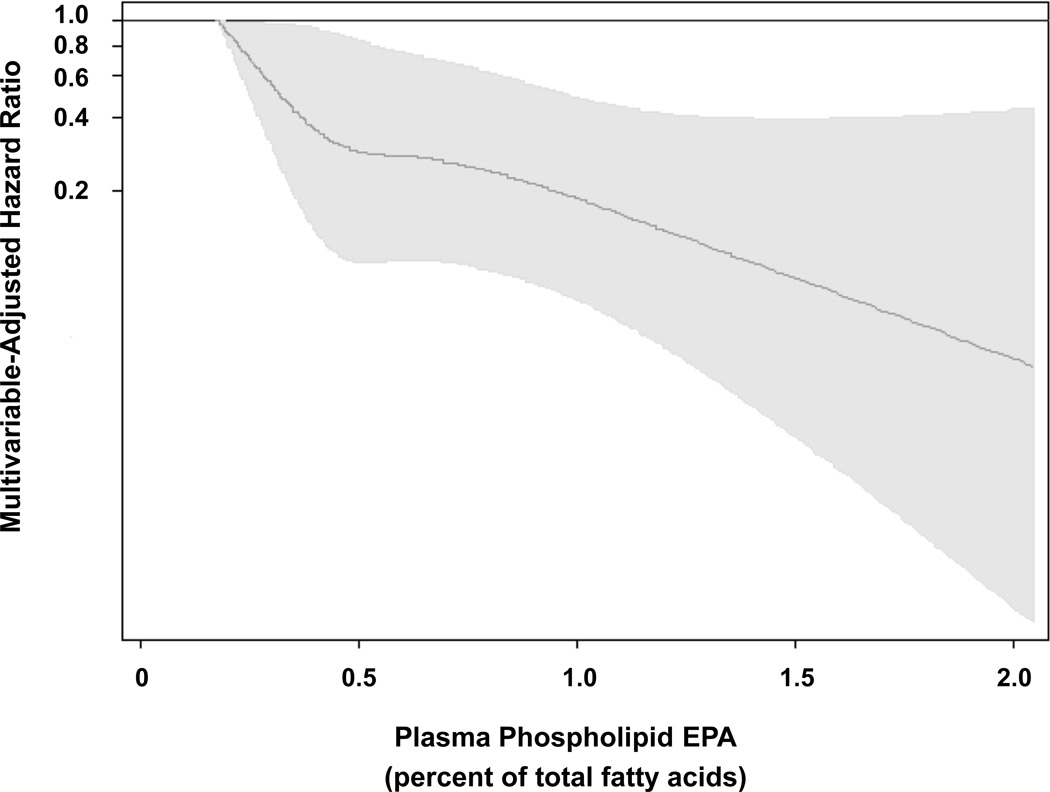
Results: After multivariate adjustment, plasma phospholipid EPA concentration was inversely associated with incident CHF; risk was approximately 50% lower in the highest versus the lowest quartile (hazard ratio [HR], 0.52 [95% CI, 0.38 to 0.72]; P for trend = 0.001). In similar analyses, trends toward lower risk were seen for DPA (HR, 0.76 [CI, 0.56 to 1.04]; P for trend = 0.057) and total long-chain ω-3 fatty acids (HR, 0.70 [CI, 0.49 to 0.99]; P for trend = 0.062) but not for DHA (HR, 0.84 [CI, 0.58 to 1.21]; P for trend = 0.38). In analyses censored to the middle of follow-up (7 years) to minimize exposure misclassification over time, multivariate-adjusted HRs were 0.48 for EPA (CI, 0.32 to 0.71; P for trend = 0.005), 0.61 for DPA (CI, 0.39 to 0.95; P for trend = 0.033), 0.64 for DHA (CI, 0.40 to 1.04; P for trend = 0.057), and 0.51 for total ω-3 fatty acids (CI, 0.32 to 0.80; P for trend = 0.003).
Limitations: Temporal changes in fatty acid concentrations over time may have caused underestimation of associations. Unmeasured or imperfectly measured covariates may have caused residual confounding.
Conclusion: Circulating individual and total ω-3 fatty acid concentrations are associated with lower incidence of CHF in older adults.
Primary funding source: National Institutes of Health.
Conflict of interest statement
Figures
Comment in
-
Summaries for patients. Omega-3 fatty acids and congestive heart failure in older adults.Ann Intern Med. 2011 Aug 2;155(3):I-29. doi: 10.7326/0003-4819-155-3-201108020-00001. Ann Intern Med. 2011. PMID: 21810703 No abstract available.
References
-
- Mozaffarian D, Wu JHY. Omega-3 fatty acids and cardiovascular disease – Effects on risk factors, molecular pathways, and clinical events. J Am Coll Cardiol. 2011 In press. - PubMed
-
- Gottdiener JS, Arnold AM, Aurigemma GP, Polak JF, Tracy RP, Kitzman DW, et al. Predictors of congestive heart failure in the elderly: the Cardiovascular Health Study. J Am Coll Cardiol. 2000;35(6):1628–1637. - PubMed
-
- Gottdiener JS, McClelland RL, Marshall R, Shemanski L, Furberg CD, Kitzman DW, et al. Outcome of congestive heart failure in elderly persons: influence of left ventricular systolic function. The Cardiovascular Health Study. Ann Intern Med. 2002;137(8):631–639. - PubMed
-
- Centers for Medicare and Medicaid Services. Medicare News. 2004
Publication types
MeSH terms
Substances
Grants and funding
- P30 DK040561/DK/NIDDK NIH HHS/United States
- R01-HL-085710-01/HL/NHLBI NIH HHS/United States
- U01-HL080295/HL/NHLBI NIH HHS/United States
- N01-HC-85086/HC/NHLBI NIH HHS/United States
- N01 HC055222/HL/NHLBI NIH HHS/United States
- N01-HC-55222/HC/NHLBI NIH HHS/United States
- N01 HC075150/HL/NHLBI NIH HHS/United States
- N01 HC045133/HC/NHLBI NIH HHS/United States
- N01 HC035129/HC/NHLBI NIH HHS/United States
- R01 HL085710/HL/NHLBI NIH HHS/United States
- U01 HL080295/HL/NHLBI NIH HHS/United States
- N01 HC015103/HC/NHLBI NIH HHS/United States
- N01 HC085086/HL/NHLBI NIH HHS/United States
- N01 HC085079/HL/NHLBI NIH HHS/United States
- N01-HC-75150/HC/NHLBI NIH HHS/United States
- N01-HC-85079/HC/NHLBI NIH HHS/United States
- UL1 RR025758/RR/NCRR NIH HHS/United States
LinkOut - more resources
Full Text Sources
Other Literature Sources
Medical
Research Materials