. 2011;6(7):e22389.
doi: 10.1371/journal.pone.0022389. Epub 2011 Jul 21.

Expression of the lantibiotic mersacidin in Bacillus amyloliquefaciens FZB42

Affiliations

Expression of the lantibiotic mersacidin in Bacillus amyloliquefaciens FZB42

Anna Maria Herzner et al. PLoS One. 2011.

Abstract

Lantibiotics are small peptide antibiotics that contain the characteristic thioether amino acids lanthionine and methyllanthionine. As ribosomally synthesized peptides, lantibiotics possess biosynthetic gene clusters which contain the structural gene (lanA) as well as the other genes which are involved in lantibiotic modification (lanM, lanB, lanC, lanP), regulation (lanR, lanK), export (lanT(P)) and immunity (lanEFG). The lantibiotic mersacidin is produced by Bacillus sp. HIL Y-85,54728, which is not naturally competent.

Methodology/principal findings: The aim of these studies was to test if the production of mersacidin could be transferred to a naturally competent Bacillus strain employing genomic DNA of the producer strain. Bacillus amyloliquefaciens FZB42 was chosen for these experiments because it already harbors the mersacidin immunity genes. After transfer of the biosynthetic part of the gene cluster by competence transformation, production of active mersacidin was obtained from a plasmid in trans. Furthermore, comparison of several DNA sequences and biochemical testing of B. amyloliquefaciens FZB42 and B. sp. HIL Y-85,54728 showed that the producer strain of mersacidin is a member of the species B. amyloliquefaciens.

Conclusions/significance: The lantibiotic mersacidin can be produced in B. amyloliquefaciens FZB42, which is closely related to the wild type producer strain of mersacidin. The new mersacidin producer strain enables us to use the full potential of the biosynthetic gene cluster for genetic manipulation and downstream modification approaches.


Conflict of interest statement

Competing Interests: The authors have declared that no competing interests exist.

Figures

Figure 1
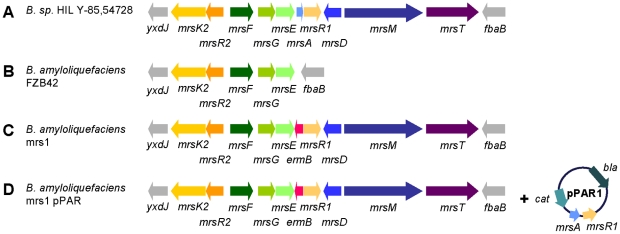
Figure 1. The (partial) mersacidin biosynthesis gene clusters of the mersacidin producer B. sp. HIL Y-85,54728, B. amyloliquefaciens FZB42 and its derivatives.
The mersacidin gene cluster of the original producer strain B. sp. HIL Y-85,54728 (A) consists of the immunity genes mrsFGE (green colors), the structural gene mrsA (light blue), the modification enzymes mrsD and mrsM (dark blue colors), the exporter containing a protease domain mrsT (purple) and the regulatory genes mrsR1, mrsR2 and mrsK2 (yellow and orange colors). The genome of B. amyloliquefaciens FZB42 (B) harbors a partial mersacidin gene cluster consisting of the immunity genes mrsFGE and the regulatory genes mrsK2 and mrsR2. The genes are found at the same site as in the original producer strain, i. e. between ycdJ and fbaB. In the mutant strain B. amyloliquefaciens mrs1 (C), a partial completion of the mersacidin gene cluster was reached by competence transformation using genomic DNA of a mersacidin deletion mutant (B. sp. HIL Y-85,54728 Rec1). An erythromycin resistance (ermB) cassette substituting mrsA served as selection marker. mrsR1 is most probably not transcribed in this mutant because of a polar effect. The completion of the mersacidin gene cluster in B. amyloliquefaciens mrs1 pPAR1 (D) was achieved in trans by transformation with the plasmid pPAR1, carrying the structural gene mrsA and mrsR1, yielding B. amyloliquefaciens mrs1 pPAR1.
Figure 2
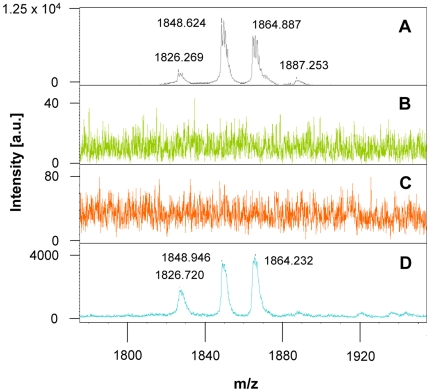
Figure 2. MALDI-TOF mass spectra of pure mersacidin and culture supernatants of B. amyloliquefaciens clones.
Panel (A) shows pure mersacidin (control). The spectra of culture supernatants of B. amyloliquefaciens FZB42 (B) as well as of B. amyloliquefaciens mrs1 (C), which harbor only a part of the mersacidin gene cluster or miss the structural gene mrsA, respectively, show no mersacidin production. In contrast, the culture supernatant of B. amyloliquefaciens mrs1 pPAR1 (D) is characterized by the presence of the typical mersacidin-related mass signals [1826 Da: mersacidin + H, 1848 Da: mersacidin + Na and 1864 Da: mersacidin + K] which demonstrate the production of mersacidin by this strain.
Figure 3
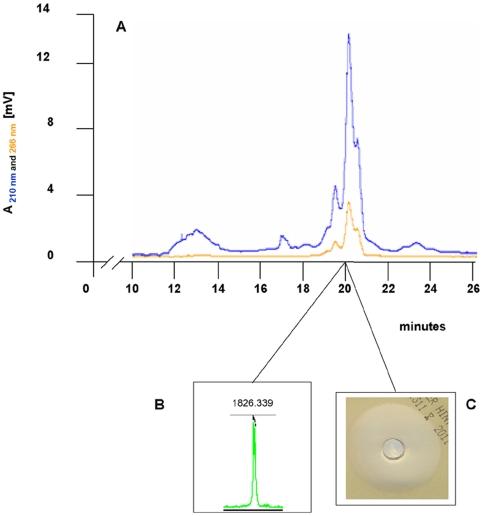
Figure 3. Purification of mersacidin from culture supernatant of B. amyloliquefaciens mrs1 pPAR1.
The culture supernatant of B. amyloliquefaciens mrs1 pPAR1 was applied to a Poros RP-HPLC column and eluted in a gradient of 30 % to 42 % acetonitrile (containing 0.1 % TFA). Active fractions were pooled and lyophilized. The resulting lyophilizate was resuspended in 5 % acetonitrile and applied to a Nucleosil RP-C18 column (A). The antimicrobial activity of the fractions was assayed in agar well diffusion tests against M. luteus (diameter 3.2 cm) (C) and analyzed by MALDI-TOF (B). Active fractions eluted after 20 min in a gradient of 50 – 65 % acetonitrile (0.1 % TFA) and were characterized by the presence of a peak with 1826.339 Da representing mersacidin.
Figure 4
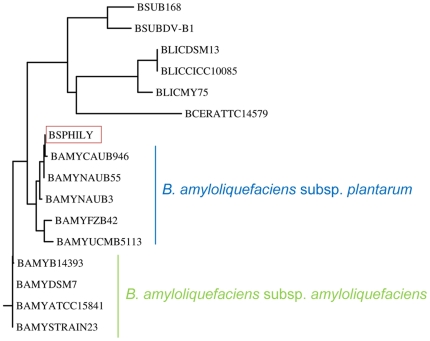
Figure 4. Phylogenetic tree based on the partial nucleotide sequence of the gyrA gene.
The tree was calculated based on the gyrA nucleotide sequences of the mersacidin producer (BHILY, marked by a red box) and different members of the genus Bacillus (NCBI accession numbers in brackets) [B. amyloliquefaciens  =  BAMY strains: FZB42 (CP000560), CAUB946 (FN652789), S23 (FN652780), ATCC15841 (FN662838), DSM7 (FN597644), NAUB3 (FN652783), NAUB55 (FN652801), UCMB5113 (AY212974); B. licheniformis  =  BLIC strains: MY75 (EU073420), DSM13 (BLi00007), CICC10085 (GQ355995); B. subtilis  =  BSUB strains: 168 (BSU00070), DV1-B1 (EF134416) and B. cereus  =  BCER strain: ATCC14579 (BC0006)]. The mersacidin wild type producer is placed among the members of the subspecies B. amyloliquefaciens subsp. plantarum; it does not belong to the subspecies amyloliquefaciens that consists of strains closely related to the type strain B. amyloliquefaciens DSM 7T. It is also clearly not a member of the species B. subtilis, B. cereus or B. licheniformis.

References

    1. Chatterjee S, Lad SJ, Phansalkar MS, Rupp RH, Ganguli BN, et al. J Antibiot. Vol. 45. Tokyo: 1992. Mersacidin, a new antibiotic from Bacillus. Fermentation, isolation, purification and chemical characterization. pp. 832–838. - PubMed
    1. Altena K, Guder A, Cramer C, Bierbaum G. Biosynthesis of the lantibiotic mersacidin: organization of a type B lantibiotic gene cluster. Appl Environ Microbiol. 2000;66:2565–2571. - PMC - PubMed
    1. Schmitz S, Hoffmann A, Szekat C, Rudd B, Bierbaum G. The lantibiotic mersacidin is an autoinducing peptide. Appl Environ Microbiol. 2006;72:7270–7277. - PMC - PubMed
    1. Guder A, Schmitter T, Wiedemann I, Sahl HG, Bierbaum G. Role of the single regulator MrsR1 and the two-component system MrsR2/K2 in the regulation of mersacidin production and immunity. Appl Environ Microbiol. 2002;68:106–113. - PMC - PubMed
    1. Brötz H, Bierbaum G, Leopold K, Reynolds PE, Sahl HG. The lantibiotic mersacidin inhibits peptidoglycan synthesis by targeting lipid II. Antimicrob Agents Chemother. 1998;42:154–160. - PMC - PubMed

Publication types

LinkOut - more resources