


Adipose tissue fatty acid patterns and changes in anthropometry: a cohort study
- PMID: 21811635
- PMCID: PMC3141072
- DOI: 10.1371/journal.pone.0022587
Adipose tissue fatty acid patterns and changes in anthropometry: a cohort study
Abstract
Introduction: Diets rich in n-3 long chain polyunsaturated fatty acids (LC-PUFA), but low in n-6 LC-PUFA and 18:1 trans-fatty acids (TFA), may lower the risk of overweight and obesity. These fatty acids have often been investigated individually. We explored associations between global patterns in adipose tissue fatty acids and changes in anthropometry.
Methods: 34 fatty acid species from adipose tissue biopsies were determined in a random sample of 1100 men and women from a Danish cohort study. We used sex-specific principal component analysis and multiple linear regression to investigate the associations of adipose tissue fatty acid patterns with changes in weight, waist circumference (WC), and WC controlled for changes in body mass index (WC(BMI)), adjusting for confounders.
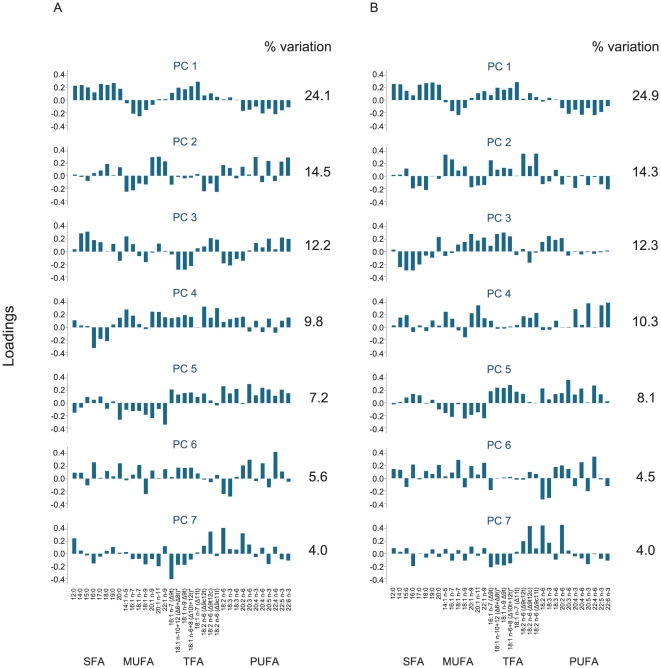
Results: 7 principal components were extracted for each sex, explaining 77.6% and 78.3% of fatty acid variation in men and women, respectively. Fatty acid patterns with high levels of TFA tended to be positively associated with changes in weight and WC for both sexes. Patterns with high levels of n-6 LC-PUFA tended to be negatively associated with changes in weight and WC in men, and positively associated in women. Associations with patterns with high levels of n-3 LC-PUFA were dependent on the context of the rest of the fatty acid pattern.
Conclusions: Adipose tissue fatty acid patterns with high levels of TFA may be linked to weight gain, but patterns with high n-3 LC-PUFA did not appear to be linked to weight loss. Associations depended on characteristics of the rest of the pattern.
Conflict of interest statement
Figures
References
-
- Haslam DW, James WPT. Obesity. Lancet. 2005;366:1197–1209. - PubMed
-
- Yusuf S, Hawken S, Ounpuu S, Bautista L, Franzosi MG, et al. Obesity and the risk of myocardial infarction in 27,000 participants from 52 countries: a case-control study. Lancet. 2005;366:1640–1649. - PubMed
-
- Pischon T, Boeing H, Hoffmann K, Bergmann M, Schulze MB, et al. General and Abdominal Adiposity and Risk of Death in Europe. New Engl J Med. 2008;359:2105–2120. - PubMed
-
- Janssen I, Heymsfield SB, Allison DB, Kotler DP, Ross R. Body mass index and waist circumference independently contribute to the prediction of nonabdominal, abdominal subcutaneous, and visceral fat. Am J Clin Nutr. 2002;75:683–688. - PubMed
Publication types
MeSH terms
Substances
LinkOut - more resources
Full Text Sources
