


Computed tomography for minor head injury: variation and trends in major United States pediatric emergency departments
- PMID: 21813133
- PMCID: PMC3209487
- DOI: 10.1016/j.jpeds.2011.06.024
Computed tomography for minor head injury: variation and trends in major United States pediatric emergency departments
Abstract
Objectives: To investigate the variation and trends in neuroimaging in children examined for minor head injury at major US pediatric emergency departments.
Study design: We conducted a retrospective study of children <19 years of age with mild head injury who were examined and discharged home from the emergency department at 40 pediatric hospitals from 2005 to 2009 by using the Pediatric Health Information Systems database. Variation in computed tomography (CT) rates between hospitals was assessed for correlation with hospital-specific rates of intracranial hemorrhage, admission, and return visits. Age-adjusted trends in CT use were calculated for the 5 years.
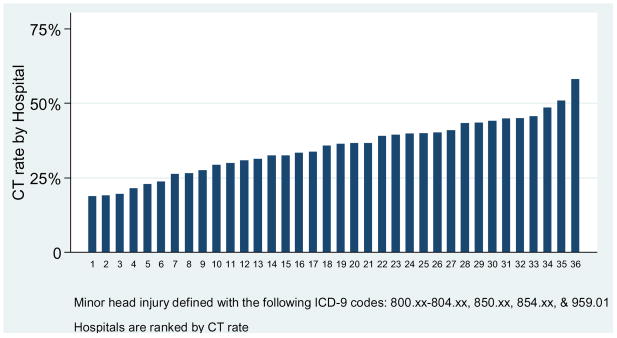
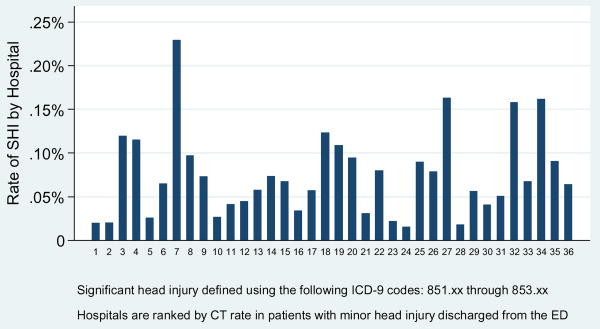
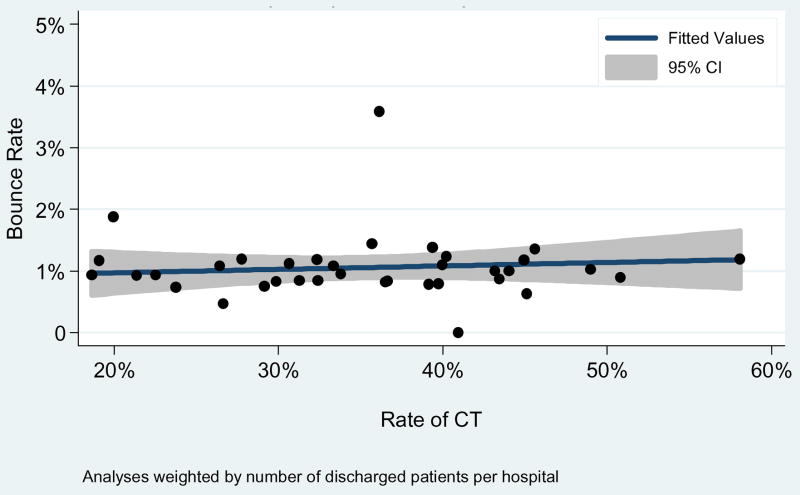
Results: In the 5 years, the median rate of imaging for minor head injured patients was 36% (IQR, 29%-42%; range, 19%-58%). There was no correlation between institution-specific rates of CT imaging and intracranial hemorrhage, admission, or return-visit rates. Age-adjusted rates of CT use decreased in the 5-year period (OR, 0.94; 95% CI, 0.92-0.97; P < .001).
Conclusions: In this study, we found significant practice variation in CT use at pediatric hospitals examining children with minor head injury. These data may help guide national benchmarks for the appropriate use of CT imaging in pediatric patients with minor head injury.
Copyright © 2012 Mosby, Inc. All rights reserved.
Conflict of interest statement
The authors declare no conflicts of interest
Figures
References
-
- Kuppermann N. Pediatric head trauma: the evidence regarding indications for emergent neuroimaging. Pediatr Radiol. 2008;38 (Suppl 4):S670–674. - PubMed
-
- Kuppermann N, Holmes JF, Dayan PS, Hoyle JD, Jr, Atabaki SM, Holubkov R, et al. Identification of children at very low risk of clinically-important brain injuries after head trauma: a prospective cohort study. Lancet. 2009;374(9696):1160–1170. - PubMed
-
- Palchak MJ, Holmes JF, Vance CW, Gelber RE, Schauer BA, Harrison MJ, et al. A decision rule for identifying children at low risk for brain injuries after blunt head trauma. Ann of Emerg Med. 2003;42:492–506. - PubMed
-
- Brenner D, Elliston C, Hall E, Berdon W. Estimated risks of radiation-induced fatal cancer from pediatric CT. AJR Am J Roentgenol. 2001;176(2):289–296. - PubMed
-
- Brenner DJ. Estimating cancer risks from pediatric CT: going from the qualitative to the quantitative. Pediatr Radiol. 2002;32(4):228–223. discussion 242–224. - PubMed
