


Is traumatic brain injury a risk factor for schizophrenia? A meta-analysis of case-controlled population-based studies
- PMID: 21813439
- PMCID: PMC3196949
- DOI: 10.1093/schbul/sbr091
Is traumatic brain injury a risk factor for schizophrenia? A meta-analysis of case-controlled population-based studies
Abstract
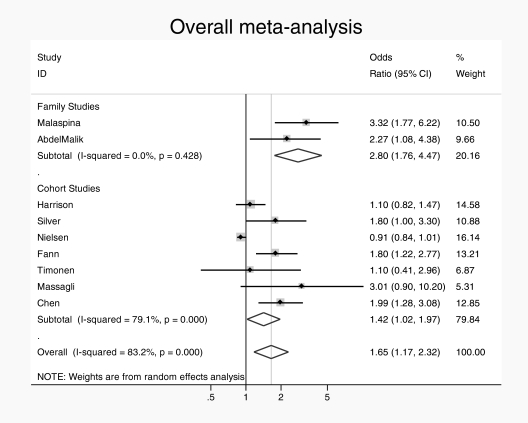
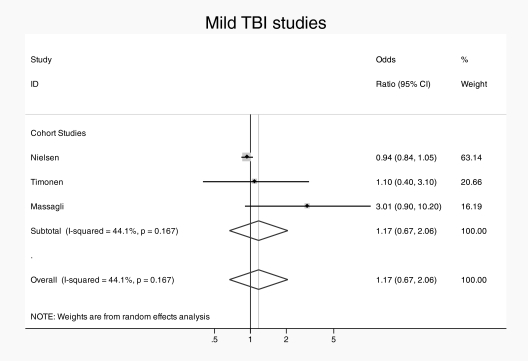
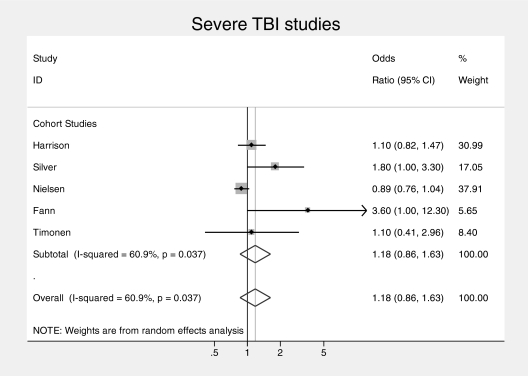
Traumatic brain injury (TBI) is known to lead to a range of adverse psychiatric sequelae but the question of whether TBI is a risk factor for psychosis and, in particular, schizophrenia remains unclear. Studies examining this issue have yielded conflicting results. We carried out a systematic review of the literature on TBI and psychosis in order to identify all population-based controlled studies which provide estimates of risk for schizophrenia following TBI. Odds ratios (ORs) were combined using random effects meta-analysis. Our literature search yielded 172 studies which were considered to be potentially relevant. From these, we identified 9 studies that could provide estimates of risk in the form of ORs. The pooled analysis revealed a significant association between TBI and schizophrenia (OR = 1.65; 95% CI = 1.17-2.32), with significant heterogeneity between the studies. Estimates from the family studies (OR = 2.8: 95% CI =1.76-4.47) were higher than those from the cohort/nested case-control studies (OR = 1.42: 95% CI = 1.02-1.97) by a factor of almost 2. There did not appear to be a dose-response relationship between severity of head injury and subsequent risk of schizophrenia. This meta-analysis supports an increased risk of schizophrenia following TBI, with a larger effect in those with a genetic predisposition to psychosis. Further epidemiological and neuroscientific studies to elucidate the mechanisms underlying this association are warranted.
Figures
References
-
- Bryant RA, O’Donnell ML, Creamer M, McFarlane AC, Clark CR, Silove D. The psychiatric consequences of traumatic injury. Am J Psychiatry. 2010;167:312–320. - PubMed
-
- Fleminger S. Head injury. In: David A, Fleminger S, Kopelman MD, Lovestone S, Mellers JDC, editors. Lishman’s Organic Psychiatry: A Textbook of Neuropsychiatry. 4th ed. Chichester, UK: Blackwell Publishing; 2009. pp. 167–279.
-
- Davison K, Bagley CR. Schizophrenia-like psychoses associated with organic disorders of the central nervous system: a review of the literature. Current problems of neuropsychiatry. Br J Psychiatry. 1969;(Special Publication 4):S113–S184.
-
- Kim E. Does traumatic brain injury predispose individuals to develop schizophrenia? Curr Opin Psychiatry. 2009;21:286–289. - PubMed
Publication types
MeSH terms
LinkOut - more resources
Full Text Sources
Medical
