. 2011 Oct;85(19):10079-89.
doi: 10.1128/JVI.05121-11. Epub 2011 Aug 3.

Loss of protease dimerization inhibition activity of darunavir is associated with the acquisition of resistance to darunavir by HIV-1

Affiliations

Loss of protease dimerization inhibition activity of darunavir is associated with the acquisition of resistance to darunavir by HIV-1

Yasuhiro Koh et al. J Virol. 2011 Oct.

Abstract

Dimerization of HIV protease is essential for the acquisition of protease's proteolytic activity. We previously identified a group of HIV protease dimerization inhibitors, including darunavir (DRV). In the present work, we examine whether loss of DRV's protease dimerization inhibition activity is associated with HIV development of DRV resistance. Single amino acid substitutions, including I3A, L5A, R8A/Q, L24A, T26A, D29N, R87K, T96A, L97A, and F99A, disrupted protease dimerization, as examined using an intermolecular fluorescence resonance energy transfer (FRET)-based HIV expression assay. All recombinant HIV(NL4-3)-based clones with such a protease dimerization-disrupting substitution failed to replicate. A highly DRV-resistant in vitro-selected HIV variant and clinical HIV strains isolated from AIDS patients failing to respond to DRV-containing antiviral regimens typically had the V32I, L33F, I54M, and I84V substitutions in common in protease. None of up to 3 of the 4 substitutions affected DRV's protease dimerization inhibition, which was significantly compromised by the four combined substitutions. Recombinant infectious clones containing up to 3 of the 4 substitutions remained sensitive to DRV, while a clonal HIV variant with all 4 substitutions proved highly resistant to DRV with a 205-fold 50% effective concentration (EC(50)) difference compared to HIV(NL4-3). The present data suggest that the loss of DRV activity to inhibit protease dimerization represents a novel mechanism contributing to HIV resistance to DRV. The finding that 4 substitutions in PR are required for significant loss of DRV's protease dimerization inhibition should at least partially explain the reason DRV has a high genetic barrier against HIV's acquisition of DRV resistance.


Figures
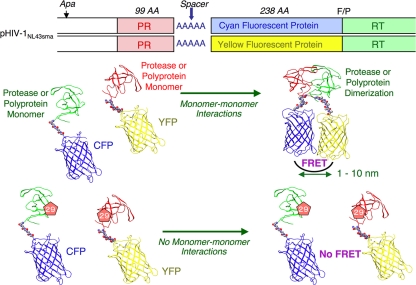
Fig. 1.
Fig. 1.
FRET-based HIV expression system. Plasmids encoding full-length molecular infectious HIV (HIVNL4-3) clones that produce CFP- or YFP-tagged PR were prepared using the PCR-mediated recombination method as described in Materials and Methods. A linker consisting of five alanines was inserted between PR and the fluorescent protein. A phenylalanine-proline site (F/P) that HIV PR cleaves was introduced between the fluorescent protein and RT. Shown are structural representations of PR monomers and dimer in association with the linker atoms and fluorescent proteins. FRET occurs when the two fluorescent proteins become 1 to 10 nm apart. If an agent that is capable of inhibiting the dimerization of PR monomer subunits is present when the CFP- and YFP-tagged PR monomers are produced within the cell upon cotransfection, no FRET occurs. If certain amino acid substitutions (AA) such as D29N (shown below) are introduced, PR subunits do not get dimerized and no FRET occurs.
Fig. 2.
Fig. 2.
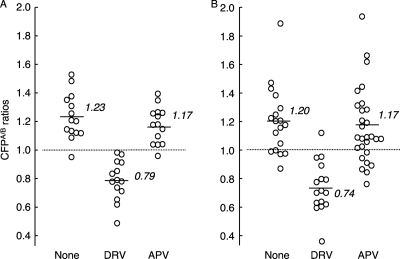
DRV blocks the dimerization of both pHIV-PRWT-encoded PR and pPRWT-encoded PR. (A) COS7 cells were cotransfected with pHIV-PRWTCFP plus pHIV-PRWTYFP in the absence or presence of 1 μM DRV or APV. On day 3 after transfection, CFPA/B ratios were determined using an FV500 confocal laser microscope. When the average value of CFPA/B ratios was greater than 1.0, it was judged that the dimerization of PR occurred, whereas when it was less than 1.0, it was judged that the dimerization did not occur. (B) COS7 cells were cotransfected with a pair of wild-type PR-expressing plasmids (pPRWTCFP plus pPRWTYFP) in the absence or presence of 1 μM DRV or APV, and CFPA/B ratios were determined as described above. Note that DRV inhibited the dimerization of PR when it was expressed as HIV virions and virion-free PR. The results of statistical evaluation of the changes in the CFPA/B ratios, determined in the presence or absence of DRV or APV, using the nonparametric Mann-Whitney U test, are as follows. (A) For the CFPA/B ratios in the absence of drug (CFPA/BNo Drug) versus the CFPA/B ratios in the presence of 1.0 μM DRV (CFPA/B1.0 DRV), P = 0.00001, and for CFPA/BNo Drug versus CFPA/B1.0 APV, P = 0.42. (B) For CFPA/BNo Drug versus CFPA/B1.0 DRV, P = 0.000003, and for CFPA/BNo Drug versus CFPA/B1.0 APV, P = 0.60.
Fig. 3.
Fig. 3.
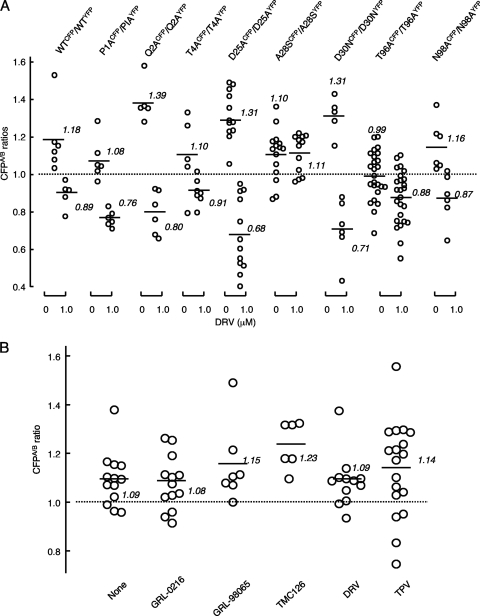
Dimerization profiles of single PR mutants in the presence of DRV. (A) COS-7 cells were cotransfected with pHIV-PRWTCFP plus pHIV-PRWTYFP (shown as WTCFP/WTYFP) or mutated pairs such as pHIV-PRP1ACFP plus pHIV-PRP1AYFP (shown as P1ACFP/P1AYFP) in the absence or presence of 1 μM DRV. On day 3 after transfection, CFPA/B ratios were determined. (B) COS7 cells were cotransfected with plasmid pair pHIV-PRA28SCFP and pHIV-PRA28SYFP in the absence or presence of an agent (1 μM GRL-0216, DRV, GRL-98065, TPV, or TMC126), and CFPA/B ratios were determined as described above. (A) The statistical evaluation of all the changes in the CFPA/B ratios determined in the presence or absence of DRV using the nonparametric Mann-Whitney U test, gave P values ranging 0.000037 to 0.044, except for the P value for the pair A28SCFP and A28SYFP, which was 0.57. (B) The differences between the CFPA/B ratios in the absence of drug (CFPA/BNo Drug) and the CFPA/B ratios in the presence of 1.0 μM DRV (CFPA/B1.0 DRV) were statistically insignificant, indicating that all of the agents examined failed to block the dimerization of A28SCFP/A28SYFP.
Fig. 4.
Fig. 4.
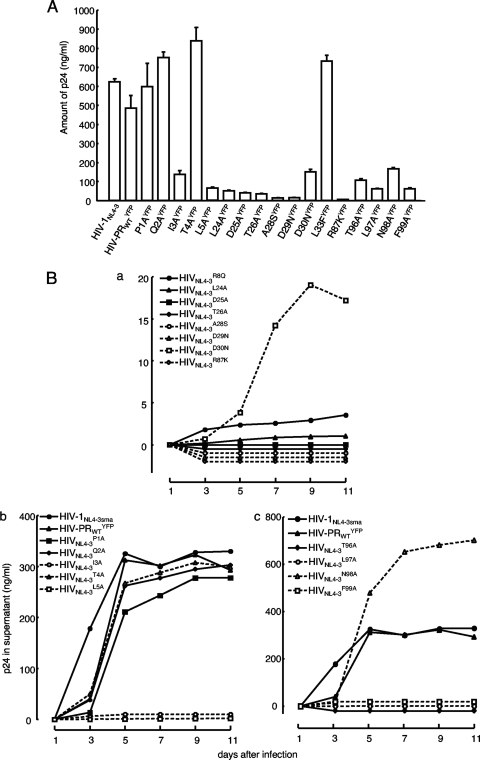
Replication kinetics of HIV-PRYFP with wild-type or mutated PR. (A) 293T cells were transfected with pHIV-PRWTYFP or mutated pHIV-PRYFP (if pHIV-PRP1AYFP was used, it is shown as P1AYFP), and the amounts of p24 Gag in the culture supernatants were determined 48 h after transfection. (B) MT-4 cells (105) were exposed to the harvested supernatant of each infectious HIV-PRYFP clone shown in panel A (100 ng of p24 Gag protein/ml) for 6 h, washed twice with phosphate-buffered saline (PBS), and further cultured in 7 ml of complete medium. Culture supernatants (50 μl) were harvested every other day, and virus replication was monitored by the amounts of p24 Gag produced in the culture supernatants. Replication kinetics of various HIV-PRYFP mutants are shown over 11 days. In subpanels a, b, and c, the replication kinetics of infectious clones carrying mutations in the active site, N ternimus, and C terminus, respectively, are shown. Note that recombinant HIV clones, whose replication rates were relatively poor, are illustrated in subpanel a. The experiments that generated data in subpanels a and b were performed on the same occasion. Thus, two controls (HIV-1NL4-3sma and HIV-PRWTYFP) in subpanel b serve as controls in subpanel a as well.
Fig. 5.
Fig. 5.
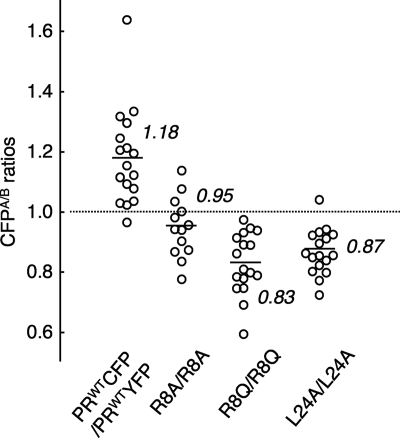
Dimerization inhibition profiles of selected HIV-1 PR mutants. COS7 cells were cotransfected with a pair of HIV-PRCFP and HIV-PRYFP strains either wild type or carrying single amino acid (AA) substitutions, such as the R8A, R8Q, or L24A, in the absence of drug. The CFPA/B ratios were determined at the conclusion of the 3-day period of culture. The differences between the CFPA/B ratios of the WT and the CFPA/B ratios of the mutant had P values of 0.000099 for R8A, 0.000084 for R8Q, and 0.0000014 for L24A.
Fig. 6.
Fig. 6.
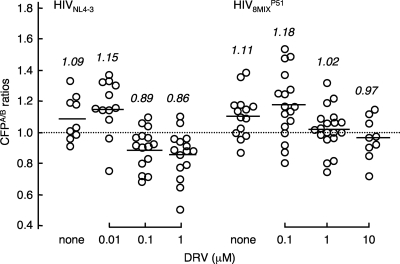
DRV fails to inhibit the dimerization of the protease of a highly DRV-resistant HIV8MIXP51 variant. COS7 cells were transfected with a pair of plasmids encoding a full-length molecular infectious HIV-1 clone (HIV8MIXP51) containing CFP- or YFP-tagged PR with 14 amino acid substitutions (L10I, I15V, K20R, L24I, V32I, L33F, M36I, M46L, I54M, L63P, K70Q, V82I, I84V, and L89M) in the presence or absence of 0.1, 1, or 10 μM DRV. On day 3 after transfection, CFPA/B ratios were determined as described in the legend to Fig. 2. HIVNL4-3 served as a reference. Note that 0.1 and 1 μM DRV failed to block the dimerization of the protease of HIV8MIXP51, while the same concentration of DRV blocked protease dimerization in HIVNL4-3. The differences between the CFPA/B ratios in the absence of drug (CFPA/BNo Drug) and the CFPA/B ratios in the presence of 0.01 μM DRV (CFPA/B0.01 DRV), between the CFPA/B ratios in the presence of 0.01 μM DRV (CFPA/B0.01 DRV) and 0.1 μM DRV (CFPA/B0.1 DRV), and between the CFPA/B ratios in the presence of 0.1 μM DRV (CFPA/B0.1 DRV) and 1.0 μM DRV (CFPA/B1.0 DRV) had P values of 0.32, 0.0025, and 0.34 for HIVNL4-3, respectively. The differences between the CFPA/BNo Drug and the CFPA/B0.1 DRV, between the CFPA/B0.1 DRV and CFPA/B1.0 DRV, and between the CFPA/B1.0 DRV and the CFPA/B10.0 DRV had P values of 0.42, 0.022, and 0.26, respectively, for HIV8MIXP51.
Fig. 7.
Fig. 7.
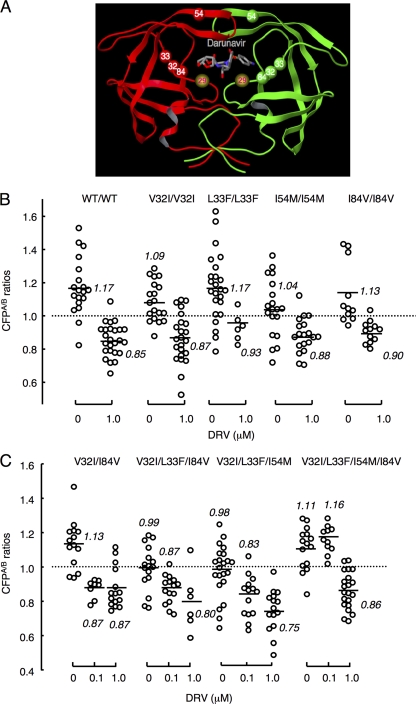
Amino acid changes conferring DRV resistance on HIV. (A) Locations of amino acid substitutions V32I, L33A/F, I54M, and I84V associated with HIV's DRV resistance. The location of Asp29 (D29), which is known to be an essential amino acid for dimerization, is also shown. (B) Profiles of DRV's dimerization inhibition of PR carrying a single amino acid substitution. COS7 cells were cotransfected with a pair of HIV-PRCFP and HIV-PRYFP variants carrying wild-type PR or a single amino acid substitution such as V32I, L33F, I54M, or I84V, each of which was found to be associated with the development of HIV resistance to DRV, in the presence of 1 μM DRV, further cultured, and the CFPA/B ratios were determined. Note that none of the amino acid substitutions introduced blocked the dimerization of PR. The statistical evaluation of all the changes in the CFPA/B ratios determined in the presence or absence of DRV, conducted using the nonparametric Mann-Whitney U test, showed P values ranging from 0.00000034 (3.4E−07) to 0.0026. (C) Profiles of DRV's dimerization inhibition of PR carrying combined amino acid substitutions. COS7 cells were cotransfected with a pair of HIV-PRCFP and HIV-PRYFP variants carrying combined amino acid substitutions such as V32I and I84V, V32I, L33F, and I84V, V32I, L33F, and I54M, or V32I, L33F, I54M, and I84V. The COS7 cells were further cultured in the continuous presence of 0, 0.1, and 1 μM DRV, and the CFPA/B ratios were determined at the conclusion of the 3-day period of culture. The differences between the CFPA/B ratios in the absence of drug (CFPA/BNo Drug) and the CFPA/B ratios in the presence of 0.1 μM DRV (CFPA/B0.1 DRV) and between the CFPA/B ratios in the presence of 0.1 μM DRV (CFPA/B0.1 DRV) and 1.0 μM DRV (CFPA/B1.0 DRV) had P values of 0.0015 and 0.42 for V32I and I84V, 0.0047 and 0.15 for V32I, L33F, and I84V, 0.033 and 0.07 for V32I, L33F, and I54M, and 0.3 and 0.0000073 for V32I, L33F, I54M, and I84V, respectively.
Fig. 8.
Fig. 8.
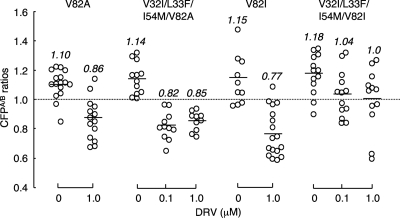
Effects of V82A and V82I substitutions on DRV's activity to inhibit PR dimerization. COS7 cells were cotransfected with the pHIV-PRCFP and pHIV-PRYFP pair of plasmids carrying a single V82A or V82I substitution or four combined mutations (V32I, L33F, and I54M plus V82A or V82I). The COS7 cells were further cultured in the continuous presence of 0.1 and 1 μM DRV, and the CFPA/B ratios were determined at the conclusion of the 3-day period of culture. Note that combined with other three substitutions V32I, L33F, and I54M, V82A did not have a significant effect on DRV's dimerization inhibition activity, while V82I compromised the dimerization inhibition of DRV at 0.1 and 1.0 μM. The differences between the CFPA/B ratios in the absence of drug (CFPA/BNo Drug) and the CFPA/B ratios in the presence of 1.0 μM DRV (CFPA/B1.0 DRV) had P values of 0.00017 for V82A and 0.0027 for V82I. The differences between the CFPA/B ratios in the absence of drug (CFPA/BNo Drug) and the CFPA/B ratios in the presence of 0.1 μM DRV (CFPA/B0.1 DRV) and between the CFPA/B ratios in the presence of 0.1 μM DRV (CFPA/B0.1 DRV) and 1.0 μM DRV (CFPA/B1.0 DRV) were 0.000055 and 0.38 for V32I, L33F, I54M, and V82A and 0.026 and 0.91 for V32I, L33F, I54M, and V82I, respectively.

References

    1. Amano M., et al. 2007. A novel bis-tetrahydrofuranylurethane-containing nonpeptidic protease inhibitor (PI) GRL-98065 potent against multi-PI-resistant HIV in vitro. Antimicrob. Agents Chemother. 51:2143–2155 - PMC - PubMed
    1. Antiretroviral Therapy Cohort Collaboration 2008. Life expectancy of individuals on combination antiretroviral therapy in high-income countries: a collaborative analysis of 14 cohort studies. Lancet 372:293–299 - PMC - PubMed
    1. Aoki M., et al. 2009. Non-cleavage site Gag mutations in amprenavir-resistant human immunodeficiency virus type 1 (HIV-1) predispose HIV-1 to rapid acquisition of amprenavir resistance but delay development of resistance to other protease inhibitors. J. Virol. 83:3059–3068 - PMC - PubMed
    1. Babe L. M., Rose J., Craik C. S. 1992. Synthetic “interface” peptides alter dimeric assembly of the HIV 1 and 2 proteases. Protein Sci. 1:1244–1253 - PMC - PubMed
    1. Bastiaens P. I., Jovin T. M. 1996. Microspectroscopic imaging tracks the intracellular processing of a signal transduction protein: fluorescent-labeled protein kinase C beta I. Proc. Natl. Acad. Sci. U. S. A. 93:8407–8412 - PMC - PubMed

Publication types