. 2011 Sep;94(3):945-54.
doi: 10.3945/ajcn.111.014639. Epub 2011 Aug 3.

High platelet count as a link between renal cachexia and cardiovascular mortality in end-stage renal disease patients

Affiliations

High platelet count as a link between renal cachexia and cardiovascular mortality in end-stage renal disease patients

Miklos Z Molnar et al. Am J Clin Nutr. 2011 Sep.

Abstract

Background: It is not clear why cardiac or renal cachexia in chronic diseases is associated with poor cardiovascular outcomes. Platelet reactivity predisposes to thromboembolic events in the setting of atherosclerotic cardiovascular disease, which is often present in patients with end-stage renal disease (ESRD).

Objectives: We hypothesized that ESRD patients with relative thrombocytosis (platelet count >300 × 10(3)/μL) have a higher mortality rate and that this association may be related to malnutrition-inflammation cachexia syndrome (MICS).

Design: We examined the associations of 3-mo-averaged platelet counts with markers of MICS and 6-y all-cause and cardiovascular mortality (2001-2007) in a cohort of 40,797 patients who were receiving maintenance hemodialysis.

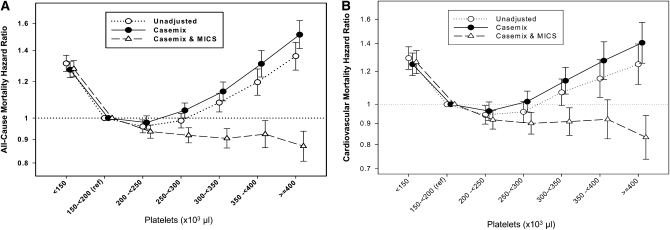
Results: The patients comprised 46% women and 34% African Americans, and 46% of the patients had diabetes. The 3-mo-averaged platelet count was 229 ± 78 × 10(3)/μL. In unadjusted and case-mix adjusted models, lower values of albumin, creatinine, protein intake, hemoglobin, and dialysis dose and a higher erythropoietin dose were associated with a higher platelet count. Compared with patients with a platelet count of between 150 and 200 × 10(3)/μL (reference), the all-cause (and cardiovascular) mortality rate with platelet counts between 300 and <350, between 350 and <400, and ≥400 ×10(3)/μL were 6% (and 7%), 17% (and 15%), and 24% (and 25%) higher (P < 0.05), respectively. The associations persisted after control for case-mix adjustment, but adjustment for MICS abolished them.

Conclusions: Relative thrombocytosis is associated with a worse MICS profile, a lower dialysis dose, and higher all-cause and cardiovascular disease death risk in hemodialysis patients; and its all-cause and cardiovascular mortality predictability is accounted for by MICS. The role of platelet activation in cachexia-associated mortality warrants additional studies.


Figures
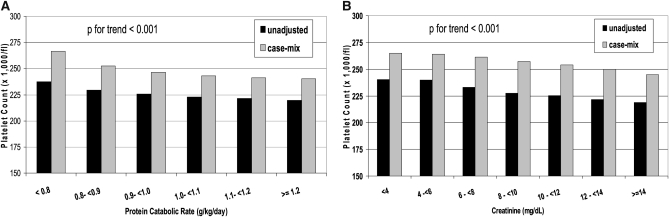
FIGURE 1.
FIGURE 1.
Association between protein catabolic rate (A) and serum creatinine (B) and predicted platelet count after an unadjusted and case-mix adjusted analysis of linear regression models. Unadjusted model: adjusted for entry calendar quarter (quarter 1 through quarter 20). Case-mix adjusted model: adjusted for entry calendar quarter plus age, sex, 10 preexisting comorbid states, categories of dialysis vintage, primary insurance, marital status, the standardized mortality ratio of the dialysis clinic during entry quarter, dialysis dose as indicated by Kt/V (single pool), the presence or absence of a dialysis catheter, and residual renal function during the entry quarter (ie, urinary urea clearance).
FIGURE 2.
FIGURE 2.
HRs (and 95% CIs) of all-cause mortality (A) and cardiovascular mortality (B) across platelet concentrations after Cox regression analyses in 40,797 long-term hemodialysis patients who were observed over a 6-y observation period (July 2001–June 2007). Unadjusted model: adjusted for entry calendar quarter (quarter 1 through quarter 20). Case-mix adjusted model: adjusted for entry calendar quarter plus age, sex, 10 preexisting comorbid states, categories of dialysis vintage, primary insurance, marital status, the standardized mortality ratio of the dialysis clinic during entry quarter, dialysis dose as indicated by Kt/V (single pool), the presence or absence of a dialysis catheter, and residual renal function during the entry quarter (ie, urinary urea clearance). Case-mix– and malnutrition-inflammation cachexia syndrome (MICS)–adjusted model: adjusted for all of the covariates in the case-mix model plus BMI, the average dose of erythropoietin stimulating agent, normalized protein equivalent of total nitrogen appearance—also known as normalized protein catabolic rate—as an indicator of daily protein intake, serum albumin, serum total-iron-binding capacity, serum ferritin, serum creatinine, serum phosphorus, serum calcium, serum bicarbonate, peripheral white blood cell count, lymphocyte percentage, and iron saturation ratio.
FIGURE 3.
FIGURE 3.
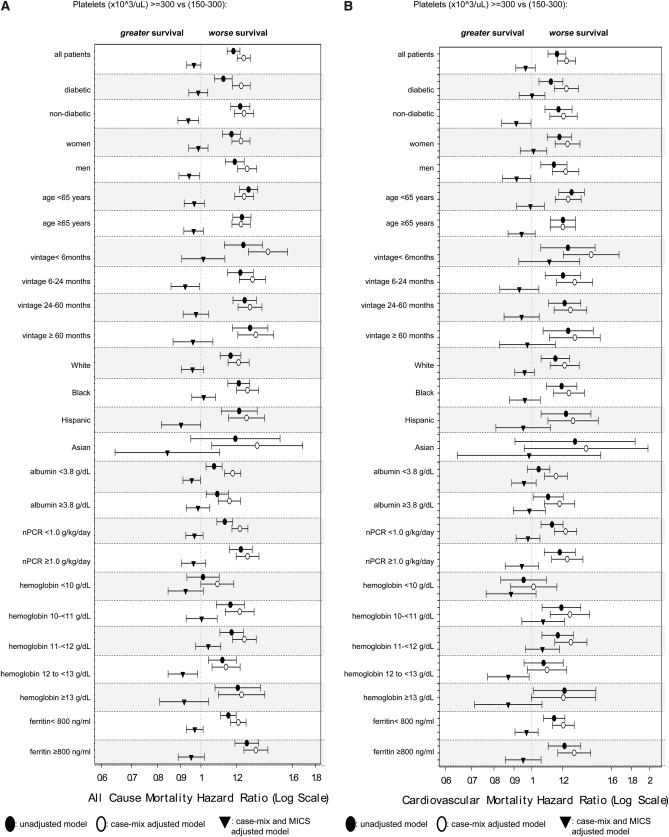
HRs (and 95% CIs) of all-cause mortality (A) and cardiovascular disease mortality (B) between platelet counts [150–300 × 103/μL (reference) compared with ≥300 × 103/μL] by using Cox regression analyses in 40,797 long-term hemodialysis patients who were observed over a 6-y observation period (July 2001–June 2007) in various subgroups of patients. Unadjusted model: adjusted for entry calendar quarter (quarter 1 through quarter 20). Case-mix adjusted model: adjusted for entry calendar quarter plus age, sex, 10 preexisting comorbid states, categories of dialysis vintage, primary insurance, marital status, the standardized mortality ratio of the dialysis clinic during entry quarter, dialysis dose as indicated by Kt/V (single pool), the presence or absence of a dialysis catheter, and residual renal function during the entry quarter (ie, urinary urea clearance). Case-mix– and malnutrition-inflammation cachexia syndrome (MICS)–adjusted model: adjusted for all of the covariates in the case-mix model plus BMI, the average dose of erythropoietin stimulating agent, normalized protein equivalent of total nitrogen appearance—also known as normalized protein catabolic rate (nPCR)—as an indicator of daily protein intake, serum albumin, serum total-iron-binding capacity, serum ferritin, serum creatinine, serum phosphorus, serum calcium, serum bicarbonate, peripheral white blood cell count, lymphocyte percentage, and iron saturation ratio.
FIGURE 4.
FIGURE 4.
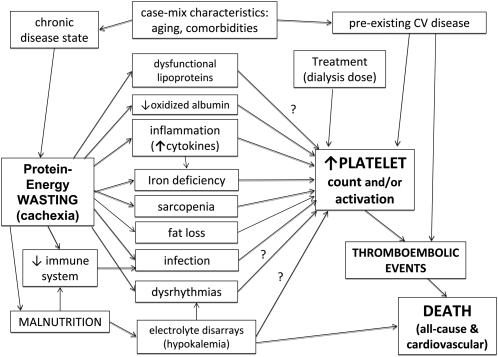
Potential pathophysiologic mechanism of how cachexia leads to death. CV, cardiovascular.

References

    1. Coresh J, Astor BC, Greene T, Eknoyan G, Levey AS. Prevalence of chronic kidney disease and decreased kidney function in the adult US population: third National Health and Nutrition Examination Survey. Am J Kidney Dis 2003;41:1–12 - PubMed
    1. Anker SD, Negassa A, Coats AJ, Afzal R, Poole-Wilson PA, Cohn JN, Yusuf S. Prognostic importance of weight loss in chronic heart failure and the effect of treatment with angiotensin-converting-enzyme inhibitors: an observational study. Lancet 2003;361:1077–83 - PubMed
    1. Collins AJ, Foley RN, Herzog C, Chavers BM, Gilbertson D, Ishani A, Kasiske BL, Liu J, Mau LW, McBean M, et al. Excerpts from US Renal Data System 2009 Annual Data Report. Am J Kidney Dis 2010;55:S1 - PMC - PubMed
    1. Zile MR, Gaasch WH, Anand IS, Haass M, Little WC, Miller AB, Lopez-Sendon J, Teerlink JR, White M, McMurray JJ, et al. Mode of death in patients with heart failure and a preserved ejection fraction: results from the Irbesartan in Heart Failure With Preserved Ejection Fraction Study (I-Preserve) trial. Circulation 2010;121:1393–405 - PubMed
    1. Aljaroudi WA, Halabi AR, Harrington RA. Platelet inhibitor therapy for patients with cardiovascular disease: looking toward the future. Curr Hematol Rep 2005;4:397–404 - PubMed

Publication types

MeSH terms